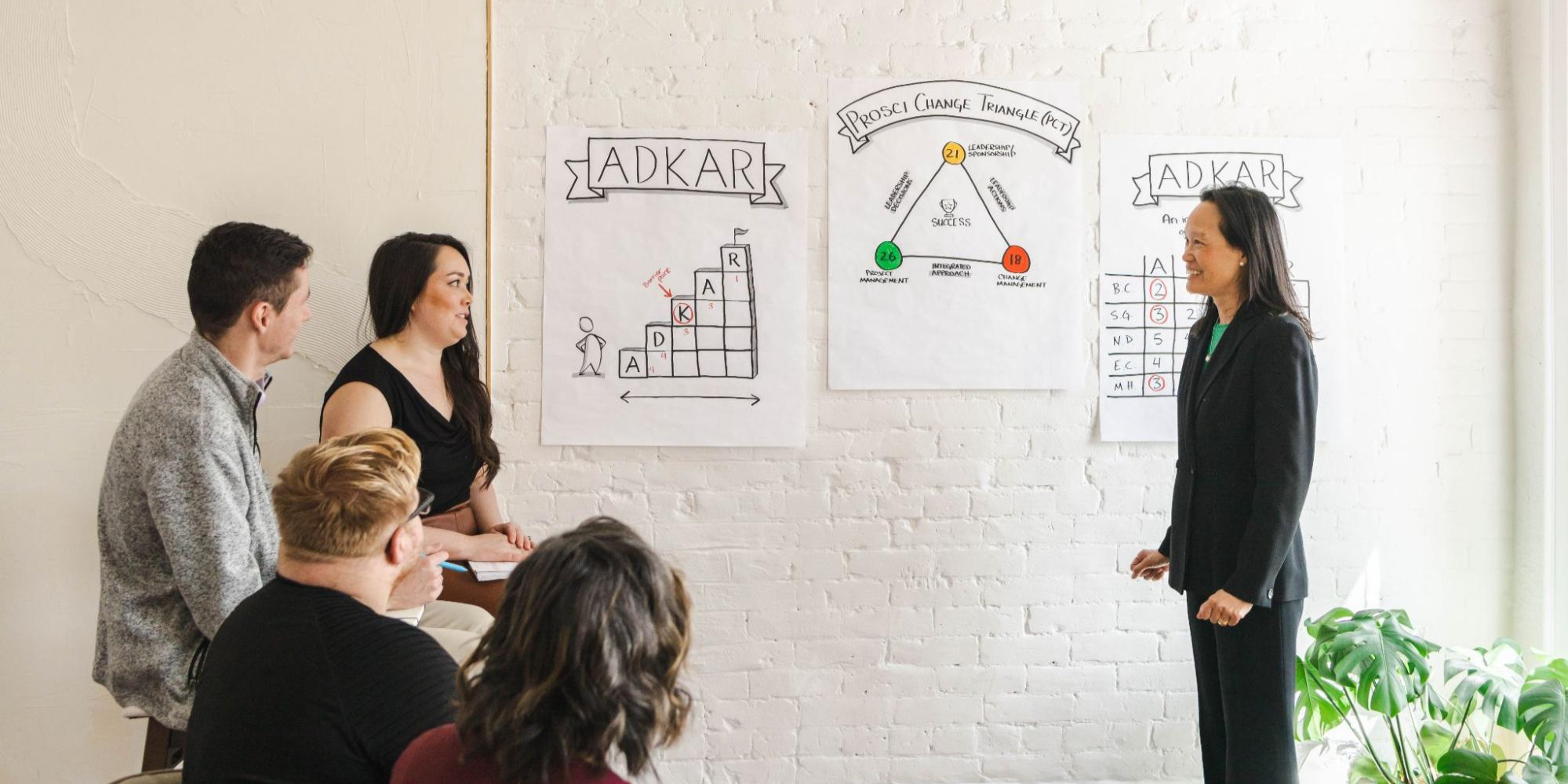
Digital transformation is a complex, high-risk organizational change that impacts an entire enterprise. A strong digital transformation leader is essential to guide the process, make critical decisions and drive adoption.
To successfully navigate the transition, digital transformation leaders should incorporate a structured change management framework, like the Prosci Methodology.
In this guide, we’ll explain digital transformation, the role of a transformation leader, and how change management can help them be successful.
What Is Digital Transformation?
Digital transformation involves integrating digital technology into a business' operations and processes, fundamentally changing how it op...
Organizational Transformation: What It Is and How To Succeed
Agile and innovative organizations need to consistently change their work processes, structures or culture to stay competitive. Although leaders can plan new goals or alter processes, successful organizational transformation relies on changing how employees and stakeholders work and the culture they're a part of. To successfully transform your company, you need a detailed change management strategy that engages employees, minimizes resistance, and facilitates the transition. In this guide, we'll explain organizational transformation and its importance in shaping culture during change. We'll detail the general transformation process and dive into why and how change management focuses on the people side of change to improve project outcomes. What Is Organizational Transformation? Organizational transformation is significantly changing the existing work culture to meet new mindsets and goals. It redefines a company's core operations, strategy and direction. While a change initiative targets specific areas and focuses on execution, transformation is a portfolio of interdependent change initiatives that affect the entire organization. Transformation is also iterative, experimental and more unpredictable. Organizational transformation can take many forms, including: Cultural transformation Digital transformation Mergers and acquisitions (M&A) Restructuring Process reengineering System changes Strategic transformation Innovation and product development Market expansion Leadership and governance changes Consider Amazon as an example of a well-executed strategic transformation and product development. In 2022, third-party sellers made up over 60% of sales in the Amazon store. To better support these sellers, the company announced drastic changes in 2023 to provide a range of products for independent sellers to simplify warehousing, delivery, finances and CRM. This transformation is set to ensure long-term partnerships between Amazon and the sellers on the platform, benefiting both over time. Why Organizational Transformation Needs Your Attention Culture shapes behavior, while people's commitment and capabilities drive performance. Without focusing on the employees, even the best strategies can fail. Because change management focuses on the people side of change, it is a critical driver of transformation. By implementing a detailed transformation strategy—a comprehensive plan ensuring effective, sustained and beneficial change—and using change management frameworks like the Prosci Methodology, companies can reap the benefits of organizational transformation, which include: Greater likelihood of success – A structured approach enables your business to drive faster adoption of changes. Our research shows that organizations with excellent change management are 4.6X more likely to stay on or ahead of schedule. Faster adoption can drive growth, revenue and profitability. Enhanced agility – When people adopt and use changes through organizational transformation, your business is better equipped to respond swiftly to evolving markets, customer demands and technologies. Improved productivity – By reevaluating and redesigning processes, organizations can remove inefficiencies and streamline operations, often using the latest technology. This enables people to collaborate better and builds a more productive workplace. Increased competitive advantage – Transformation can help organizations differentiate themselves from competitors, enter new markets, or enhance customer experiences. Foster innovation – Organizational transformation often involves adopting new technologies and methodologies, empowering employees to form and implement new ideas. This helps create new products and services while also reimagining those that already exist. Improved customer satisfaction – By better understanding customer needs, organizations can implement a customer-centric transformation that significantly enhances customer satisfaction. They can change or create systems or products that foster loyalty, increase retention, and attract new consumers. Although organizational transformation has plenty of benefits, the consequences can be severe when managed poorly. Misaligned objectives, inadequate focus on culture and people, and poor communication can lead to a workforce that’s disengaged, unproductive, and resistant to change. In the worst cases, a failed transformation can lead to losing competitive standing and financial instability. The Prosci Methodology 6 Key Aspects of the Organizational Transformation Process Transformation calls for systemic change, right down to the employees' day-to-day activities and habits. This requires careful planning, patience and persistence. Over time, the organization moves from resisting change to becoming resilient to change. Consider these key areas before you begin to plan for your organizational transformation: 1. Integrate project management and change management The technical aspects of the organizational transformation are only part of the equation. To achieve success, project teams need to align the technology, process changes, and other technical-side aspects of the change with the people-side aspects. This ensures that people are prepared and equipped to adopt changes at critical points during the transformation. Integrating the technical and people sides should begin during the planning stages of the transformation—well before making decisions about tools, technologies or processes—and not at go-live. Prosci Unified Value Proposition 2. Understand your change capabilities and maturity Before deploying an organizational transformation, it's essential to measure your change management capability and maturity. This depends on where you stand in five key areas: leadership, application, competencies, standardization and socialization. Once you've understood your company's change capabilities, you can develop a clear, structured business strategy outlining the organization's goals and the changes required to achieve them. Your approach must aim for a long-term steady transformation, rather than a big-bang approach that prioritizes quick results. A rushed transformation is often ineffective because impacted people struggle to keep up with the pace of the changes, ultimately burning out or becoming disengaged. 3. Align the leadership Successful transformation requires the organization's leadership’s commitment and alignment. Leaders must be unified in their vision and goals for the transformation program, ready to champion the change, and be prepared to actively support the transition throughout its lifecycle. Leadership teams must also train to build their own resilience, especially because transformation is a complex and lengthy process that often comes with challenges and negative thoughts. Change teams can help leaders navigate these and other issues by equipping them for their critical roles as sponsors of changes. 4. Engage stakeholders Engaging stakeholders (employees, customers, partners and investors) early and throughout the transformation process is crucial. This involves communicating the reasons behind and benefits of the transformation, addressing concerns, sharing your approach to change, and involving impacted people in the process. 5. Redesign processes and introduce new technologies Organizational transformation requires redesigning existing processes or creating new ones to align with goals or strategies. This can involve helping people adopt new systems, streamlining workflows, eliminating inefficiencies, and other changes to the way people do their daily work. Technology plays a critical role in modern organizational transformations. Integrating new digital tools and systems can enable better data analysis, improve communication, automate processes and enhance decision-making. New technological changes can be stressful for teams but a people-focused approach to change will help to combat this difficult transition. 6. Sustain outcomes Transformation is an ongoing process. To sustain positive results and build change capability, organizations must reinforce changes. The Prosci ADKAR® Model and Prosci Methodology have built-in mechanisms for continuous improvement, feedback accountability, recognition and reinforcement, and more to sustain outcomes. Among other activities, maintaining outcomes involves regularly reviewing performance, soliciting feedback, and adjusting strategies and processes. “Change takes time, especially when a culture change is involved. Research shows that on average it takes 5 to 7 years to embed sustained change in an organization. Most companies are trying to speed this process up, but the human brain is not geared to deal with multiple and continuous changes. This leads to stress and ultimately, burnout.”— Isabella Brusati, Change Management Director, Prosci Europe How Change Management Drives Successful Organizational Transformation Change management is a vital driver of successful organizational transformation. It involves preparing, equipping and supporting people through their individual change journeys, so they can adopt and use the changes involved in the overall transformation. Prosci research on the best practices in change management shows that organizations with effective change management are up to seven times more likely to meet or exceed objectives. Percentage of Respondents That Met or Exceeded Project Objectives Change management equips you to guide people through complex transformations while achieving benefits beyond implementing the technical aspects. Your business will: 1. Cultivate a culture of adaptability Individuals need to be informed and feel supported to adapt to change. Giving them the right tools helps them embrace change and creates an environment where team members can grow and learn. Effective change management contributes to adaptability through comprehensive communication, active and visible sponsorship, training resources, and other tasks and tools. 2. Gain leadership commitment Leaders and sponsors define and guide the direction of change. The Prosci Change Triangle (PCT) Model helps you understand the four critical aspects of successful change and how they work together to promote the health of your transformation. Change management enables you to get leaders involved and help them align the transformation with organizational goals. It also provides an approach to prepare and equip leaders to perform their responsibilities as sponsors of the transformation. This alignment builds trust and clarity, allowing leaders to make decisions and take actions that effectively implement and sustain change. The PCT Model for Organizational Transformation 3. Overcome resistance Resistance to change is natural but can be a significant barrier to successful transformation. Change management strategies focus on anticipating, identifying and addressing the root causes of resistance through impact assessments, coaching and other support. Change management also mitigates many resistance behaviors by involving employees in the transformation, so they engage and feel heard. For instance, over 41% of employees stated in a 2023 report that a lack of trust in leadership makes them resistant to change. While many underlying reasons exist for this mistrust, a change management strategy can alleviate it by helping create a trusting, open environment driven by transparent communication and active sponsors. 4. Effectively manage the transition The Prosci Methodology is a structured, adaptable and repeatable approach to managing the people side of change. It's comprised of three components: Prosci Change Triangle (PCT) Model – A framework to help change teams understand the four critical aspects of change success — Leadership/Sponsorship, Success, Project Management and Change Management. Prosci ADKAR Model – A model for helping individual people progress through change. Prosci 3-Phase Process – A structured process that enables organizations to scale individual adoption and usage at the organizational level. The Prosci Methodology is a research-based, proven approach to managing the people side of change. It includes assessments, frameworks and a robust set of tools designed to drive successful adoption of organizational transformations and project changes. 5. Sustained changes A crucial role of change management is to make business transformation permanent by embedding new behaviors and practices into the organization's operations and culture. Reinforcement is vital to sustaining change but is often difficult as organizations move from one change to the next while battling resource scarcity and change saturation. You can implement feedback loops, recognition programs, accountability systems, and continuous improvement processes to successfully reinforce change and prevent regression. How Prosci Can Elevate Your Organizational Transformation Organizational transformation can significantly affect processes, systems and structures. Leaders can propose and plan for transformations but are far less likely to succeed without a comprehensive change management methodology. An effective change management strategy prepares your company and employees for the transformation and guides you through the implementation, all while helping employees adapt to new systems and cultures.
ADKAR vs Kotter: Which Change Model Should You Choose?
Do you take a top-down or a bottom-up approach when driving organizational change? While the Kotter 8-Step Process focuses on a leader’s perspective, the research-based Prosci ADKAR® Model enables you to drive change more effectively by supporting leaders at the top as well as people on the front lines of your organization—and everyone in between. In this way, the Prosci ADKAR Model offers something truly unique: an insider’s perspective that makes change stick by shepherding individuals through the process. While Kotter enables organizations to “do change to people,” the ADKAR Model works with people in the trenches, supporting them through their change journeys. When considering ADKAR vs. Kotter, which change management model is best for your organization? Let's decode these change management models. Understanding the Prosci ADKAR Model The Prosci ADKAR Model is a framework for sustainable transformation that supports change at individual and organizational levels. It includes five sequential elements or building blocks: Awareness – Of the need for change Desire – To participate and support the change Knowledge – On how to change Ability – To implement the required skills and behaviors Reinforcement – To sustain the change Jeff Hiatt, the founder of Prosci, developed this model in 1994 after researching 700 organizations. He wanted to understand why some changes succeed and others don't. He learned that human beings experience and react to change in predictable ways, and that supporting employees and leaders during transitions leads to far better outcomes. The ADKAR Model is grounded in a simple truth: Organizations don’t change, people do. ADKAR is popular around the world because it’s easy to understand and intuitive. In some ways, it’s like a roadmap, guiding you and your people through the terrain of change, from the first realization that a new direction is needed (Awareness) to the final step of making that change stick (Reinforcement). Imagine you're leading a project team to implement a new technology with significant changes in workflow. If people don’t adopt and use the technology, the change will fail and your organization will lose its investment—not to mention the desired strategic outcomes from installing the technology, like efficiencies, cost savings, and better employee satisfaction. The Prosci ADKAR Model also prompts a shift from passive observation to active participation in change. Each element of the model requires people to make a conscious choice to move forward or not. A change manager can help people through transitions, but change can’t be “done to them” when organizations use ADKAR. Even better, when you scale ADKAR with an organizational approach like the full Prosci Methodology, you gain the ability to align and drive complex changes while incorporating both the employee-centric and leadership perspectives. Want to take a deeper dive? Explore the building blocks of the Prosci ADKAR Model in our Prosci ADKAR Model eBook bundle. Overview of the Kotter 8-Step Change Model The Kotter 8-step Process originated in John Kotter's 1996 book, “Leading Change” and outlines eight sequential steps for change as follows: Instill urgency by highlighting the need for change and presenting the process’ benefits to spark initial motivation. Assemble a diverse team (guiding coalition) from various levels, departments, locations and genders to drive change for organization-wide support. Set clear goals and milestones for the change initiative and demonstrate how change will shift the organization’s future. Build a volunteer army willing to contribute to driving the change at an individual level while focusing on their transformation efforts at the collective level. Identify and address cultural, structural or resource-related obstacles, such as change complacency and legacy rules, to pave the way for change. Celebrate early and meaningful wins to maintain momentum and encourage the broader adoption of change. View change as a continuous process, highlighting the need for ongoing improvement until you fully realize your vision. Embed new practices into the organization's culture to make them standard operations for lasting change. Using the Kotter 8-Step change model addresses changes through a leader's lens. These steps serve as high-level directives for the change management work to be done by change management teams. ADKAR vs. Kotter: Similarities and Differences The Prosci ADKAR Model is a key part of a comprehensive change management approach called the Prosci Methodology. Both put people at the center of successful change through a strategic, bottom-up approach. Kotter's 8-Step Change Model is broad and less detailed, emphasizing organizational change driven by top-down directives. Understanding both change management models will help you choose the approach that aligns with your unique organization. A flawed comparison: ADKAR is not the Prosci Methodology Before we dig into the models, it’s important to note that people who are new to change management often confuse the ADKAR Model with the complete Prosci Methodology. It’s true that ADKAR is an individual change model that can be used for personal, professional, individual and organizational changes. But the comprehensive Prosci Methodology is what enables you to scale the ADKAR Model for organizational changes efficiently. Although organizations change one person at a time, it would be impractical to implement large-scale change management that way. The point is that comparing ADKAR vs. Kotter can be an inaccurate comparison. Although the ADKAR Model can be used without a comprehensive methodology, when implementing organizational changes, you should compare the full Prosci Methodology, including our ADKAR Model, to the Kotter 8-Step Process, as in the table below. ADKAR vs. Kotter Aspect Prosci ADKAR Model Prosci Methodology Kotter 8-Step Process Focus Individual transitions as the foundation for driving organizational change Structured approach to managing change at both individual and organizational levels Organizational change with a top-down approach Elements/Steps Awareness Desire Knowledge Ability Reinforcement Prosci ADKAR Model Prosci 3-Phase Process: Phase 1 – Prepare Approach Phase 2 - Manage Change Phase 3 – Sustain Outcomes Prosci Change Triangle (PCT) Model Establishing a sense of urgency Creating the guiding coalition Developing a vision and strategy Building a volunteer army Identifying and tackling change-related obstacles Generating short-term wins Consolidating gains and producing more change Anchoring new approaches in the culture Key advantages Focus on individual change Practical, actionable steps Employee-centric Comprehensive and strategic Structured approach Research-based Includes additional models, frameworks, tools and assessments Comprehensive and strategic Structured approach Emphasizes vision and coalition Complexity Widely considered easy to apply to changes, from simple to complex Moderate to high Requires training and resources Requires significant buy-in from top management Can be more complex to implement Adaptability Adaptable to different types and scales of change High Best suited for large-scale changes Resistance handling Proactively and directly removes difficult obstacles to change at multiple stages Scalable to any project size Focuses on managing resistance through strategy and vision communication Now that you know the key differences between ADKAR and Kotter, let’s take a closer look. Limitations of the Kotter Change Model The Kotter 8-step change model has disadvantages that ignore the barriers to change that cause employee resistance: Emphasizes the need to create a sense of urgency without providing detailed guidance on managing the complexities of change. Lacks clarity on vision and a strategy, despite providing a high-level roadmap Follows a step-by-step process where missing detailed steps can lead to confusion or misdirection Limits employee participation with its top-down approach, leading to potential frustration and feelings of disempowerment Positions change as a one-off event and fails to consider the continuous nature of change common in today's business environment Doesn’t address change readiness and lacks an analysis of the key organizational maturity models Doesn't consider the effects of previous changes and the cultural impacts of the proposed change Focuses only on organizational change, overlooking employees' personal transitions and emotional reactions during change Advantages of ADKAR Over Kotter When comparing ADKAR vs. Kotter, the Prosci ADKAR Model stands out by combining adaptability with a focus on individual transformation. This model for individual change sets itself apart with research-backed approaches and applications for effective change across various organizational settings. Let's explore some of the advantages that ADKAR has over Kotter. Adaptability – The Prosci ADKAR Model is adaptable to various project management methodologies, including Waterfall, Agile and hybrid approaches. Its flexibility aligns it with project milestones, ensuring individual change processes synchronize with organizational goals. This makes the Prosci ADKAR Model a versatile tool across diverse change initiatives. Practical implementation – The ADKAR Model works with organizational change processes, especially the Prosci 3-Phase Process, to scale even the most complex changes with actionable insights, tactics and tools. Focus on individual change – The Prosci ADKAR Model recognizes that organizational change is the cumulative result of individual transitions. It addresses the people and groups impacted by a change and creates an inclusive and supportive environment. Real-world effectiveness – By mapping project milestones to the Prosci ADKAR Model milestones, organizations can ensure that individuals are adequately prepared and supported throughout the change process. This alignment increases the likelihood of achieving desired strategic outcomes and sustaining long-term change. Enhanced sponsorship – The Prosci ADKAR Model strengthens sponsorships roles, guiding leaders to become more effective sponsors through their change journeys. Research validation – The foundational principles of the Prosci ADKAR Model come from 25 years of extensive research and real-world applications, offering a robust framework proven to drive successful change. Aligning ADKAR Elements in Sequential Change (e.g., Waterfall) Success Story: Prospera embraces ADKAR for seamless merger and cultural integration Following the merger of two sizable credit unions, Prospera faced the challenge of uniting cultures and systems without disrupting the member-focused services that define their organizational success. Prosci solutions: Initiated the Prosci Change Management Certification Program for key team members Implemented project acceleration workshops to integrate the Prosci ADKAR Model into ongoing projects Conducted the Change Management Sponsor Briefing meetings to enhance executive leadership’s role in change initiatives Secured an Enterprise Change Management (ECM) License for comprehensive access to the Prosci Methodology, models and tools Results: Cultivated a culture of change readiness and continuous learning Established an organizational change management team and committee, enhancing internal collaboration and support Achieved over 200 successful integration projects, significantly improving service delivery and member experience Increased employee engagement by 8%, and improved the change management maturity score by 6% on a five-point scale, demonstrating a substantial uplift in internal change capabilities By strategically applying the Prosci ADKAR Model, Prospera navigated the complexities of a merger and laid the foundation for a resilient, change-ready culture. Read the detailed case study here. Implementing ADKAR: Tips and Strategies To successfully apply the Prosci ADKAR Model, focus on clear and effective communication plans, setting clear goals, and providing support. Here's a high-level look at applying the ADKAR Model when driving a change at work: Start by communicating why the change is needed and why it needs to happen now. For example, digital transformation will improve efficiency now that employees work from home offices. Highlight the specific outcomes of mastering a new tool, such as saving an hour daily or developing skills that will offer career opportunities. Build desire by connecting the change to individual or organizational goals. For instance, illustrate personal transformation by highlighting someone who achieved something great recently. Provide the necessary training and resources. For a software upgrade, offer hands-on workshops. Create opportunities for practicing new skills. Set up a pilot project for the team where they can apply the skills learned in training. Reinforce the change by celebrating milestones through the new system and offering additional support as needed. Understanding and working to support people through resistance is crucial. Directly address barriers, such as lack of awareness, fears, or lack of confidence. Offer reassurance and support, and engage in two-way communications with your team about the change and processes to come. Here's a free quick-start guide showing how to apply the Prosci ADKAR Model to today's business challenges. ADKAR vs Kotter: Which Change Model Should You Choose? In the ADKAR vs. Kotter debate, the Prosci ADKAR Model prevails with its human-centric approach. Putting people first and addressing the human aspects of change will empower your teams to achieve your desired results and outcomes—and a truly successful organizational transformation.