5 Mins
Published: May 15, 2026



Enterprise resource planning (ERP) projects rarely lack ambition. Organizations often invest millions of dollars in technology and implementation with the expectation that a new system will streamline operations, improve decision-making, and unlock meaningful business value. But when it comes time to report on results, many ERP teams find themselves struggling to turn promised return on investment (ROI) into delivered ROI, especially without the right metrics.
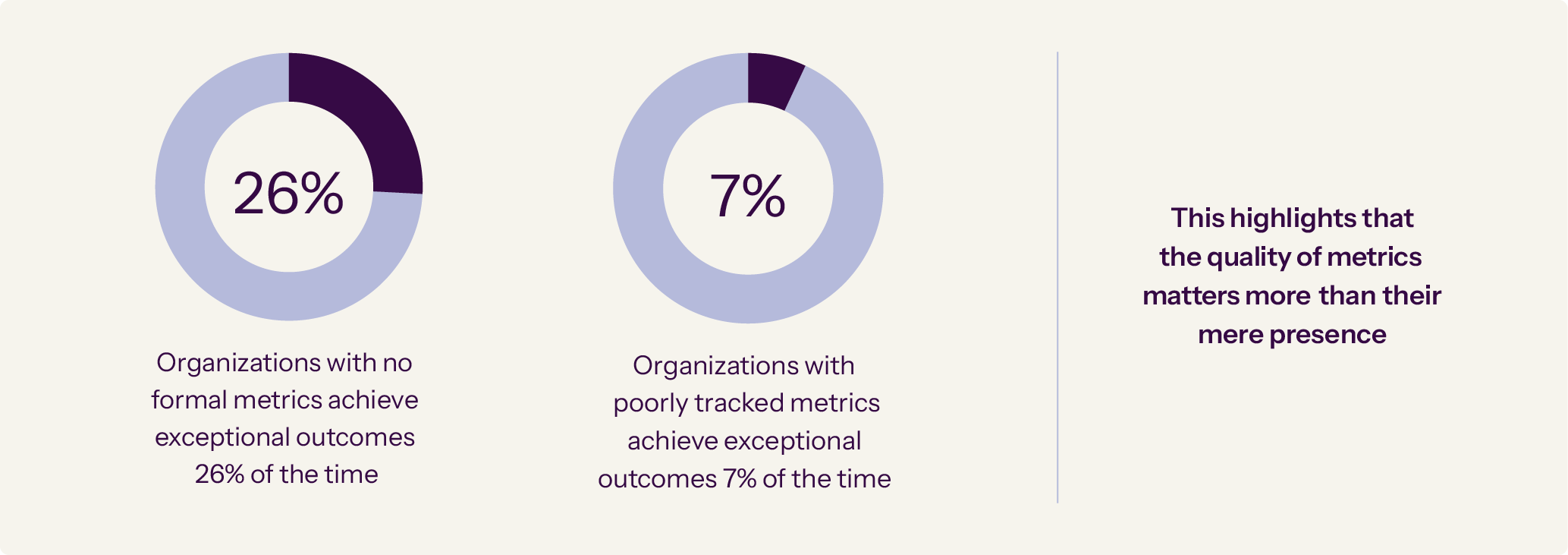
Metrics are a critical component for measuring ERP success, and one of the most challenging aspects to get right. According to Prosci’s 2025 Unlocking ERP Implementations study, organizations with comprehensive metrics maturity achieve 28% success rates, 4x better than those with poor metrics (7%). Yet there’s a surprising twist: Organizations with no formal metrics (26%) outperform those with poor metrics, meaning bad metrics are worse than no metrics at all.
To bridge the gap between promised and delivered ROI, organizations need to move beyond system usage and toward business and people-focused metrics. The question executives need to ask is: “Am I delivering systems or value?”
The ERP metrics maturity gap
Prosci’s 2025 ERP research showed that comprehensive metrics maturity (28%) leads to 4x better outcomes than poor metrics (7%). Organizations that define strong metrics significantly outperform those with poor ones, but the path to defining strong metrics isn’t always clear.
Real-world reasons for the disconnect in ERP metrics maturity
Most commonly, the disconnect in ERP metrics maturity stems from misalignment.
Across client engagements, I’ve seen instances where organizations didn’t clearly define their metrics or where they defined the wrong ones. When this happens, stakeholders often outline their own version of what they should measure to deem the ERP transformation a success. Different business functions define their metrics in silos and believe the ones they choose are the right ones, creating an inconsistent narrative across teams.
When ERP implementation teams, including sponsors, the steering committee, and additional senior leaders, define metrics together at the beginning of the project, they develop a common language and shared understanding of what success looks like. In practice, this works best when leaders gather input from impacted groups to understand how to measure success at the level where the work happens.
Aligning and defining metrics for success can make or break whether an ERP implementation achieves its intended business outcomes. Executives can start by asking: Do we have a clear, shared ERP vision tied to business and people outcomes, or are we relying mostly on system usage metrics and siloed definitions of success?

Defining ERP success before you start
When joining a client engagement, it’s not uncommon for us to see that organizations aren’t considering measurement from the start. But measurement must begin early in the process, not at go-live, because without baseline data, it’s nearly impossible to gather metrics that showcase real business value.
The right time to design this measurement approach is during the ERP business case construction, not after configuration has started. Anchoring metrics design to the business case ensures that the value story, baselines, and success measures align from day one.
Measuring the people side of change beyond system metrics
One of the ways we help clients engage in early measurement conversations is by conducting Prosci’s 4 P’s Exercise, identifying the project, purpose, particulars, and people. In conducting this exercise, we ask questions about how we will measure the people impact. In ERP change management, we focus on submetrics, including:
- Speed of adoption – How quickly individuals or groups change their behaviors to use a new process or system
- Ultimate utilization – How many people are using the new process or system
- Proficiency – How well individuals perform after adopting the change, and whether they use the new process or system correctly and effectively
To measure these, organizations typically have to extract multiple datasets to represent these areas. Things like accurate inventory accounts and cycles for speed of adoption, how many people completed training for ultimate utilization, and competency levels for proficiency. To gather these metrics, we need to understand how the organization currently uses and measures them so that we can identify comparisons in the people side of change.
When we have these conversations early and involve change management expertise, we’re better able to identify the right metrics, leading to more successful outcomes.
Business outcomes vs. ERP system metrics
Too often, in the absence of business outcome-focused metrics, teams depend on system metrics, including logins and transactions, to paint the success story. While logins and transactions are the first step toward accessing the new ERP system, they don’t demonstrate the system's value or whether end users use it effectively.
Moving from system metrics to business outcomes such as cycle time, inventory impact, and workforce productivity often requires a shift in thinking. We have conversations about the Prosci ADKAR® Model and the reinforcement and sustainment efforts post-go-live that drive feedback loops for continuous improvement and better business results, guiding clients toward people-focused metrics.
We know from Prosci’s research that post-go-live is where ERP value materializes. What logins and transactions as core metrics miss are the feedback and information loops that facilitate adoption and ongoing use of the ERP system.
Benefits realization governance
Turning promised ROI into delivered ROI requires more than a strong business case at the outset. It requires disciplined benefits realization governance throughout the ERP lifecycle and well beyond go-live.
One practical mechanism is a regular, often monthly, business case review where sponsors and the steering committee revisit value assumptions, assess which benefits are at risk, and decide on course corrections before issues compromise ROI.
Effective governance starts with a clear agreement on how sponsors will stay informed. If I were in the role of an executive sponsor, I would want to know:
- How will I know what’s going on?
- How frequently will I be updated?
- How will teams surface decisions to the steering committee and me?
- How will we be informed about emerging risks and challenges?
- How will we know that we are successful?
- What will we measure, how will we measure it, and who is accountable for measuring it?
The questions shape how the organization will monitor both ERP system implementation progress and value realization. At the center of these reviews is a simple but powerful question for executives: “Am I delivering systems or value?” This question keeps discussions anchored in benefits realization rather than just technical milestones.
Measuring ERP benefits throughout the lifecycle
Executives who want to understand whether their ERP is actually delivering value should work with change leaders to draw on tools like the Prosci Change Triangle (PCT) Assessment to gauge progress, conduct ADKAR assessments or pulse-check surveys, and review submetrics to determine how impacted groups are adapting to the change.
By focusing on the sponsor’s area of the business, change leaders can make benefits realization tangible and relevant, reinforcing that the ERP is not just a technology program but a business transformation.
Go-live is the starting line
What leaders said they would do differently to improve the business benefits gained from their ERP implementation
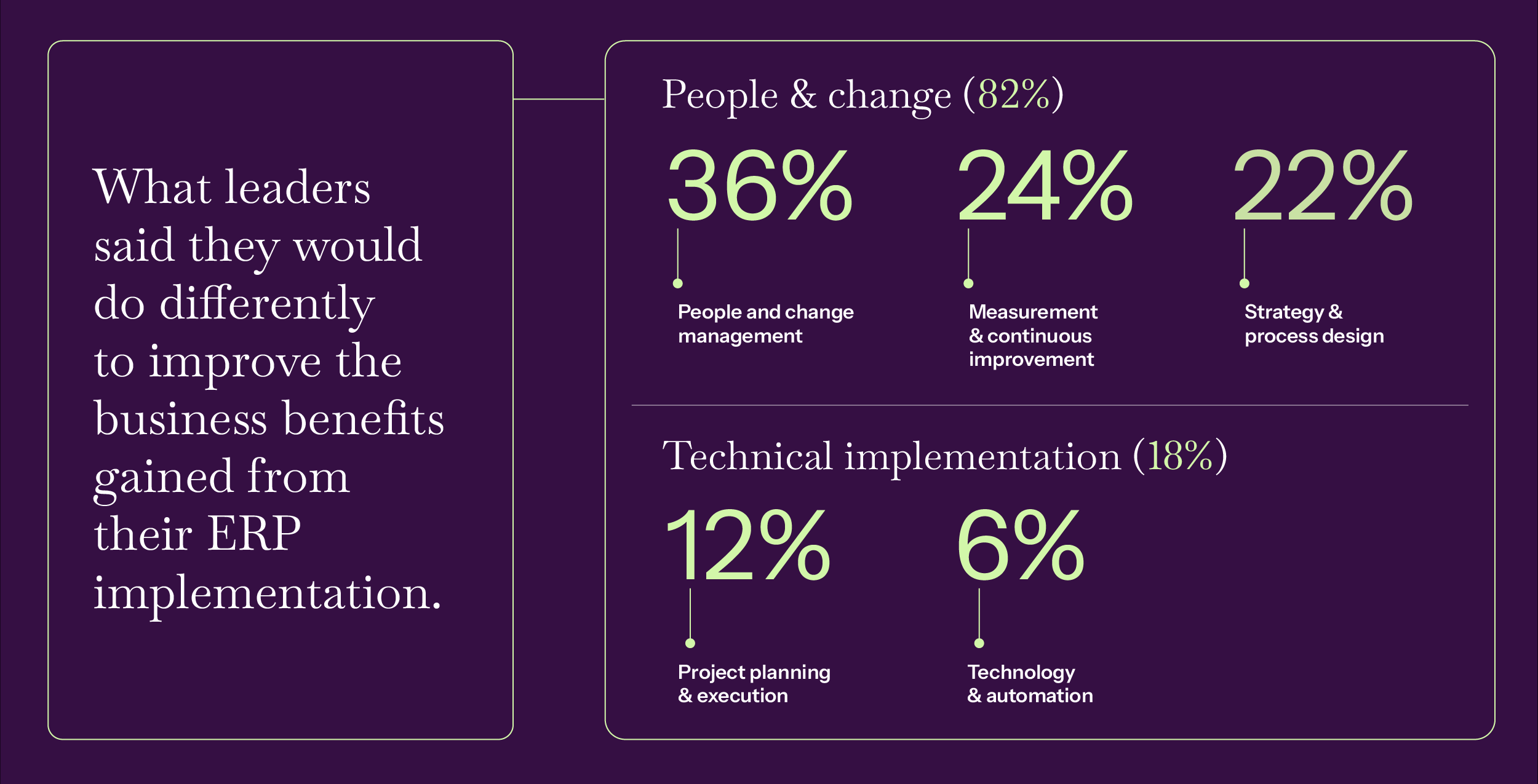
Participants in Prosci’s ERP implementation analysis cited Measurement and Continuous Improvement as the second-highest benefit lever (24%), trailing only People and Change Management (36%). Most notably, a significant finding emerged: Organizations that treat go-live as the finish line misunderstand when ERP value materializes.
Effective ERP adoption doesn’t stop at go-live. The real business value often comes after implementation through process refinements, user feedback, data insights, and automation opportunities. One participant in our ERP implementation research identified 15-20% cost savings opportunities in inventory and procurement through predictive analytics, a testament to ongoing monitoring and continuous optimization.
Opportunities like these only become available through continuous measurement and development, which is why it’s necessary to:
- Structure post-go-live investments – Many organizations view go-live as the destination, dedicating 92% of their budget to technical activities leading up to deployment (Best Practices in Change Management, 12th Edition). But organizations that want to see real value from their investment need to view go-live as a starting point and allocate resources to facilitate post-go-live support, including change management.
- Build feedback systems that surface problems early – Both early and post-implementation feedback are necessary. The former shapes the ERP implementation design, while the latter drives optimization.
- Embed measurement into operational dashboards – Real-time visibility through dashboards and embedded analytics provides insights that inform decision-making and demonstrate value early.
Executive action for delivering ERP ROI
Translating promised ROI into delivered ROI doesn’t come from better status reports or more system metrics. It comes from executives who deliberately govern benefits across the full ERP lifecycle and hold themselves accountable for value, not just go-live.
To do that, executives can focus on three areas:
- Define a shared version of success early – Align on baselines before go-live so you can show real, comparable value later. Don’t let every function define its success metrics in silos.
- Assign clear accountability for benefits realization – Name who owns benefits realization and how they will track and communicate progress and risks.
- Invest beyond go-live and treat feedback as an opportunity – Protect post–go-live budget and capacity for change management, training, and optimization. Build feedback loops and dashboards that tie back to the success scorecard, not just system usage.
Delivered ROI demonstrated through aligned metrics, sustained adoption, and visible business outcomes builds trust, unlocks future investment, and proves that the ERP is a true business transformation, not just a technology upgrade. Promised ROI will get you funded, but the delivered ROI will get you funded again.