6 Mins
Updated: May 8, 2026
Published: April 15, 2026



Enterprise Resource Planning (ERP) system implementations are complex, enterprise-wide initiatives that impact processes, data, and, most importantly, how people work. Delivering an ERP system on time and on budget isn’t the most significant challenge; ensuring people adopt it to drive business value is. Successful ERP implementations require project management to guide technical delivery and change management to prepare the organization for new ways of working. In this guide, we explore the importance of project management in ERP implementations and how to integrate it with change management for the best results.

The Importance of Project Management in ERP
Project management is a necessary component in the success of ERP initiatives. Effective project management aligns stakeholders, identifies dependencies, controls scope, and keeps timelines and budgets on track while navigating the inherent complexities in ERP system implementations.
ERP software also plays a powerful role in improving how organizations manage projects post-implementation. By centralizing data, standardizing processes, and improving visibility into resources, costs, and performance, ERPs enable better decision-making, strengthening project management capabilities long after go-live.
Project Management Methodologies & Approaches in ERP
ERP implementation projects require a delivery approach that aligns with the organization’s complexity, risk tolerance and change readiness. The chosen project management methodology influences how teams plan, make decisions, and address issues. ERP projects typically rely on one of the following approaches, or a combination of them:
Traditional Waterfall approach
The Waterfall approach follows a linear, sequential process in which teams must complete each phase before moving to the next. It emphasizes detailed upfront planning, documentation, and milestone management. This approach works best when requirements are well understood, regulatory needs are high, and the organization prioritizes predictability and formal governance structures. The Waterfall approach is particularly effective in large enterprises (10,000+ employees) due to its structured nature.
Agile approach
Agile emphasizes flexibility, with iterative cycles that enable regular reassessment and adaptation. In the context of an ERP implementation, agile is most beneficial in environments where requirements are likely to evolve, and rapid adaptation is necessary for the project to succeed. Agile approaches are most effective in smaller organizations or projects where fast iterations and collaboration are feasible.
Hybrid approach
A hybrid project management approach blends Waterfall with the flexibility of agile, balancing the needs of comprehensive planning with iterative adaptation. It provides an adjustable framework to meet varying project needs. Medium- to large-sized organizations often use a hybrid approach to balance control and flexibility when managing complex, enterprise-wide change, such as an ERP implementation.
Roles and Responsibilities in ERP Project Management
Clear roles and responsibilities are essential in ERP project management, as multiple team members are required to drive project success. Below are the key roles and responsibilities across the technical and people-related aspects of an ERP implementation:
ERP Project Manager
This role is responsible for day-to-day execution and ensuring the project stays aligned with agreed objectives. The ERP Project Manager owns the overall timeline, budget, risk management, and coordination across workstreams.
Executive Sponsor
Prosci research demonstrates that sponsors are so critical to change efforts that they can make or break a project or initiative. The sponsor provides active and visible participation throughout the project, builds a sponsorship coalition, and communicates the change to impacted groups.
Functional Leads
This group represents the needs and priorities of their respective business units. They define requirements, validate process changes, and ensure the ERP software supports real-world operational workflows.
Technical Team
This team ensures the chosen ERP solution is stable, secure, and ready to support business operations at go-live and beyond. They manage the system configuration, integrations, data migration, and technical testing.
Change Management Lead
The change manager or change management team is responsible for stakeholder engagement, organizational readiness, training, communication, and adoption. They focus on the people side of change, ensuring people are prepared to work differently using the new ERP software.
The Challenges of Implementing an ERP System
Research from Prosci’s 2025 Unlocking ERP Implementations revealed that human factors matter 6x more than technical factors in improving ERP benefits. These findings highlight a disconnect between conventional wisdom and reality: people-related challenges outweigh process-related and technical ones.
Below are some of the common challenges faced during ERP implementations:
- Poor stakeholder alignment – Misalignment among stakeholder groups leads to conflicting priorities and delayed decision-making. In Prosci’s 2025 Unlocking ERP Implementations research, respondents emphasized the importance of engaging stakeholders early to improve ERP implementation outcomes, second only to improving training, underscoring the criticality of stakeholder engagement and alignment for implementation success.
- Inadequate change management – When the people side of change is underfunded, delayed, or missing altogether, ERP implementation projects suffer. Change management is one of five human factors that participants in Prosci’s research identified as drivers of value realization and success.
- Resistance from end-users – Resistance is a natural human reaction to change. Prosci research shows that preventing resistance to change is more effective than addressing it reactively. Following a change management approach supports the prevention and management of resistance.
- Scope creep – Uncontrolled changes to requirements can derail timelines and budgets. Without strong governance, small additions compound into significant delivery risk.
- Data migration issues – Poor data quality, unclear ownership, and late validation contribute to disruptions during testing and go-live, causing timeline delays.
- Underestimating testing effort – ERP testing requires significant time, coordination, and business involvement. Inadequate testing increases the risk of defects, process breakdowns, and operational disruptions post–go-live.
- Lack of reporting and visibility – Limited insight into project status, risks, and adoption metrics makes it difficult to intervene early and get implementations back on track.

Integrating Change Management with Project Management in ERP
Integrating change management with project management in ERP implementations is crucial for achieving successful outcomes. While project management focuses on delivering the system, change management ensures the organization is ready to adopt and sustain new ways of working.
Benefits of early integration
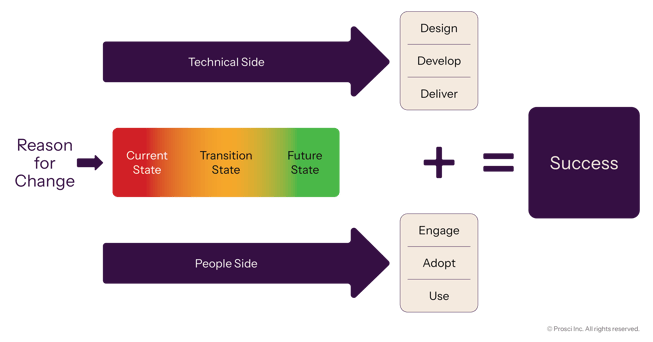
Project management and change management are complementary disciplines with a common objective: to meet or exceed project objectives and realize organizational benefits. Prosci's research demonstrates that organizations integrating these disciplines report higher success rates in meeting or exceeding project objectives. A successful change is characterized by a solution that is effectively designed, developed and delivered (project management) and that is embraced, adopted and used by impacted employees (change management).
Prosci’s Unified Value Proposition illustrates how project management and change management work together to create successful change.
Unified Value Proposition
Need for stakeholder engagement
ERP implementations impact many stakeholders across the organization, making structured stakeholder engagement planning essential. All stakeholders, from executives to employees, can influence whether a change initiative thrives or falters.
Change management helps teams identify impacted groups and assess how the change impacts them. When stakeholder engagement is coordinated with project milestones, teams are better able to coach those in core change management roles to fulfill their responsibilities and help prepare, equip, and support people during change.
Clear communication
Effective communication bridges the gap between ERP implementation technical milestones and organizational understanding. Project updates often focus solely on timelines and deliverables. Change management ensures that messaging explains why the organization is implementing the ERP solution and how it will affect employees' daily work. Aligning communication plans with project phases helps reduce uncertainty and keeps stakeholders informed and engaged throughout the ERP implementation.
Organizational readiness
Project management measures system readiness, which is critical for ensuring the solution delivers the intended technical results. But change management measures change readiness, a crucial aspect in understanding whether the organization is ready, willing and able to adopt new ways of working and implement change. Without organizational readiness, even the best-laid ERP implementation project management plans will fail, as adoption success is people-dependent.
Best Practices for Project Management in ERP
The following best practices help ERP project teams deliver successful implementations with changed ways of working, beyond go-live, to increase value realization:
- Prioritize change management and training – Integrating these into the project plan ensures users are prepared to adopt new processes and ways of working. Early and ongoing change management inclusion prevents costly rework and failed implementations.
- Define clear scope and success metrics – Prevent scope creep and misaligned expectations by clearly defining what work is in scope and how your organization will measure success.
- Use a phased or agile-hybrid approach – Choose an approach that allows teams to manage complexity while adapting to feedback.
- Establish strong governance and decision-making – Clear governance structures enable timely decisions and accountability across the project. Strong sponsorship and escalation paths help resolve issues before they impact delivery.
- Maintain realistic timelines and budgets – Realistic planning reduces burnout, rework, and the likelihood of cost overruns.
- Track KPIs throughout the ERP project lifecycle – Monitoring KPIs such as schedule performance, defect rates, and adoption readiness provides early visibility into risks.
- Leverage ERP-specific project management tools – Tools designed for ERP implementations simplify dependency management, progress tracking, and escalation pathing.
Integrating Project Management and Change Management for ERP Implementation Success
When project management and change management operate together, ERP systems are not just deployed; they are adopted, embedded, and leveraged to drive measurable business value. Change done right is how we create better business outcomes.
FAQs
How long does an ERP project take?
The length of an ERP implementation varies based on organizational size, scope, and complexity. Often, ERP implementations are multi-year-long. While there are no right or wrong answers regarding implementation timing, realistic scheduling is critical. Planning conservatively is necessary for delivering working systems and changed behavior.
What are the biggest ERP implementation risks?
Based on Prosci’s 2025 Unlocking ERP Implementations research, the top ERP implementation risks are human factors, including inadequate or incomplete training, stakeholder misalignment, lack of structured change management, unclear communication, and insufficient cross-functional collaboration.
What are some common metrics to measure the success of the ERP integration?
System uptime, data accuracy, process efficiency, user adoption rates, and training completion are some common metrics for measuring the success of ERP integration. It’s essential to evaluate system performance and organizational adoption, in line with business goals, to achieve the best results.
How can organizations ensure effective communication during ERP projects?
Effective communication requires planning, consistency, and role-specific messaging from preferred senders. Regular updates aligned with project milestones, the reasons for change, and opportunities to provide feedback keep stakeholders informed and engaged.
Why is integrating change management with project management important in ERP implementations?
Integrating change management ensures that adoption, readiness, and behavioral changes are addressed alongside technical delivery. This alignment helps the organization realize the intended business benefits of the ERP system.
How does change management contribute to the success of an ERP project?
Change management prepares people for new processes, tools, and ways of working. By focusing on stakeholder engagement, training, and communication, it ensures that users are ready, willing, and able to adopt the ERP system.