5 Mins
Updated: April 22, 2026
Published: March 10, 2026



One of the biggest challenges organizations face today is translating an enterprise-level AI initiative ("We are deploying generative AI tools across the organization") to the individual level ("How AI actually fits into the day-to-day work of individuals"). This translation process is essential for successful AI adoption.
The pace of AI advancement can feel both exciting and overwhelming. For many professionals, it's unclear how AI actually fits into their daily work. When we give people prompt libraries and copy-and-paste use cases, we're essentially just giving them fish. The Prosci AI Integration Framework teaches them to fish—equipping them with a framework to make sense of their own personal integration of AI.
The Prosci AI Integration Framework
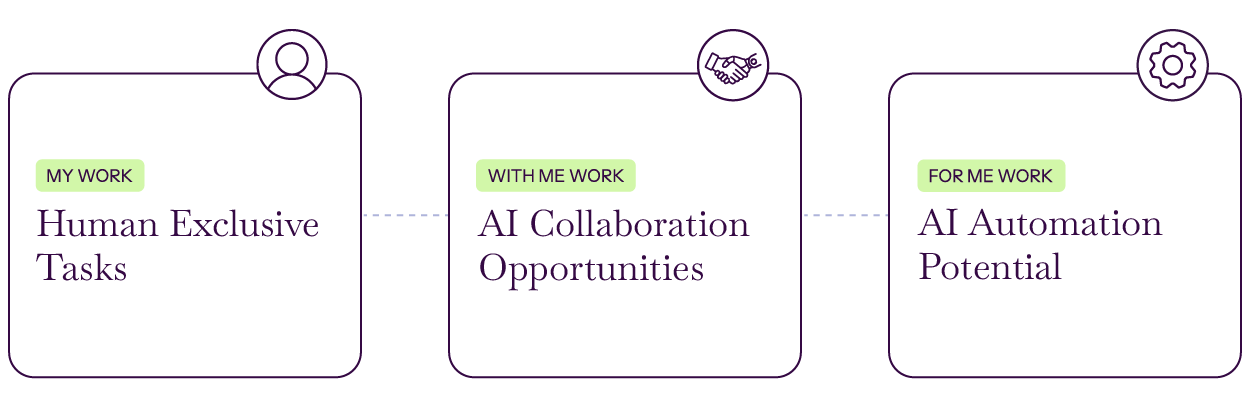
Prosci's AI Integration Framework is a human-centered model that helps individuals and organizations categorize their work into three distinct buckets—My Work (human-exclusive tasks), "With Me" Work (AI collaboration opportunities), and "For Me" Work (AI automation potential)—to make intentional decisions about when, where, and how to integrate AI into their daily responsibilities. By organizing responsibilities this way, individuals begin to see where AI adds value and where human strengths remain essential. This approach encourages confidence and control. It helps individuals and teams move from anxiety about AI to meaningful, intentional use.
My Work: Human-Exclusive Tasks
The first category is called "My Work." These are the tasks that must remain human. They rely on qualities that AI simply cannot replace: emotional intelligence, ethical judgment, real-time improvisation, and personal connection.
Whether it's leading a team meeting, making a sensitive decision, or building trust with a client, these are the moments when your presence and judgment are non-negotiable. This category includes:
- Work that is emotionally complex or ethically sensitive
- Work that is improvisational or dependent on human presence
- Work that reflects personal values, relationships, or meaning
- Work that is routine, time-consuming, or draining
- Work that follows rules or repeatable steps
- Work that is important but not uniquely human
- Work that is easier, better, or faster with smart support
- Work that benefits from structure, synthesis, iteration, or polish
- Work that still needs you—but not every step
These are the tasks that define the human side of work and will continue to belong to people, no matter how advanced AI becomes. This is often the work that drew people to their profession in the first place—the cultural alignment, the facilitation of high-stakes conversations, the building of trust and empathy.
"For Me" Work: AI Automation Potential
The second category is "For Me" Work. These are tasks that AI can take off your plate entirely. Think of the things you do repeatedly—routine, repetitive work that doesn't require your judgment or creativity.
Examples include generating routine reports, organizing data, sending calendar reminders, or processing standardized information. This category includes:
These are tasks that can be automated to save time, reduce errors, and free up your energy for more meaningful efforts. While it's tempting to focus heavily on this category because automation feels like a clear win, the most exciting transformation actually happens in the third category.
"With Me" Work: AI Collaboration Opportunities
The third category is "With Me" Work. This is where you collaborate with AI to do your job better. In this space, AI doesn't take over the task—it becomes a digital collaborator or partner. It helps you think faster, write more clearly, analyze more deeply, assimilate data more quickly, or brainstorm more creatively.
You are still in control, but AI gives you a boost. Imagine drafting a report and asking AI to organize your ideas or exploring customer data and having AI suggest patterns to watch for. This category includes:
These are tasks where AI becomes a digital collaborator, helping you deliver your work at a higher quality, in less time, with less strain, and ultimately with more enjoyment. This is the magic in the middle.
Using the AI Integration Framework
The most straightforward application is to list the three categories and have individuals or teams sort their tasks accordingly. The table below includes definitions and examples for each category.
|
Category |
Definition |
Example Tasks |
|
My Work |
Tasks that require human presence, emotional intelligence, or ethical judgment |
Building trust through nuanced client relationships; Making judgment calls that balance logic, values, and emotion; Navigating ambiguity with human insight |
|
"With Me" Work |
Tasks that benefit from AI collaboration to improve quality, speed, or outcomes |
Drafting client communications with AI as a writing partner; Exploring ideas through AI-assisted brainstorming; Using AI to clarify thinking or structure presentations |
|
"For Me" Work |
Tasks that are routine, rule-based, and can be fully automated |
Logging work or time automatically; Filing emails, notes, and documents; Generating standardized reports |
Often, a change practitioner or leader can start this process independently, leveraging existing job descriptions and task inventories. By reviewing current work, you can uncover integration opportunities that the team may have missed. Additionally, facilitating this activity with teams using a collaborative, design-thinking approach can be engaging and clarifying.
Additional Benefits of the AI Integration Framework
Builds Personal Relevance Into Adoption
One of the biggest hurdles in AI adoption is convincing people to integrate it into their daily workflows. Traditional tools offer a clear value proposition: "Follow this process, and efficiency improves." But generative AI doesn't operate on a one-size-fits-all value proposition. For an employee to embrace AI, they need to see their challenge reflected in the solution. The AI Integration Framework creates that personal connection by starting with the individual's actual tasks—not abstract capabilities.
Shifts ROI From Process Optimization to Individual Empowerment
Traditional tools optimize processes; generative AI unlocks human potential. In a CRM, every user performs tasks in a standardized way to generate predictable outcomes. But generative AI is like having a personal productivity partner—one that adjusts to your working style, helps you think more clearly, and removes blockers as they arise. If organizations only focus on system-wide use cases, they miss the deeply human layer of value that AI brings. The ROI is not just in speeding up workflows; it's in improving the quality of individual outputs, reducing mental fatigue, fostering creativity, and freeing up time for strategic work.
The framework also enables clearer adoption metrics. When you've defined which tasks belong in "With Me" Work versus "For Me" Work, you can measure whether people are collaborating with AI on the right activities—not just whether they've logged into a tool.
Sparks Curiosity and Experimentation
When AI integration begins with people's tasks instead of tool functionality, they become naturally curious about its potential. They start experimenting. They ask questions like, "What else can this tool do for me?" That curiosity is the engine of adoption and innovation. When AI is framed around rigid use cases, experimentation shrinks. People use the tool only in predefined ways, and the real potential—found in those unscripted, unexpected moments—remains untapped. The AI Integration Framework opens space for discovery by putting the individual's work at the center.
Scales Adoption Through Individuals, Not Just Systems
The long-term success of AI adoption doesn't just depend on systems integration—it depends on integration into daily work. Individuals who discover transformative moments with AI become advocates. They share stories, show results, and build excitement. Those breakthrough moments happen when AI feels personal, not procedural. When someone experiences, "This tool just helped me solve a problem I've been stuck on for days," they don't need a mandate to keep using it. They become self-motivated ambassadors.

Extending the AI Integration Framework
Once we understand the framework for the individual, we can extend it to teams and the enterprise. The same three categories apply—but the language shifts from "Me" to "Us."
- Our Work (Human Exclusive): Work that requires team connection, trust, and dialogue to move forward
- "With Us" Work (AI Collaboration): Work that benefits from AI-synthesized inputs and co-creation
- "For Us" Work (AI Automation): Work that is procedural or status-based and can run without manual effort
Teams use AI to solve bigger problems in news ways, while collaborating and connecting like never before. Enterprises integrate AI to better deliver on their mission to the customer, constituents, and stakeholders. At each level, the framework gives groups a shared language for deciding where AI fits—and where it doesn't.
This extension allows organizations to move from individual productivity gains to enterprise-wide AI integration, infusing AI capabilities into the value streams and operations that drive organizational success.
Human-Centered AI Integration
The Prosci AI Integration Framework is more than a categorization tool—it's a perspective on the relationship between humans and AI. It turns AI from an external force into a partner, a digital collaborator that people can shape and apply in their own context.
By focusing on tasks instead of tools, and collaboration instead of replacement, the framework helps individuals and organizations unlock the full potential of AI. It puts you in the driver's seat, deciding when and where and how to bring AI into your work.
At its core, this shift is not about technology—it's about people. People don't adopt tools because they're told to; they adopt them because they feel equipped, supported, and excited. The AI Integration Framework creates the conditions for that to happen—one interaction, one task, and one human at a time.