5 Mins
Updated: April 21, 2026
Published: April 20, 2026



Workday is a cloud-based software platform for enterprises that integrates human capital management (HCM), financial management, and business planning and analytics into a single system. Organizations use it to manage core human resources (HR), payroll, finance, business operations, and management processes.Workday touches multiple business areas and becomes a critical component in how businesses operate. That’s why a change management strategy is non-negotiable for organizations that want to deploy Workday. In this guide, we’ll help you understand how an effective change management strategy can increase the value of your Workday implementation.

Understanding Workday change management
Aligning change management with your Workday implementation is essential because the platform fundamentally reshapes how employees carry out HR, finance, and planning processes. The platform doesn’t merely replace legacy systems. Instead, it introduces standardized processes, new data structures, greater transparency, and opportunities for ongoing improvement as organizations evolve.
Workday plays a central role in transforming HR, finance, and planning processes by enabling real-time data, streamlined workflows, and more connected decision-making. To realize these benefits, organizations must help their workforce understand how their responsibilities are changing and why new ways of working matter. Without a change management strategy, ERP Workday implementations risk failure while creating confusion, resistance, and inconsistent adoption.
Why organizations need a change management strategy for Workday
Implementing Workday represents a significant shift in how an organization operates. Change management helps bridge the gap between technical implementation and day-to-day behavior change by:
Addressing the complexity of transitioning to a new system
ERP implementations are complex, and not just from a technology standpoint. There are several technical and human considerations involved in transitioning to a new system.
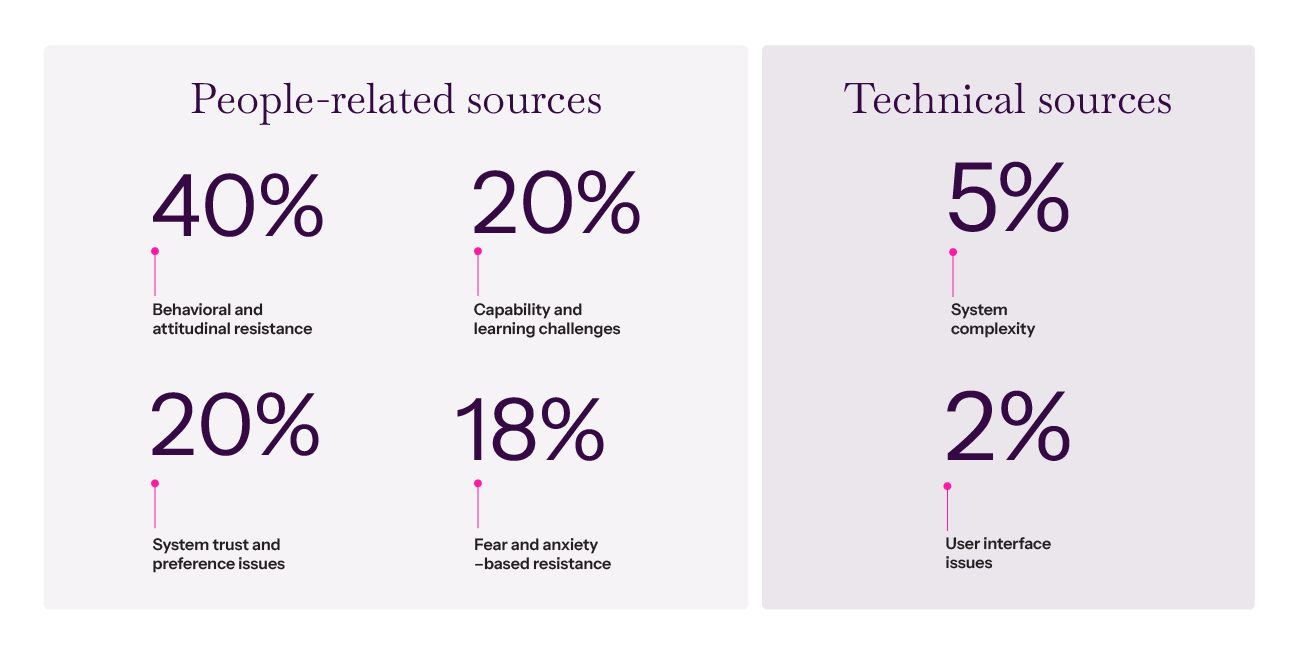
According to Prosci’s 2025 Unlocking ERP Implementation study, human factors drive success, as 98% of resistance during ERP implementations stems from people-related sources, including behavioral, emotional, capability, and trust. Effective change management strategies help ensure human factors are accounted for, increasing the likelihood of Workday implementation success.
Sources of Resistance During ERP Implementations
Minimizing resistance and fostering employee buy-in
Resistance is a natural human reaction to change. It’s an emotional and psychological response that arises when individuals face uncertainty, perceive threats, or are not fully aware of the reasons behind a change.
A structured change management approach proactively addresses concerns through clear communication, leadership alignment, and opportunities for engagement. Findings from Prosci’s 2025 Unlocking ERP Implementations study suggest organizations can reduce resistance to change when implementing Workday by combining evidence-based demonstrations, inclusive engagement, capability building, and sustained recognition.
Enhancing user adoption and maximizing return on investment (ROI)
ROI from Workday depends on behavioral changes, not system implementation and functionality alone. A Workday change management strategy supports adoption by helping employees understand how Workday fits into their roles and what changes they need to make in their workflows. When users are capable and confident champions of the system, organizations see higher utilization and promising business outcomes.
Ensuring compliance and alignment with organizational goals
According to Prosci’s 2025 Unlocking ERP Implementations study, the biggest challenge in measuring ERP success is unclear business goals, underscoring the need for a change management strategy to equip teams with a clear understanding.
A structured change management strategy helps translate organizational objectives into clear expectations for how and why employees will use Workday. This alignment strengthens compliance while ensuring the ERP supports the outcomes the organization cares most about.
Key components of a Workday change management strategy
A successful Workday implementation requires a change management strategy that addresses both the technical and people sides of change. The following components help organizations equip employees, support adoption, and sustain performance as Workday becomes part of daily operations.
Stakeholder engagement and communication plans
Stakeholder engagement and targeted communication plans ensure leaders, managers, and employees receive timely, relevant information about the Workday implementation. Stakeholder-specific change tactics are essential. Research from Prosci’s 2025 Unlocking ERP Implementations study revealed that resistance is not limited to end users; executives and team leaders also show high levels of resistance to change.
Organizations that implement ERP systems successfully engage stakeholders early, clarify roles, and provide ongoing support throughout the implementation lifecycle. Clear messaging helps set expectations, explain the purpose of the change, and reinforce how Workday supports organizational priorities.
Training and support initiatives for end users
A structured approach to training and ongoing support helps users navigate the new system, build confidence using Workday, and reduce reliance on workarounds. Creating detailed training plans with role-based, practical, and real-world examples improves training effectiveness. Training should not be a one-and-done experience. Post-go-live support, such as help resources and refresher training, reinforces adoption as employees gain experience with the system.
Change readiness assessments and impact analysis activities
Change readiness assessments and impact analyses help organizations understand and anticipate the work required to achieve adoption. These activities identify where change will be most significant, which roles require additional support, and how prepared the organization is for the transition. This information informs the change management strategy and ensures the right activities are in place to move the organization and individuals from the current to the future state.
Continuous feedback mechanisms and performance metrics
Despite the common misconception that ERP implementations are complete at go-live, business value often materializes later, long after go-live occurs. Ongoing feedback and measurement help organizations understand how the Workday implementation is performing beyond go-live. Systematic channels for user feedback, adoption metrics, and other performance indicators provide visibility into what’s working and where there’s room to improve. Using these insights to refine change strategies supports continuous improvement and sustained value realization.
Best practices for implementing Workday change management
The following best practices help organizations facilitate successful and lasting adoption of Workday and similar tools through effective change management:
Establish a change management team with clear roles and responsibilities
A dedicated change management team provides focus and accountability throughout the Workday implementation. In Prosci’s 2025 Unlocking ERP Implementations study, 69% of organizations implementing Workday chose to lead change management internally. This finding reflects a strategic preference for internal ownership of transformation efforts.
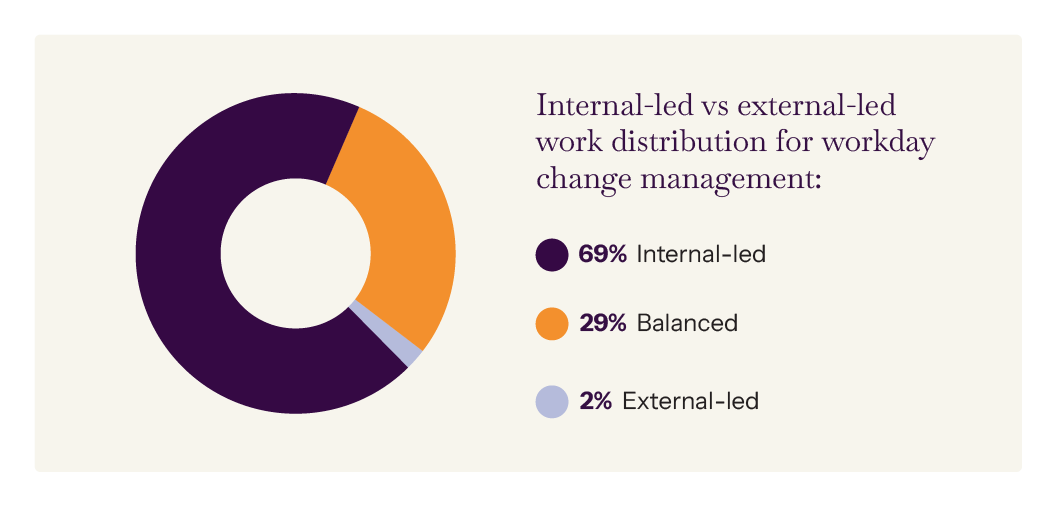
Whether your organization prefers to lead change management internally or to engage external help, establishing a change management team with clearly defined roles ensures that the right people are in the right places to support the work.
Develop a comprehensive change management plan tailored to Workday
A one-size-fits-all approach rarely works for Workday implementations. A tailored change management plan aligns activities with Workday-specific impacts, implementation phases, and organizational priorities for smoother execution.
Organizations can create comprehensive and effective change management plans using the Prosci 3-Phase Process. The Prosci 3-Phase Process is a structured, repeatable and adaptable approach for organizational change management.
/Methodology-EN.webp?width=462&height=478&name=Methodology-EN.webp)
Phase 2 – Manage Change is the longest and most visible to organizations and impacted individuals. The deliverable for this phase is the Master Change Management Plan, which consolidates individual plans and serves as the guiding document for the change management team.
Use the ADKAR® Model to guide individual transitions
The Prosci ADKAR Model is the second foundational model of the Prosci Methodology, alongside the Prosci 3-Phase Process. While the Prosci 3-Phase Process provides a framework for organizational change, the ADKAR Model enables successful change at the individual level.
Prosci ADKAR Model
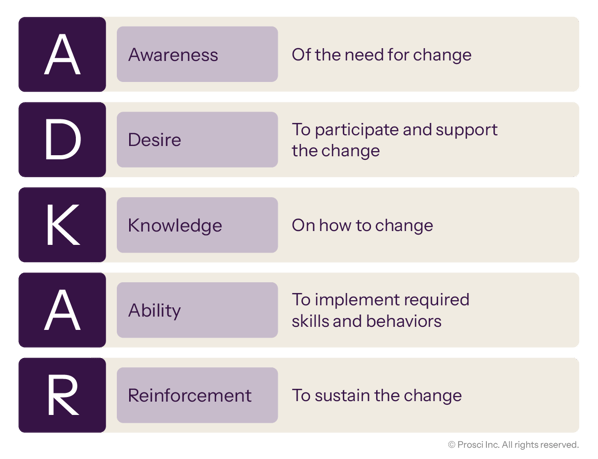
The word “ADKAR” is an acronym for the five outcomes an individual needs to achieve for a change to be successful: Awareness, Desire, Knowledge, Ability and Reinforcement. Applying ADKAR during a Workday implementation improves adoption by addressing both behavioral and skill-related barriers.
Foster a culture of adaptability and continuous improvement
Workday’s ongoing updates require organizations to embrace change as a constant, not a one-time event. Collecting feedback and input for continuous improvement, establishing and monitoring measurable performance indicators, and providing support post-go-live keep employees engaged and adaptable as the system evolves. Fostering a change-ready culture ensures the organization prioritizes a collaboration culture and continues to realize value from Workday well beyond go-live.
Partner with Prosci for Workday change management
The Workday platform delivers its greatest value when organizations have an effective change management strategy to support implementation. By following a structured change approach, such as the Prosci Methodology, organizations position themselves to achieve adoption and sustain new ways of working in the long term. Achieve change success with Prosci.