7 Mins
Updated: June 26, 2026
Published: May 13, 2026



Change is constant in today’s workplaces, driven by digital transformation, evolving business models, and shifting workforce expectations. A career in change management offers the opportunity to guide organizations through critical moments, ensuring new initiatives are not only implemented but also fully adopted and sustained.
For those interested in helping people navigate change, a career in change management could be a great, purposeful fit. If you’re wondering how to become a change manager, this guide will walk you through what to expect. Keep reading to learn whether a change management career path is right for you.

Why choose a career in change management?
For individuals who enjoy solving complex organizational challenges and working closely with people, a career in change management provides compelling advantages, including:
- High demand across industries – Change management has become increasingly important as organizations face constant transformation driven by technology, market shifts, and evolving workforce expectations. Organizations across nearly every sector need skilled professionals to guide employees through complexity.
- Competitive salary potential – Because successful transformation initiatives depend on effective adoption, experienced change management professionals often command competitive compensation and advancement opportunities.
- Cross-functional exposure – Change management professionals work with stakeholders across many departments, including human resources (HR), IT, department heads, and senior executives, offering broad visibility throughout the organization.
- Opportunity to influence strategy and culture – By helping people adopt new ways of working, change professionals play a meaningful role in shaping both business outcomes and company culture.
- Career flexibility – Change management skills are in demand and highly transferable, creating opportunities for professionals to work in consulting, internal transformation teams, project management offices, leadership roles, and more.
What does a change manager do?
A change manager helps organizations successfully navigate transitions by focusing on the people side of change. They develop structured change management strategies that prepare individuals and teams to adopt new processes, technologies, and ways of working. This typically involves conducting change impact assessments to understand how the change will affect employees, designing communication and training plans, and building stakeholder support across the organization.
Throughout the initiative, change managers collaborate closely with project teams to align change management with project milestones, monitor adoption progress, and address resistance when it arises. By guiding communication, reinforcing strategic alignment, and ensuring employees have the knowledge and support they need, change managers help translate organizational change into sustained behavioral adoption. 
Change management career pathways
Change management careers typically evolve through progressively higher levels of responsibility, with professionals gaining more in-depth experience in strategy, stakeholder leadership, and organizational transformation. While specific titles vary by organization, most change management careers follow a path from supporting project-level change activities to leading enterprise-wide transformation.
Entry-level change management career opportunities
Early career change management professionals often support change initiatives by conducting stakeholder analyses, preparing communication materials, coordinating training logistics, and assisting with change-readiness assessments. This stage focuses on building foundational skills in change management frameworks, communication, and project coordination while gaining exposure to how organizations implement and manage change. Common entry-level titles include: Change Analyst, Change Management Analyst, Project Coordinator and Organizational Development Assistant.
Mid-level change management career opportunities
At this stage, individuals typically lead change efforts within projects or programs, developing structured change management strategies and plans. Responsibilities include conducting impact assessments, engaging stakeholders, managing resistance, guiding training and communication efforts, and working closely with project managers and leadership teams to ensure successful adoption of new initiatives. Mid-level professionals often hold titles such as Change Manager, Change Consultant or Organizational Development Specialist.
Senior-level change management career opportunities
Experience change management professionals oversee large-scale or enterprise change initiatives and often shape organizational transformation strategy. In addition to guiding multiple change programs, senior leaders build change management capabilities across the organization, advise executives, and ensure that strategic initiatives are successfully adopted and sustained over time. Senior positions include: Senior Change Manager, Director of Change Management, Head of Transformation and Chief Transformation Officer.
Change management career path challenges
While change management can be a rewarding and impactful career, the change management career path isn’t without its challenges, including:
Organizational maturity
Not all organizations have the same level of awareness or maturity in change management. In our Best Practices in Change Management data on change management career paths, only 10% of participants in our research reported that their organization had a formal career path for change management professionals. In some workplaces, leaders may misunderstand and underfund change management, treating it as an optional add-on rather than a critical discipline. This can require practitioners to spend significant time educating leaders and advocating for structured change practices.
Resistance to change
While resistance is a normal human reaction to change, it is one of the most significant challenges change professionals and organizational leaders alike face. Employees may feel uncertain about how changes will affect their roles, processes, or job security. Preventing and addressing resistance to change requires empathy, clear communication, and a passion for developing strategies that build trust and engagement, even when it’s challenging.
Leadership buy-in
Effective change initiatives depend heavily on active and visible sponsorship. However, some leaders underestimate the importance of their role in reinforcing change. Change professionals must coach leaders on communication, modeling desired behaviors, and supporting employees through the transition. This challenge highlights the need for strong relationship management skills.
Complexity of change
Organizational change initiatives can be highly complex, involving multiple stakeholders, shifting priorities, and overlapping projects. Change managers must balance strategic thinking with practical execution while maintaining alignment across teams. Navigating this complexity requires strong coordination skills and the ability to adapt as circumstances evolve.
Key skills needed for a change management career pathway
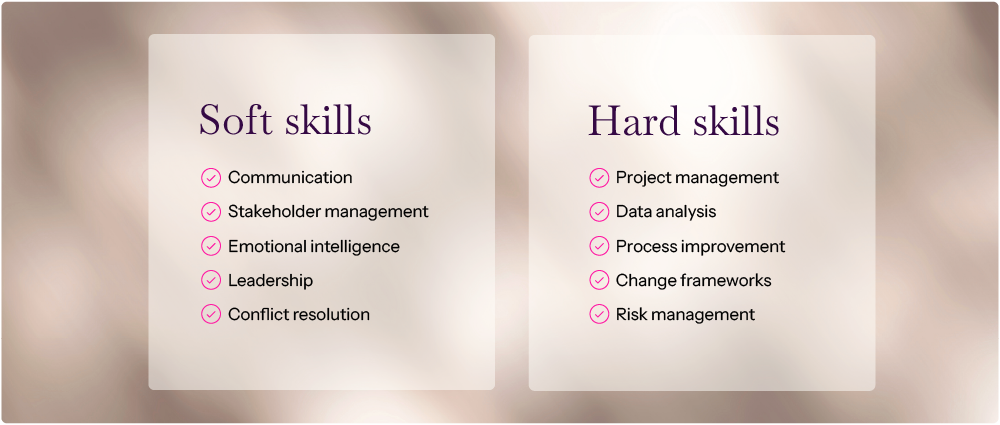
Successful change management professionals possess a combination of interpersonal skills and practical hands-on capabilities. Below are the soft and hard skills that allow change practitioners to sit at the intersection of people and organizational change:
Soft skills
- Communication – Change managers must know how to clearly communicate the purpose, benefits, and impacts of change initiatives and help other key stakeholders, such as people managers, fulfill their communication responsibilities.
- Stakeholder management – Building relationships, managing expectations, and maintaining alignment among diverse stakeholders is critical for driving adoption.
- Emotional intelligence – Understanding how people react to change allows practitioners to address concerns, build trust, and guide teams through uncertainty. At the same time, change professionals work with a variety of stakeholders with different interests and opinions, and they must navigate them effectively.
- Leadership – Even without direct authority, change management professionals must influence decision-making and guide teams toward shared desired outcomes.
- Conflict resolution – Organizational change often surfaces competing priorities and general concerns, requiring the ability to mediate disagreements and find constructive solutions.
Hard skills
- Project management – Change initiatives must be planned, coordinated, and executed alongside project milestones to build people readiness as projects progress toward completion.
- Data analysis – Interpreting data, including impact assessments, survey results, and feedback, allows change managers to assess progress and adjust change management strategies accordingly.
- Process improvement – Understanding how business processes work enables practitioners to support transitions to more efficient and standardized ways of working.
- Change frameworks – Familiarity with change frameworks, such as the Prosci Methodology and other change models, helps guide consistent, effective change strategies.
- Risk management – Identifying adoption risks and proactively addressing them helps prevent delays and improves the likelihood of successful change outcomes.
Education & certifications for change management
Change management professionals come from diverse educational backgrounds. Degrees in business administration, psychology, human resources, organizational development, communications, or management are especially relevant because they combine organizational strategy with an understanding of human behavior. Some change management roles may have specific educational requirements.
Several professional certifications can also help practitioners deepen their expertise and demonstrate credibility in the field, including:
- Prosci Change Management Certification – Our widely recognized certification program delivers the complete Prosci Methodology in a 3-day intensive format, providing a structured approach for managing the people side of change. Our certification is for anyone responsible for driving change, including change practitioners, project managers, HR business partners, IT professionals, continuous improvement specialists, and organizational development professionals.
- ACMP Certified Change Management Professional (CCMP®) – Offered by the Association of Change Management Professionals, the CCMP® is a globally recognized credential for professionals to demonstrate their investment in ongoing development and change management capabilities. Prosci’s Change Management Certification provides Professional Development Units (PDUs) toward the requirements for the CCMP®. Experience, market differentiation, and long-term investment compound when you combine Prosci Certification and CCMP.
- Project Management Professional (PMP) – While not exclusively focused on change management, the PMP certification demonstrates strong expertise in project management methodologies. Many change practitioners pursue this credential to strengthen their ability to integrate change management activities with project execution.
In many organizations, certification is not strictly required to work in change management, but it can be valuable for building credibility, expanding professional knowledge, and advancing into more senior roles.
Change management salary expectations
While change management salaries vary, the ranges below provide a general idea of what to expect on the change management career path:
Entry-level salary range
An entry-level job, such as a change management analyst, earns between $37 and $51 per hour in the United States. While these jobs may be considered entry-level, they often require some experience, even if from adjacent areas.
Mid-level salary range
A mid-level job, such as a change management manager, earns between $45 and $65 per hour across the United States, with an average base salary of $58 per hour or $120,531 annually. Job location, years of experience, and credentials impact where you might fall in this range.
Senior-level salary range
A senior-level role in the United States, such as a director of change management, earns between $127,500 and $203,000 annually, with an hourly average rate of $81. Some roles, likely with more experience and specialized training, report up to $277,000 annually.
Factors affecting salary (industry, location, certifications, experience)
A change management salary varies based on experience, location, industry and credentials. Job seekers with formal training and certification have higher earning potential, but some start in change management projects in adjacent roles, such as project management, and later earn change management certification.
How to start a change management career
There are many paths to starting a career in change management, whether you want to become a change manager in your current organization or explore external change management jobs. There are many ways to begin developing the skills and experience needed to support and lead change initiatives. Keep these foundations in mind to jumpstart your change management career.
- Build foundational skills – Focus on developing core capabilities such as communication, stakeholder engagement, problem-solving, and organizational awareness, which are essential for guiding people through change.
- Gain project experience – Participate in projects that involve new systems, process improvements, or organizational transitions to gain exposure to how change unfolds in real time.
- Learn change frameworks – Familiarize yourself with established change frameworks, such as the Prosci Methodology, to plan and execute a change initiative from start to finish.
- Earn relevant certifications – Consider obtaining the Prosci Change Management Certification to deepen your specialized knowledge of managing the people side of change.
- Apply for entry-level jobs or transition internally – Look for entry-level roles where you have adjacent experience or consider transitioning into change work within your current organization.
- Build a portfolio of change initiatives – Document your experience supporting change efforts, including your role in communications, training, stakeholder engagement, or adoption activities, to showcase your practical experience as you advance in the field.
Building a successful change management career path
A career in change management offers a unique and impactful opportunity to work at the intersection of business transformation and people. As organizations continue to evolve, the need for professionals who can guide individuals through change and ensure adoption will only grow.
FAQs
Is change management a good career choice long-term?
Change management is widely considered a strong long-term career path as organizations continue to undergo digital transformation, restructuring, and process improvements. Businesses will continue to need experts to help guide people through change.
Do you need a certification to work in change management?
Certification is not typically required to enter the field, but it can help professionals build credibility and develop structured knowledge of change management methodologies. Many practitioners gain experience first through project work and later pursue certifications to advance their careers.
What industries hire change management professionals?
Organizations across a wide range of industries, including technology, healthcare, finance, government, manufacturing, and consulting, hire change management professionals. Any organization undergoing significant transformation, such as system implementations, mergers, or operational changes, often benefits from dedicated change expertise.
What experience do you need to move into a change management career?
Experience with initiatives involving process improvements, technology adoption, or organizational change can provide a strong foundation for entering the field. Many change management professionals transition from related fields such as project management, HR, organizational development, or communications, using their previous people-focused expertise as a foundation.