9 Mins
Updated: April 17, 2026
Published: April 15, 2026



When change doesn’t take hold, the reason usually isn’t found in tighter schedules, additional controls, or more detailed reporting. It shows up in moments that rarely make it into status decks: when people hesitate to use a new system, revert to old habits, or quietly work around a process that doesn’t feel usable. Adoption, confidence, and sustained behavior change are what ultimately determine whether a project delivers real value, and those outcomes don’t happen automatically once a solution goes live.
This tension has fueled long-running debates about whether change management belongs inside the Project Management Office (PMO) at all. Some argue the disciplines are incompatible. Others attempt to bolt change activities onto existing governance and hope for the best. Neither approach is reliable, but a change management PMO is.
What Is a Change Management PMO?
A Project Management Office is a function within an organization that brings structure and consistency to how projects are planned, governed, and delivered. Traditionally, PMOs focus on managing timelines, budgets, scope, standards, and reporting so leaders can see progress and make informed decisions across a portfolio of initiatives.
A change management PMO builds on this foundation by expanding the focus beyond delivery to enabling adoption and sustaining outcomes. Its purpose is to ensure the people side of change is addressed with the same discipline and visibility as technical execution, creating greater project consistency, reducing adoption hurdles, and providing a clearer line of sight between delivery and realized value.
Understanding Change Management
Change management focuses on how individuals move from a current state to a future state. Projects deliver solutions, such as new systems, processes, structures, or ways of working, and change management is the people-focused science that ensures those solutions are actually adopted, used correctly, and sustained over time.
This distinction is critical. Projects can be completed successfully from a technical standpoint and still fail to deliver value if people do not understand the change, support it, or feel equipped to work in the new way. Change management addresses this gap by focusing on readiness, engagement, capability, and reinforcement, all of which determine whether change becomes part of day-to-day work.
The Role of ADKAR in a Change Management PMO
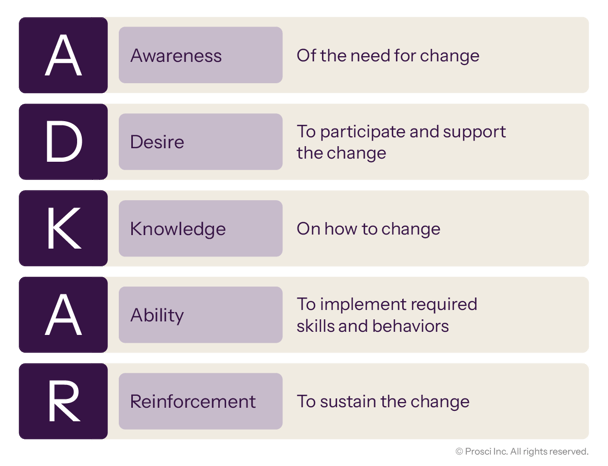
To manage change effectively, organizations need a way to understand how individuals experience it. Prosci’s ADKAR Model describes the five building blocks individuals must achieve for successful change:
- Awareness of the need for change
- Desire to support and participate in the change
- Knowledge of how to change
- Ability to apply new skills and behaviors
- Reinforcement to sustain the change over time
In a change management PMO, ADKAR serves as a diagnostic lens helping leaders and project teams understand where and why people aren’t adapting and adopting. For example, resistance may stem from a lack of awareness regarding a new process rather than a lack of skill, or adoption may stall as employees drift back to old habits once training ends and no reinforcement follows. ADKAR insights allow a change management PMO to guide targeted interventions and better support sponsors and managers amidst the change process.
The Prosci ADKAR Model
The Role of the PMO in Change Management
Traditionally, a PMO establishes frameworks, standards, and governance to bring order to complex portfolios of work. In a change-heavy environment, the PMO’s role expands from governing projects to enabling successful change. This includes:
Identifying Change-Related Risks Early
One of the PMO’s most valuable contributions to change management is risk visibility. While project risks often focus on scope, schedule, or technical dependencies, change-related risks are rooted in people. Common risks that negate change include:
- Low awareness or understanding of the change
- Weak sponsorship or inconsistent leadership messaging
- Change saturation across teams
- Insufficient capability or capacity to adopt new ways of working
A change management PMO incorporates these risks into standard assessment and review processes, so they can be identified and addressed before they become long-term issues.
Stakeholder and Communication Management
A change management PMO helps reduce the noise and confusion that often accompany multiple, overlapping changes. It establishes feedback loops that surface questions, concerns, and resistance early, so leaders have the opportunity to respond before issues harden.
Just as importantly, the change PMO reinforces consistent messaging about both what is changing and why it matters, so people can connect their daily work to the broader intent of the change. It’s the PMO’s job to support ongoing dialogue that keeps leaders, managers, and impacted employees aligned throughout the change journey.
Upskilling Internal Teams for Change
Sustainable change does not depend on a small group of specialists. It depends on leaders, managers, and project teams who understand their role in driving adoption. The change management PMO supports this by embedding change capability into project roles, providing training and tools for sponsors and people managers, amd reinforcing consistent expectations across initiatives.
Tracking KPIs and Adoption Metrics
A change management PMO looks beyond delivery milestones to incorporate metrics that reflect:
- Employee adoption and usage trends
- Stakeholder engagement and sentiment
- Progress through key change milestones
These insights are not used to police teams, but to guide leadership so they know where to reinforce, where to intervene, and where change is at risk.
Resource Allocation and Support
In change-heavy environments, teams are often expected to absorb new systems, processes, and behaviors on top of their existing workloads. Without intentional coordination, even well-designed changes can fail simply because people do not have the time, energy, or support required to adopt them. A change-focused PMO helps leaders account for a change’s impact when sequencing initiatives, not just technical dependencies or funding availability.
Integrating Change Management into PMO Processes
For organizations with an established PMO, integrating change management does not require starting from scratch. Most PMOs already oversee activities that directly influence whether change succeeds – portfolio reviews, governance checkpoints, risk assessments, and status reporting – even if those activities are not explicitly labeled as “change management.”
The opportunity is more about expanding the lens through which existing processes are used. Instead of focusing solely on delivery feasibility and progress, a change-enabled PMO begins to ask how people will experience, adopt, and sustain what is being delivered. Readiness, sponsorship, and adoption risk become part of the same conversations as scope, schedule, and cost.
This shift requires two things: a clear lifecycle framework that keeps change visible from initiation through sustainment, and a set of integration principles that ensure project management and change management are working together, not in isolation.
Using the Prosci 3-Phase Process as a Unifying Framework
The Prosci 3-Phase Process gives PMOs a practical way to align governance and delivery activities with how people move through change over time. Rather than treating change management as a one-time effort or a late-stage add-on, the process ensures that adoption considerations are addressed early, managed intentionally, and reinforced after go-live.
The Prosci 3-Phase Process

In Phase 1 – Prepare Approach, the PMO helps set initiatives up for success by expanding early-stage governance to include readiness and adoption risk. This means assessing change characteristics and organizational readiness alongside technical feasibility, clarifying sponsorship and leadership roles early, and aligning project objectives with the outcomes the change is meant to achieve.
As initiatives move into execution in Phase 2 – Manage Change, the PMO reinforces consistency across projects by keeping integrated project and change plans aligned. Existing reporting and review mechanisms are used to track delivery progress and to monitor stakeholder engagement, communication effectiveness, and emerging adoption risks. This allows people-related issues to surface alongside schedule and budget data, rather than after problems have already taken hold.
In Phase 3 – Sustain Outcomes, the PMO helps address a problem many organizations know well: once a solution goes live, attention shifts elsewhere. A change-enabled PMO treats this moment differently. It plans for reinforcement, continues to review adoption after implementation, and pays attention to whether new ways of working are actually sticking. What’s learned during this phase is then carried forward to future initiatives, helping the organization improve how it manages change over time.
The Five Dimensions of Integration
While the 3-Phase Process provides a lifecycle view, Prosci’s research shows that integrating change management and project management requires alignment across five dimensions.
The first dimension is people. This dimension focuses on who executes project management and change management work and how those roles are structured and governed. Organizations may embed a dedicated change practitioner on a team alongside a project manager, rely on a centralized change function that supports multiple initiatives, combine internal and external resources, or, in some cases, assign both responsibilities to the same individuals. A change PMO brings consistency to these models by clarifying roles, relationships, and accountability across initiatives, regardless of how teams are structured.
The second dimension is process. This area addresses how the phases, activities, and milestones of project management and change management come together across the project lifecycle. Integration at the process level enables better information exchange, more intentional sequencing of work, and alignment around milestone timing and desired outcomes. A change-focused PMO reinforces this alignment by ensuring change management activities begin early – ideally at project initiation – so readiness and adoption considerations shape delivery decisions from the start.
The third dimension is tools. Project management and change management frequently use similar tools and deliverables, such as communication plans, risk assessments, training plans, and schedules. When these tools are developed separately, teams often duplicate effort or miss critical insights. A change management PMO helps integrate shared tools so they reflect both technical execution needs and people-related risks, promoting collaboration and a common understanding of progress.
The fourth dimension is methodologies. While integrating people, process, and tools happens primarily at the project level, methodology integration occurs at the organizational level. This dimension focuses on creating a standard approach to project delivery by intentionally combining project management and change management methodologies. The change management PMO supports this effort by reinforcing a single change management methodology, which gives leaders, project teams, and front-line employees a common language during periods of change.
The fifth dimension is results and outcomes. This dimension brings integration into focus by establishing a shared definition of success. Project management and change management are complementary disciplines that contribute to improved organizational performance. Under a change management PMO, success is defined not only by delivery milestones but by adoption, usage, and sustained performance.
Integrating Change Management into the Project Management Office
For organizations establishing a new PMO, there is a great opportunity to design change capability from the outset. Here’s how organizations can set up a change management project management office as an operating model:
Step 1: Assess Organizational Readiness
Start by evaluating how much change the organization can realistically absorb. This means looking ahead at the volume and impact of upcoming initiatives, understanding cultural and operational capacity, and learning from past change efforts that struggled or succeeded.
Step 2: Define the PMO’s Structure and Roles
Next, clarify how change management will be owned and executed within the PMO. This includes defining where change responsibilities sit, how sponsors and people managers are expected to contribute, and who has decision rights related to readiness, prioritization, and sustainment.
Step 3: Develop a Change Management Strategy
With roles established, define how the organization will approach change at a portfolio level. This strategy sets consistent expectations for sponsorship, communication, and enablement across initiatives while providing a shared lens for evaluating adoption risk.
Step 4: Implement Change Management Processes
Then, embed change management into how work actually gets done. This means integrating readiness and adoption considerations into governance checkpoints, aligning stakeholder engagement and communication practices, and using shared planning and reporting mechanisms to surface people-side risks.
Step 5: Train and Equip Teams
A change management PMO succeeds by building capability, not dependency. Equip sponsors to lead visibly, managers to support their teams through transition, and project teams to anticipate and address adoption challenges.
Step 6: Monitor and Adjust
Finally, treat change as a dynamic process. Continuously track adoption, engagement, and emerging resistance, and adjust strategies as conditions evolve. Monitoring progress and responding in real time helps sustain momentum and ensures changes translate into lasting outcomes rather than short-term compliance.

Measuring the Impact of Change Management in PMOs
To understand whether change management efforts are working, a PMO has to track a focused set of metrics that show how well change is being adopted and sustained:
- Employee adoption rates: Measures the percentage of impacted employees who have adopted the new processes, tools, or ways of working. Adoption rates are a primary indicator of whether change efforts are translating into real behavior change.
- Usage metrics: Tracks how frequently and effectively new systems or processes are being used. These metrics help distinguish between surface-level compliance and meaningful adoption, and often reveal where additional training or support is needed.
- End-user satisfaction and engagement: Gathers feedback on how employees are experiencing the change. Surveys and qualitative input help surface friction points, sentiment, and areas where communication or enablement needs to be adjusted.
- ADKAR-based progress indicators: Uses the ADKAR Model to assess where individuals are progressing or getting stuck so targeted interventions can help them overcome their resistance.
- Project success metrics: Includes traditional delivery measures such as schedule, budget, and scope performance. When viewed alongside adoption data, these metrics help leaders understand how effectively change management is contributing to overall project outcomes.
Together, these measures create a continuous feedback loop that allows the PMO to monitor progress, identify risks early, and refine its approach.
Frequently Asked Questions
Why is it important to integrate Change Management into a PMO?
Integrating change management into a PMO increases the likelihood that projects deliver real, lasting value. While project management focuses on delivering solutions, change management ensures those solutions are adopted, used correctly, and sustained. When change is integrated into the PMO, organizations align project goals with business outcomes, address resistance earlier, and provide leaders with better visibility into adoption risks across the portfolio.
What are the key components of a Change Management PMO?
A change management PMO is defined by capability, not structure alone. Core components include a shared change framework (such as the Prosci 3-Phase Process) to create consistency, clearly defined roles and responsibilities for leading and supporting change, intentional approaches to sponsorship and communication, and processes for monitoring adoption and outcomes.
How can organizations assess their readiness for a Change Management PMO?
Organizations assess readiness by conducting a Change Characteristics Assessment and an Organizational Attributes Assessment. These evaluations examine the scope and impact of upcoming changes alongside the organization’s culture, capacity for change, and track record with adoption. Together, they help leaders identify where additional structure, sponsorship, or change capability is needed before establishing a change management PMO.
What best practices should be followed when building a Change Management PMO?
Best practices begin with clearly defining the PMO’s structure and roles so that responsibility for driving change is clear and consistent. A well-defined change management strategy then provides direction for how initiatives are approached, aligned, and prioritized across the portfolio. Just as importantly, organizations invest in training and resources that equip leaders, managers, and teams to successfully adopt new changes. Ongoing communication keeps stakeholders informed and engaged, while regular monitoring and feedback help the PMO adapt its approach based on what is actually happening on the ground.
The Change-Enabled PMO
A change management PMO does not replace traditional project discipline. It builds on it. By intentionally integrating the people side of change into how work is prioritized, governed, and measured, organizations gain clearer visibility into adoption risks, stronger alignment between delivery and outcomes, and greater confidence that change will take root.
Most importantly, a change-enabled PMO treats change management as an organizational capability, not a one-time activity tied to individual projects. In a world where transformation is constant, the most effective PMOs help organizations turn strategy into action, and action into lasting results.