
5 Mins
Updated: May 26, 2026
Published: May 13, 2026



On paper, your organization did everything right. Senior leaders bought into deploying new artificial intelligence (AI) technologies, your organization invested in AI, and your teams deployed the tools. Yet, the final and most critical element—employee adoption—is falling flat, and you’re at risk of failing to achieve your AI adoption goals (assuming they exist) and deliver successful outcomes. Most AI rollouts are managed as technology projects, which is why, on paper, it looks like you did everything right. But AI only delivers value when people actually use it confidently and competently in their daily work. Driving AI adoption outcomes requires prioritizing the people side of change. That’s where Prosci’s ADKAR® Model makes all the difference.
Prosci’s ADKAR Model helps you understand why employees aren’t adopting AI and what to do about it, so you can drive the technology projects you’re responsible for to successful outcomes.
The AI adoption gap is a people problem
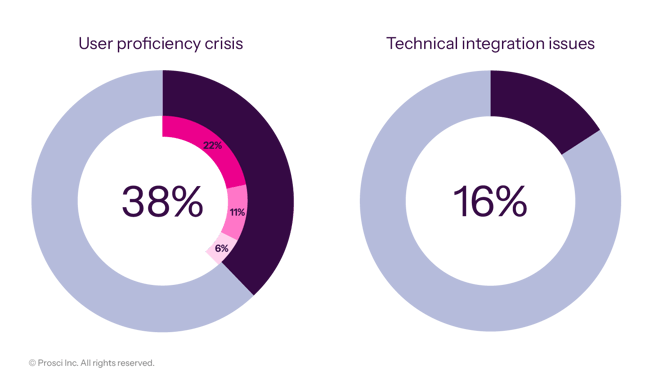
Despite AI seeming similar to traditional technology rollouts, most AI challenges aren’t technical. Recent Prosci research studying 1,107 professionals across frontline employees, team leaders, and executives reveals 63% of AI implementation challenges stem from human factors, not technical limitations. While organizations pour resources into platforms, data infrastructure, and advanced algorithms, they're missing the real barriers that determine success or failure.
User proficiency emerged as the primary challenge in our research, accounting for 38% of all reported AI implementation difficulties. This breaks down into learning curve challenges (22%), prompt engineering struggles (11%), and inadequate training (6%). Technical implementation issues account for only 16%. This represents a fundamental shift from traditional technology rollouts, where technology-specific challenges often dominate.
The technology works. The real challenge is that employees aren't using it, or aren't using it well.
Why is AI change different?
AI implementations are not like other technology rollouts, and treating them the same way is where many leaders get stuck and see adoption flatline. Previous technology implementations required employees to align their work with a system. They had to incorporate a new system into their workflows or replace an existing one.
AI inverts the relationship between people and technology entirely. It requires individuals to determine where AI fits into their daily work. That’s a fundamentally different ask that requires flexibility and agility, ethical considerations, individualized learning, and a willingness to sit with uncertainty. Organizations can’t resolve these challenges through standard training or deployment playbooks.
AI also significantly impacts everything simultaneously — roles, responsibilities, and workplace dynamics. The change impacts far exceed those of previous technology projects because AI rollouts require a fundamental redesign of work. AI changes how people spend their time, what skills they need, and how they create value. If you’re responsible for AI adoption, your challenge isn’t the technology; it’s equipping the people.
Prosci’s ADKAR Model for AI rollouts
Supporting employees through AI adoption looks like guiding individuals through the change and addressing roadblocks and barriers along the way. The Prosci ADKAR Model is a research-backed, proven approach for driving employee engagement throughout the change process.
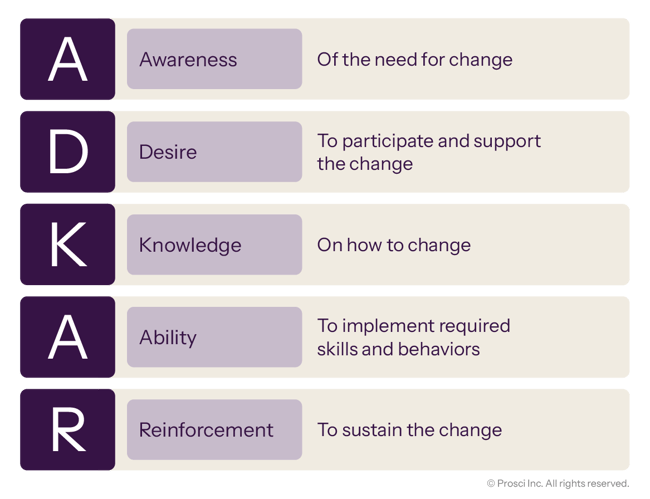
As one of the two foundational models of the Prosci Methodology, ADKAR outlines the five key outcomes individuals must achieve for successful change: Awareness, Desire, Knowledge, Ability and Reinforcement. By leveraging ADKAR, organizations address what needs to be true for each person to change. Each element is a potential barrier point. When AI adoption stalls, it's usually because one of these elements is missing.
The Prosci ADKAR Model
Why leaders driving AI initiatives need the ADKAR Model
Here’s how the ADKAR Model helps leaders uncover the people challenges during AI rollouts:
Employees who don’t understand why AI matters to their role won’t engage
People in your organization impacted by the new technology may be hesitant to embrace new AI systems.
A lack of understanding of the reasons behind the decision is the number one reason for employee resistance to change, followed by a hesitancy to embrace change within their role and fear of job displacement. 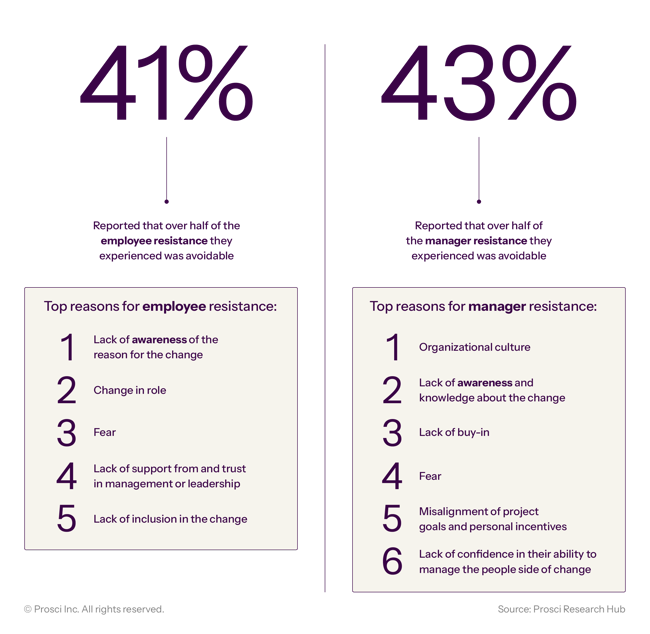
Generic messaging about organizational AI strategy does not translate into individual motivation to change behavior. If you’re leading an AI initiative, you need to ensure Awareness is differentiated and communicated by function, team, and workflow. Set up meetings and workshops to directly communicate why the organization is integrating AI and how it benefits each individual in their work.
Leaders need to address the fear of job displacement head-on
Of all five ADKAR elements, Desire is the one that leaders most frequently assume will resolve itself upon communicating, providing training, and modeling enthusiasm from the top. But this assumption is dangerous because Desire is a personal decision that often requires leaders to address underlying fears and resistance head-on.
Our study, Keys to Unlocking AI Adoption, found that 29% of employees worry about job displacement or role ambiguity during AI implementations. Leaders who address Desire effectively do two things. First, they name the fear rather than ignore it by acknowledging that AI will change roles, while being specific and honest about how. Second, they position employees as active participants in shaping how their organization uses AI rather than passive recipients of a deployed tool. The distinction between "here is what AI will do to your work" and "here is how we will figure out together what AI does for your work" is the difference between suppressed Desire and engagement that drives adoption.
Training alone doesn't build adoption; practice, coaching and time do
Many people in your organization will experience an AI learning curve—even if they’re relatively tech-savvy.
According to Prosci research, 38% of employees say that difficulties with training and adapting to new technologies, such as AI, presented a major challenge. If that challenge goes unaddressed, AI integration issues often slow processes down rather than speed them up.
The conflation of Knowledge and Ability is one of the most persistent and costly errors in technology rollouts, including AI implementations. Knowing how a tool works and being able to use it effectively under real work conditions are different things.
Many leaders believe they achieve the Ability milestone by conducting general AI training sessions. But Ability, particularly for AI, where the tools evolve quickly, and the quality of outputs depends heavily on how well a user can prompt, evaluate, and iterate, requires repeated practice, access to coaching during the transition period, and time to develop fluency in using AI for your role. For example, a Marketing Manager may use AI tools completely differently than a Financial Analyst, and their journeys to Ability will look quite different.
Tailored AI training is critical for building Knowledge, while hands-on workshops and pilot programs that help people build confidence in their skills develop Ability. Leaders need to incorporate both into their rollout plans for successful AI transformations.
How McCarthy used the ADKAR Model for AI adoption
McCarthy Holdings, Inc., set out to implement an AI-powered work platform across its organization to maintain its competitive edge, with an ambitious timeline, and beat it by two months. By applying a structured, people-first approach to the initiative, they achieved 90% AI adoption enterprise-wide in just 30 days.
That outcome was possible because Prosci worked with McCarthy to identify where individual employees encountered barriers across Awareness, Desire, Knowledge, Ability, and Reinforcement, to address them deliberately. Leaders declared it one of the most successful tech rollouts they've ever had, with 87% of surveyed employees reporting a positive response to the new platform in the first six months, reflecting strong employee confidence and enthusiasm for AI adoption.
10 organizational conditions that make AI adoption possible
The conditions that separate successful AI adoptions from struggling ones are more predictable than most leaders realize. Prosci research identified 10 workplace conditions that differentiate successful AI implementations, organized around four pillars: Leadership and Bold AI Vision, Change Management Excellence, Transparency and Trust, and Organizational Capabilities.
These map to specific, assessable workplace conditions that leaders can evaluate in their own organizations right now. For leaders accountable for AI outcomes, knowing where the gaps are is the prerequisite for closing them.
Drive AI adoption with ADKAR
The organizations that will look back on this period as a turning point are not the ones that deployed AI fastest. They are the ones whose leaders understood that the technology was never the hard part and acted accordingly. AI is only valuable if people use it well for their specific job roles and responsibilities, and right now, those people are waiting for you to lead them.