8 Mins
Published: April 20, 2026



Enterprise Resource Planning (ERP) systems are the backbone of large organizations. They orchestrate complex processes across critical departments, from finance to supply chain management. As organizations invest heavily in these platforms to compete in a dynamic market, measuring whether people actually adopt and use them as intended is critical to gauging success, justifying costs, and supporting long-term business growth.
In this guide, we explain ERP adoption rates, the challenges of ERP adoption, and why change management is the secret ingredient for realizing the full value of your investment and achieving business outcomes.

What is ERP Adoption Rate?
ERP adoption rate measures the extent to which employees consistently and correctly use the ERP system to perform their daily work. It goes beyond simple login metrics or training completion rates and helps organizations understand whether users are following standardized processes, entering accurate data, and relying on the system to execute and inform decisions. At its core, ERP adoption reflects behavioral change, highlighting whether individuals shifted from legacy habits to new, system-driven ways of working that enable scalable growth and sustainable success.
Current ERP Adoption Rate Statistics & Measurement Methods
What do ERP adoption rates look like in today’s landscape? Here’s what ERP market statistics have to say:
Factors influencing ERP adoption rate statistics
Adoption rate statistics are influenced by how adoption is defined, measured, and reported across different ERP projects. The scope of the rollout (enterprise-wide vs. phased), industry complexity, regulatory demand, organizational size, and change maturity also affect reported rates. Additionally, the ERP landscape includes industry-specific solutions, which impact the variation in rates across industries.
Global ERP adoption rate predictions
Gartner research predicts low global ERP adoption rates and widespread failure among ERP initiatives. According to Gartner, by 2027, more than 70% of recently implemented ERP initiatives will fail to fully meet their original business case goals, signaling low project success rates and raising questions about whether ERP costs are delivering value. This would put global ERP adoption rates relatively low, but it doesn’t have to be this way.
Common ERP adoption rate measures and definitions
In Prosci’s ERP research, user adoption metrics are the most frequently tracked success indicator in ERP implementations. Some examples of adoption targets and measurement approaches organizations work toward include the following:
- Targeting ≥90% user engagement within 30 days post-go-live
- Targeting 95%+ active users within 30 days post-go-live
- Measuring 90% adoption within 3 months, using user logins and activity
- Tracking adoption by module/functionality (useful when different functions/industries use different modules differently)
Measures for ERP adoption rate
Within overall ERP adoption, measures that support these rates include:
- Active user rates – The percentage of users who regularly access and perform work in the ERP system within a defined period.
- Login frequency or patterns – The rate and consistency with which users log into the ERP system.
- Adoption velocity – The speed at which users transition from the legacy system or processes to the new ERP system and use its functionality consistently and effectively.
- Training completion rates – The percentage of users who complete required ERP training programs during different stages of the implementation.
- User proficiency levels – A measure of how effectively users perform critical role-specific tasks within the ERP system without assistance or errors.
- Engagement depth by module – The extent to which users actively utilize each ERP module and its features beyond minimal functionality.
- System usage patterns – Behavioral trends marking how, when, and what users access the ERP system for during daily operations.
Ultimately, to capture the ERP adoption rate within your organization, you need to understand how many of the total individuals are using the new ERP as intended, using a combination of metrics.

Challenges with ERP Adoption Rates
ERP adoption often faces several challenges, primarily stemming from organizational and human factors rather than the technology itself. Understanding the following common challenges allows leaders to proactively address adoption risks before an ERP implementation project fails.
Organizational size and complexity
Large, expanded organizations face inherent complexity during ERP implementations. Diverse business units, regional variations, and legacy process differences complicate standardization. The more complexity and silos there are throughout the enterprise, the more coordination and alignment are required to drive consistent adoption across the organization and improve the likelihood of project success.
Resistance to change
One significant challenge in ERP adoption is resistance to change, which can occur at all organizational levels. Resistance at leadership levels significantly affects implementation success. ERP implementations disrupt established habits and long-standing legacy ways of working. When employees feel uncertain about ERP changes, resistance naturally increases.
High implementation costs
ERP systems require significant financial costs and resources, which increase pressure to move quickly and show a return on investment. Most organizations spend an average of 92% of their ERP implementation budget on technical activities and 8% on change management (Best Practices in Change Management, 12th Edition). When budgets don’t account for, or allocate enough to, change management and the people side of change, organizations inadvertently increase the risk of low adoption and under-realized value.
Long deployment timelines
Extended implementation timelines can lead to fatigue and disengagement. As ERP projects stretch over years, it’s not uncommon for stakeholders to lose focus or shift priorities. Sustaining momentum and reinforcing the purpose and significance of the ERP is critical for maintaining adoption energy.
User resistance and low adoption internally
The work doesn’t stop at go-live. Even after the go-live milestone, users may revert to legacy systems and processes, especially when they encounter ERP challenges that require process refinement or a different configuration. Low internal adoption can signal weak reinforcement, misalignment between the ERP and how work actually happens, insufficient training, or insufficient opportunities to provide feedback.
Data migration complexity
Poor data quality or inconsistent data governance creates frustration early in the ERP lifecycle. If users encounter inaccurate or incomplete information, trust in the system declines quickly. Rebuilding confidence after initial data issues can be difficult and time-consuming.
Security and compliance concerns (especially for cloud ERP)
Cloud ERP solutions introduce additional considerations around data security, privacy, and regulatory compliance. When organizations don’t address these concerns, stakeholders may hesitate to adopt the system. Transparent governance and stakeholder involvement throughout the implementation process are necessary to build system confidence.
The Role of Change Management in ERP Adoption Rate
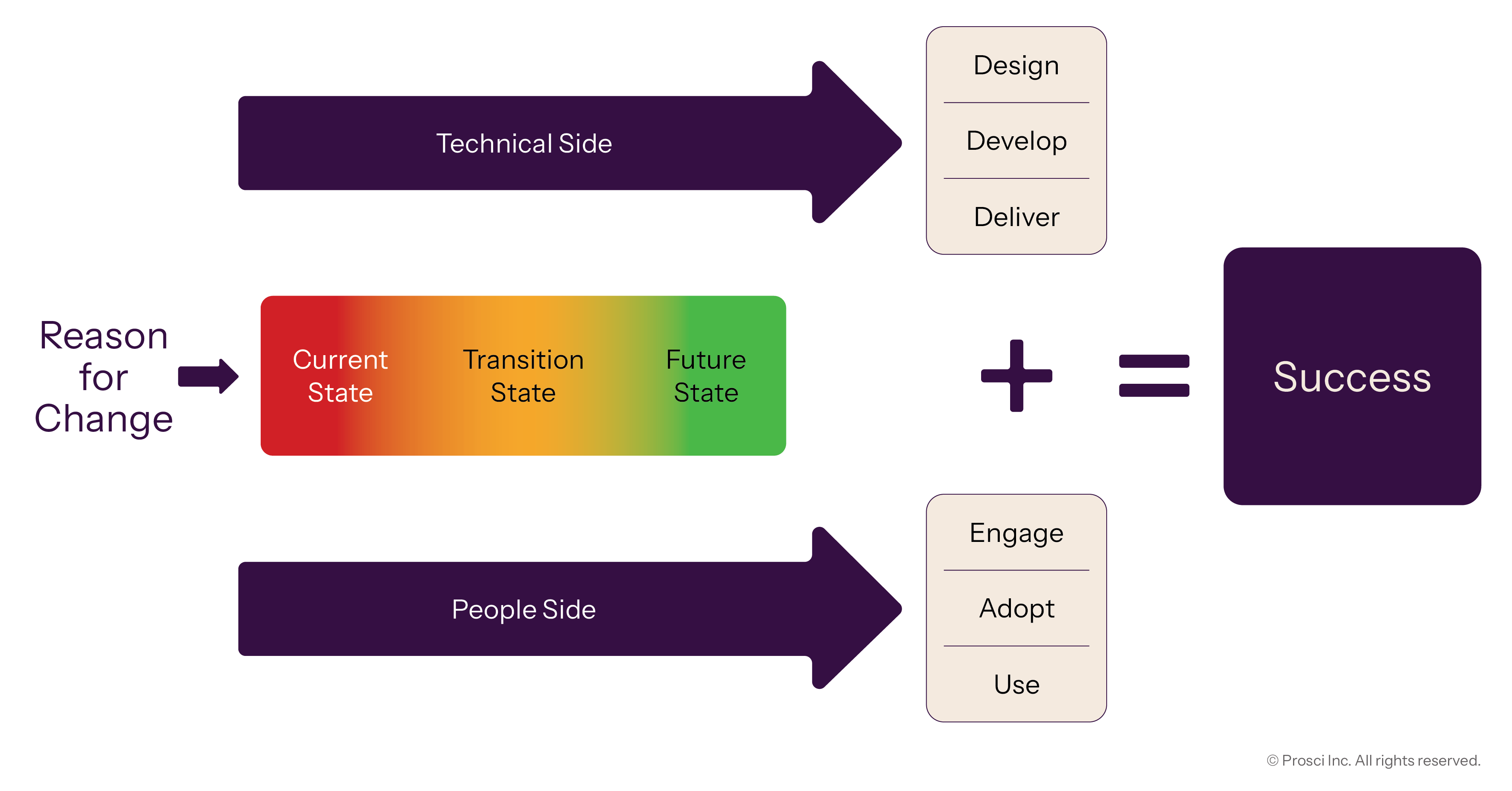
Prosci research shows that human factors matter 6 times more than technical factors in improving ERP benefits. The success of an ERP implementation project hinges on the people side of change. It’s a human transformation challenge that requires effective change management.
ERP change management is a structured approach that empowers employees to embrace process changes and new systems more quickly and efficiently. While project teams focus on the technical aspects of configuring and implementing the new system, change management prepares, equips, and supports employees to transition to new behaviors. The result is that individuals, teams, and organizations move from the current state to your desired future state and then use the updated ERP systems in their daily work.
Prosci Unified Value Proposition
How does ADKAR® apply to ERP adoption rate?
The Prosci ADKAR® Model is one of the two foundational models of the Prosci Methodology, and a trusted model for helping employees navigate the ERP implementation process at an individual level. The word “ADKAR” is an acronym for the five outcomes an individual needs to achieve for a change to be successful: Awareness, Desire, Knowledge, Ability and Reinforcement.
Prosci ADKAR Model
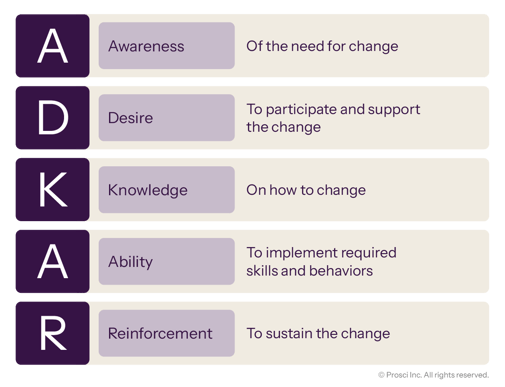 ADKAR is based on the understanding that organizational change can only happen when individuals change. The ADKAR Model drives ERP adoption at the individual level to achieve the organizational result of a successful ERP adoption.
How Businesses Can Improve ERP Adoption Rates
Improving ERP adoption rates requires intentional planning and effort throughout the ERP implementation lifecycle across strategy, leadership, and user enablement, including:
- Clear business case and goals – Clear goals align stakeholders and provide a reference point to reinforce adoption expectations. Without clarity, implementation teams may optimize for technical completion at go-live, neglecting the work needed to drive transformational outcomes.
- Stakeholder alignment – Participants in Prosci’s 2025 Unlocking ERP Implementations study emphasize the importance of engaging stakeholders early and defining clear success metrics from the outset of the project to improve success.
- Comprehensive deployment strategies – A structured rollout plan should integrate technical configuration alongside the people side of change. Coordinated deployment minimizes disruption and supports smoother user transitions.
- Phased implementation – Phasing rollout by function, geography, or ERP module can help organizations manage complexity while reducing overwhelm and risk. Incremental releases allow organizations to learn, adjust, and strengthen capabilities before expanding.
- User-centric training programs – In Prosci’s 2025 Unlocking ERP Implementations study, training led all recommendations for improving value realization in the People & Change Management category. Comprehensive, tailored training programs for all users before go-live, and post-go-live continuous learning opportunities, create long-term skill capabilities within organizations.
- Change management strategy – Participants in Prosci’s analysis also recommended following a structured change management approach to realize ERP value, as ad hoc efforts create chaos. Prioritizing the people side of change is non-negotiable for successful ERP implementation.
- Ongoing optimization post-go-live – Organizations that treat go-live as the finish line misunderstand when ERP value materializes. Deployment enables capability, but process refinements, user feedback, and data-driven insights bring business value to light in the post-implementation environment.
ERP Adoption Trends Shaping the Future
ERP adoption is evolving alongside broader technology and workforce trends. Organizations should adapt their implementation and change strategies to keep pace. The following trends are shaping how ERP systems are deployed, adopted, and optimized:
- Cloud-first and SaaS-only ERP strategies – Organizations are increasingly prioritizing cloud-based ERP platforms to improve scalability, flexibility, and cost predictability. SaaS models shift enterprises away from the infrastructure load, allowing them to focus on adoption, governance, and continuous optimization.
- User-centric design – Modern ERP platforms are investing heavily in intuitive interfaces and simplified workflows. When system design matches how people actually do their jobs, it's easier to learn how to use them, and more people are likely to use them.
- Digital transformation – More organizations are implementing ERP systems as backbones of broader digital transformation initiatives. This means successful adoption depends on aligning ERP strategy with other automation and cross-platform integration efforts.
- Artificial intelligence (AI) and automation within ERP systems – Advanced technologies and AI are enhancing forecasting, reporting, and decision-making capabilities. While these tools increase value potential, they also require user trust, data discipline, and change readiness to fully realize benefits.
- Low-code/no-code ERP customization – Low-code and no-code capabilities enable business users to configure workflows and reports with less reliance on IT. While this increases agility, it also requires governance and training to ensure consistency and prevent uncontrolled complexity.
Drive ERP Adoption Rates with Prosci
Your organization’s ERP adoption rates are highly dependent on your ability to successfully navigate change. ERP transformation promises faster workflows, better data, and smarter decisions. But those outcomes depend on people—not just systems.
Change management turns that promise into adoption. That’s the power of change done right.
FAQs
What is a good ERP adoption rate?
There’s no universal benchmark for a good ERP adoption rate, as it depends on several variables within each organization. However, generally speaking, a good ERP adoption rate will reflect consistent, enterprise-wide use of the system for core business processes. Organizations can aim for nearly universal usage within impacted roles, with minimal reliance on legacy systems or shadow tools.
How can we improve ERP adoption rates after implementation?
ERP adoption doesn’t end at go-live. After implementation, organizations can increase ERP adoption rates by offering opportunities for employees to provide feedback, providing ongoing training, and reinforcing new ways of working. When organizations follow a change management approach during implementation, they can account for these critical activities to improve ERP adoption rates after implementation.
Which industries have the highest ERP adoption rates?
Industries with high operational complexity or regulatory oversight, such as manufacturing and healthcare, often demonstrate stronger ERP adoption. They rely heavily on standardized processes, compliance reporting, and integrated data visibility, making ERP adoption nearly non-negotiable. However, adoption strength is typically driven less by industry and more by leadership engagement and effective change management practices from the start.
What factors affect ERP adoption rates the most?
According to Prosci’s 2025 Unlocking ERP Implementations study, human factors matter 6 times more than technical factors in improving ERP benefits. Organizations that want to achieve high ERP adoption rates must prioritize people and change management factors, including training, stakeholder engagement, and adherence to a change management approach, such as the Prosci Methodology.
How does change management impact ERP adoption rates?
Change management directly influences ERP adoption by preparing individuals to shift their behaviors and embrace new ways of working. Without change management, even well-planned ERP implementations can become nothing more than technical implementations with low adoption. Structured communication, resistance management, sponsorship engagement, and reinforcement planning increase confidence and accountability, leading to stronger and more sustained system use.
What change management activities improve ERP adoption rates the most?
Based on Prosci’s research, comprehensive, tailored training programs, stakeholder engagement, and transparent communication plans are crucial change management activities for improving ERP adoption rates. Following a change management approach ensures teams cover these activities effectively.
What is the difference between ERP adoption rate and ERP success rate?
ERP adoption rate measures how consistently and effectively employees use the system in their daily work. ERP success rate is a broader measure that includes whether the implementation met budget, timeline, and strategic objectives.