5 Mins
Published: April 29, 2026



How much of your enterprise resource planning (ERP) investment budget are you allocating to the new system and other technical components of the change? Most organizations allocate 92% of ERP budget to technical activities and 8% to change management (Best Practices in Change Management, 12th Edition).
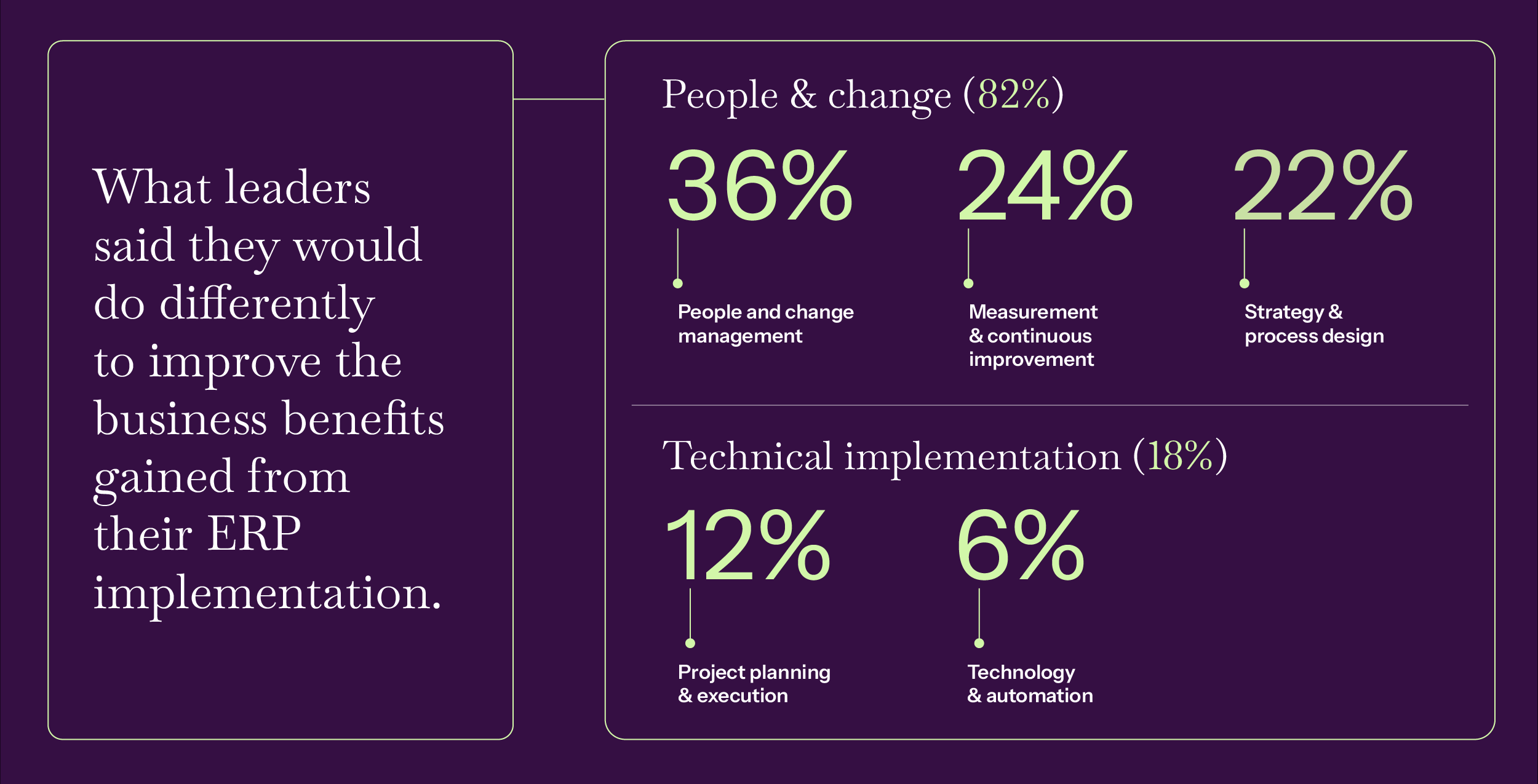
Yet when we asked 1,618 ERP professionals what they would do differently, 36% pointed to People and Change Management factors, a 6:1 ratio of human-to-technical recommendations. This misalignment between resource allocation and actual success drivers represents a strategic gap executives must address. ERP investment decisions need to shift toward people to achieve business outcomes, rather than just technology deployment.
What leaders said they would do differently to improve the business benefits gained from their ERP implementation
The ERP investment gap
Given Prosci’s research showing a 6:1 ratio of human-to-technical recommendations, it stands to reason there’s an investment gap. What’s causing the majority of ERP budgets to go to the technical aspects when people investments are imperative for success?
Real-world reasons for the disconnect in ERP budget investments
From my experience, ERP investment misalignment persists for several reasons. First, many organizations try to account for the technical aspects of the investment upfront during the initial technical requirements assessment. But it’s not uncommon for additional technical needs to emerge throughout the process as teams work to simplify processes and decommission tools.
Many executives want to implement a harmonized system while reducing the number of applications they use. On the surface, this looks like a technical project requiring the majority of the investment. But Prosci research suggests that ERP implementations are human challenges, not technical ones.
Beyond this, there’s often an underlying bias that a new ERP system is a technical replacement, which may not signal the need to invest in the people side of change. A lack of awareness of the need for effective change management contributes to disproportionate funding allocation. When organizations operate with a top-down approach to financial decisions, they often allocate investments to concrete aspects they can see, including the technology itself. Investing in people development can seem more intangible without a clear understanding of ERP change management and its contribution to value realization.

The cost of the wrong ERP sponsor
Prosci research demonstrates that sponsors are so critical to change efforts that they can make or break a project or initiative, and the stakes are even higher during ERP implementations, given the significant resource requirements. Choosing the wrong ERP sponsor is costly.
Years ago, during an SAP telecom deployment, we discovered a resistant sponsor six months into the ERP implementation. During ERP meetings, the sponsor was not proactive, did not ask questions, and was not outwardly supportive of the program director. After the team expressed concerns about a lack of active, visible sponsorship, we conducted assessments to determine whether the sponsor was the right fit. Based on our assessments, we concluded that if this sponsor remained in their position, the ERP implementation would likely fail as an enterprise change initiative.
In partnership with the program director, who played a significant role in advocating for an effective sponsor, we shifted sponsorship to the organization’s chief financial officer (CFO). The CFO was active and visible, engaged peers and the sponsor coalition, and effectively communicated with employees and managers, fulfilling Prosci’s ABCs of Sponsorship:
- Active and visible participation throughout the project, from championing the change and allocating the necessary funding to participating in change activities and supporting the team
- Build a coalition of sponsors by mobilizing other key business leaders and stakeholders so that they can advocate for the change
- Communicate, support and promote the change to impacted groups as the preferred senders of messages about the business reasons for change
Shifting to the CFO fundamentally changed the program’s trajectory over four years. The CFO was an effective sponsor who also advocated for the program director, the ERP transformation, and the need for internal change management practices. A two-person change management office (CMO) expanded to eight under the sponsor’s support and willingness to prioritize the people side of change internally.
Why resistance is an executive problem
Prosci’s 2025 Unlocking ERP Implementations study also revealed that resistance happens at every level and increases as deployment progresses. Despite the common misconception that end users are the ones resisting and slowing ERP adoption, executives and team leaders are also resistant to change, and their resistance has a disproportionate impact on outcomes.
While resistance is a normal reaction to change, resistance at the leadership level has an outsized impact on ERP adoption and value realization. Such was the case in the SAP deployment where an engaged sponsor replaced a resistant one, leading to the program’s success.
Employees look to leaders to understand whether a change is credible and high priority. Even subtle executive resistance amplifies throughout the organization. When leaders are openly hesitant, disengaged, or misaligned, teams follow suit.
Resistance is an executive problem, not only because executives themselves may be resisting the ERP, but also because they reinforce or reduce resistance across the organization. When executives recognize that resistance is their problem to understand and address, they can lead ERP implementations as true business transformations.

From communication to co-creation
In addition to monetary investments and effective sponsorship, another powerful driver of ERP success is engaging stakeholders early through meaningful involvement rather than just telling them. The outcomes for stakeholders who communicate versus those who co-create are consequential.
How one-sided communication leads to slowed ERP adoption
In one change program I supported, the change and project teams created the story for change. They received validation from the sponsor and passed the story for change along to the sponsor coalition without their validation. Since the sponsor coalition was uninvolved in creating the program’s messaging, they didn’t feel a sense of ownership. Without ownership, their lack of early engagement slowed ERP adoption among impacted teams in their respective organizations.
Communicating with key stakeholders without their input and involvement created a story for change that not everyone felt a part of. Successful ERP transformation hinges on people seeing themselves in and being a part of the story for change.
How co-creation fosters ownership and ERP adoption
By contrast, early in the SAP telecom deployment previously mentioned, we invited key stakeholders to co-create a clear story for change for the ERP program. There are many ways to conduct this type of exercise, including interviewing sponsors and the sponsor coalition directly or by organizing larger group workshops, depending on availability. When co-creating the story for change, it’s ideal to involve the sponsor, project manager, and change manager, at a minimum, to facilitate alignment.
During this exercise, we develop the story for change by answering questions like:
- Why are we changing?
- What are the key benefits?
- What solution do we want to implement, and how will it help?
- What’s the vision, and where do we want to go?
- What pain points are we solving for?
Ideally, you can involve part of the sponsor coalition, key change influencers, and the program team to create broader ownership of the story for change. The more stakeholders you can involve, the more ownership and belief in the story you can create. Most importantly, all key stakeholders need to validate the story for change to ensure the co-created narrative is the right one.
Co-creation fosters ownership and commitment and is a good way to cascade consistent messaging about the change. Prosci’s research backs this up: Engagement creates ownership. Ownership drives adoption. Adoption enables value.
Executive action for ERP investment decisions
Whether you’re in the early stages of planning an ERP transformation or looking to steer your ERP program back on track, consider:
- Rebalancing your ERP investments – If 92% of your ERP budget is still going to technical activities and only 8% to change management, you are funding the wrong success drivers. Allocating enough budget toward change management closes the gap between “system is live” and value realization. Treat people-focused investments as part of your core ERP strategy, not an optional add-on.
- Assessing sponsor readiness – Prosci’s research shows that effective sponsorship is the single greatest contributor to change success. The cost of leaving the wrong sponsor in place is far greater than the discomfort of replacing them with an effective sponsor who will see the ERP adoption through to success.
- Governing the people side with the same rigor as the technical side – Apply the same structures and practices to the people side of change, including ADKAR® milestones, preventing and managing resistance, monitoring stakeholder engagement, and holding leaders accountable for outcomes.
When you make these shifts, ERP implementations shift from technology projects to what they actually are: business transformations led by people, for people.