
6 Mins
Updated: April 27, 2026
Published: March 25, 2026



While the pace of AI advancements continues to accelerate, adoption has not. New capabilities arrive weekly, yet pilots stall and outcomes lag. The technology isn't the problem—getting people to use it is.
This isn't a new challenge, but AI’s pace creates tension with human inertia. AI intensifies this tension because it touches everything: roles, workflows, org structures, and decisions. And rather than teaching our people how to align their work with the fields and screens of a system (as we’ve done with previous technology implementations), we are expecting them to figure out where it fits into the work they're already doing. That’s a different ask; it’s just not happening.
Access is no longer the problem, but logins do not create value. Value only appears when AI is embedded into real work and tied to real outcomes. This shift—from proof of concept to proof of value—puts executives at the center of AI success. Adoption does not happen by delegation; it requires leaders who set direction, remove barriers, and visibly model how AI should be used to change results.
Prosci conducted research with 1,107 participants about the conditions of successful AI implementation across enterprises. 525 frontline employees, 393 people leaders, and 193 executives answered questions about how AI was coming into their work and organization. One thing was clear: executive behavior is one of the strongest predictors of whether AI initiatives stall or scale. Leaders shape not only which technologies are adopted but also whether people trust, use, and integrate them into daily work.
This article outlines four areas where executive action has the greatest impact on AI adoption: Visibility, Vision, Voice, and Value. These levers can turn AI ambition into enterprise impact if executives know when and how to activate them.
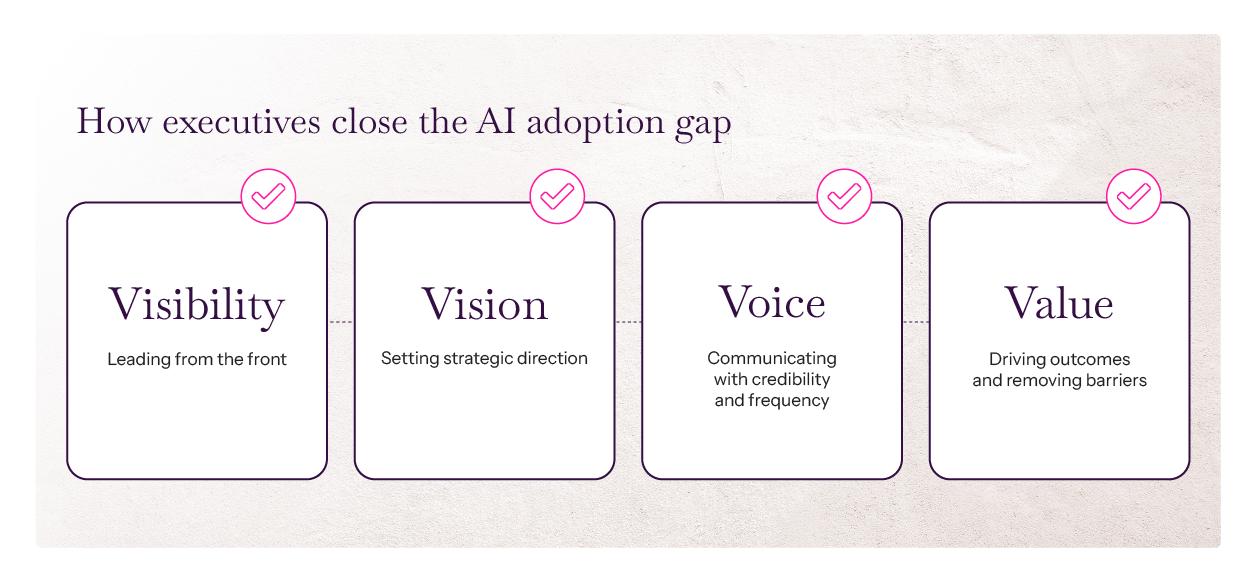
Visibility – Leading from the Front
In successful AI implementations, leadership visibility is strategic, not symbolic. Study participants rated the level of senior leadership commitment in their organizations; the gap in score between those who were struggling and those who were succeeding was largest across any factor evaluated (1.65 difference on a scale of -2 to 2). What distinguishes high performers is not stated support, but consistent executive presence across the AI lifecycle.
What Visibility Looks Like in Practice
1. Actively participating
That presence shows up most clearly when executives actively participate in AI pilots, innovation forums, and cross-functional reviews. In organizations with smooth AI implementation, executive involvement is significantly higher. This level of engagement signals that AI is not an IT experiment, but a strategic priority owned at the top.
2. Modeling behavior
Visibility also includes behavior modeling. Executives who share how they are learning, experimenting with tools, or using AI in their own work normalize adoption and reduce hesitation.
Prosci’s own Chief People Officer, Laura McGann, has been publicly sharing her own AI journey on LinkedIn. Leaders need real hours of fingers on keyboards to experience the technology and show the organization it’s okay. This kind of modeling builds psychological safety and counters cynicism, particularly in organizations where prior digital efforts stalled due to weak follow-through.
3. Leading and learning
Leading from the front means showing up as both sponsor and learner. Executives who join pilots, host open forums, and stay visible when resistance surfaces accelerate trust and momentum. When sustained, visibility becomes a force multiplier, anchoring AI adoption in leadership credibility and shared ownership.
Where Visibility Bridges the Gap
When executive presence is absent, the impact is immediate and negative. Delegating AI leadership to technical teams alone is one of the most common pitfalls identified in Prosci research. It reinforces misalignment and erodes trust—especially on the frontline, where trust in AI is roughly one-third the level reported by executives. In these environments, AI feels optional, risky, or disconnected from real work.
Vision – Setting Strategic Direction
AI initiatives falter quickly without a clear executive vision. Vision in enterprise AI adoption means defining how AI advances the organization’s mission and long-term strategy, not simply expressing enthusiasm for innovation. Prosci research shows that organizations emphasizing long-term AI planning outperform those focused on short-term wins.
What Vision Looks Like in Practice
1. Defining and sharing the “why”
Effective vision starts with executives articulating a clear “why.” Prosci identifies leadership commitment and clarity as the #1 differentiator between successful and unsuccessful AI adoption, with a +1.65 difference. When leaders explicitly link AI to core value drivers, such as customer experience, resilience, innovation, or differentiation, they move AI from a side initiative to a strategic imperative.
2. Owning the AI roadmap
Ownership of the AI roadmap is equally critical. High-performing organizations treat the roadmap as an enterprise change blueprint, not a technical backlog. Executives help balance near-term value with long-term capability building and ensure AI efforts are integrated across functions.
A recent case study on McCarthy’s success demonstrates this balance: they articulated a transformational vision and path for the organization, and then doubled down on driving exceptional adoption of an immediate enterprise deployment. In contrast, organizations that rely on siloed, incremental use cases score -1.86 on success metrics, highlighting the cost of fragmented experimentation.
3. Shaping AI mindset
Vision also shapes mindset. In organizations with smooth AI integration, employee positivity toward AI is far higher (+1.63) than in struggling environments (+0.32). Executives who frame AI as a way to amplify human capability⎯rather than replace it⎯help shift culture. Recognition of grassroots innovation and consistent storytelling around real wins reinforce that message.
Where Vision Bridges the Gap
Without a clear, inclusive vision, teams default to cautious experimentation or wait for direction, slowing momentum. Visionary leadership sets direction, makes tradeoffs explicit, and repeatedly reinforces that AI is a strategic shift, not a passing trend.

Voice – Communicating with Credibility and Frequency
Executive voice determines whether AI adoption builds confidence or confusion. Prosci research shows that high-performing organizations score +1.29 in transparency and clarity around AI strategy, while low performers lag at -0.54, creating a communication vacuum that undermines trust.
What Voice Looks Like in Practice
1. Communicating regularly and consistently
Effective executive communication is ongoing, not episodic. Leaders must communicate consistently across levels, tailoring messages to different audiences while reinforcing a shared narrative. Strategic updates explain priorities and tradeoffs; frontline communication connects AI to daily work and practical benefits.
2. Engaging in honest conversation
Credibility comes from honesty as much as ambition. Leaders who share lessons from pilots, acknowledge uncertainty, and invite dialogue strengthen trust. This matters because trust in AI declines sharply by job level: +1.09 among executives versus +0.33 among frontline workers. Two-way communication through Q&As, feedback loops, and listening channels helps close that gap.
3. Defining and reinforcing ethical AI use
Executive voice also carries responsibility for reinforcing ethical AI use. Executives demonstrate greater focus on ethical awareness (14%) than frontline employees (7–10%). When leaders regularly address data privacy, transparency, and fairness in everyday communication, not just policies, they give governance real weight.
Where Voice Bridges the Gap
Common missteps include vague messaging, overly technical explanations, or silence in response to frontline concerns. These behaviors signal distance and reinforce the perception that AI belongs to “someone else.”
A strong executive voice explains decisions, listens actively, and connects strategy to lived experience, turning AI from an initiative into a shared movement.

Value – Driving Outcomes and Removing Barriers
AI strategies ultimately rise or fall on value creation. Prosci research shows executives most often assess AI through efficiency (31%) and ROI (23%), underscoring that adoption credibility depends on measurable business outcomes, not pilot volume or tool count.
What Value Looks Like in Practice
1. Tying AI initiatives to meaningful business outcomes
Executives create value first by insisting that AI initiatives tie directly to meaningful KPIs. Too many organizations track usage or technical performance without linking AI to outcomes such as cycle time, quality, or capacity. Prosci identifies this disconnect as a recurring failure pattern. Leaders must consistently ask how AI initiatives advance strategic goals.
At a recent AI conference attended by leaders of hundreds of technology providers, the concept of shifting from POC (proof of concept) to POV (proof of value) showed up on stage and in numerous conversations, marking a shift toward real value and impact.
2. Making value realization possible by removing barriers
Equally important is removing barriers that prevent value realization. Prosci research shows that 56–64% of AI adoption challenges are people-centered, with user proficiency cited in 38% of struggles. This makes investment in change management, role-based training, and ongoing skill development a strategic necessity rather than a support function.
3. Prioritizing and owning data quality
Data quality is another executive responsibility. Thirteen percent of participants cite data concerns as a major obstacle, particularly among team leaders. Executives who prioritize data governance, ownership, and reliability protect the credibility of AI and reduce skepticism, especially on the frontlines.
4. Tailoring AI use to tangible everyday uses
Value increases when AI is tailored to real workflows. Executives report higher trust (+1.09) and ease of use (+1.19) than frontline workers, but organizations that co-design solutions around actual job needs see smoother adoption and gains in perceived usefulness and autonomy. One-size-fits-all deployments consistently underperform.
Where Value Bridges the Gap
Leaders who treat enablement as a delegated task, separate from strategy, slow adoption. High-performing executives integrate learning, change, and capability building into the core transformation agenda. Value is not just measured; it is enabled. And leadership determines whether AI becomes a set of isolated tools or a sustained enterprise capability.
Executive Leadership Is the Adoption Catalyst
AI adoption rarely fails because of technology. It fails when leadership treats AI as a tool rollout rather than a shift in how work gets done. Across Prosci’s research, the difference between stalled pilots and sustained impact consistently comes back to executive behavior.
Executives who drive successful adoption show up visibly, communicate with clarity, and anchor AI efforts to business outcomes. They invest in people, data, and learning, not just tech. In doing so, they reduce fear, build trust, and make change feel both possible and worthwhile.
The four leadership levers – Visibility, Vision, Voice, and Value – offer a practical way to focus executive effort where it has the greatest effect. Pulled together, they move AI from experimentation to integration, and from novelty to results.
As AI capabilities continue to accelerate, passive sponsorship becomes increasingly costly. Organizations do not need more pilots. They need leaders who understand that AI adoption is a human journey – powered by technology – and who are willing to lead it! Contact Prosci to engage and equip your executives to lead in the age of AI.