

4 Mins
Updated: June 3, 2026
Published: October 17, 2025



The average organization today faces five or more major transformations per year. AI implementations, digital overhauls, restructuring initiatives, and mergers and acquisitions come at a relentless pace. In many large enterprises, each department or team often tackles these changes differently. IT uses one methodology for system rollouts, HR applies another approach for organizational restructuring, and Operations follows another process for workflow changes.
Organizations that experience ongoing successful transformations recognize follow a unified approach, not departmental improvisation. Instead of allowing each team to reinvent change management, they're building systematic "change muscle" that creates consistency and strength across every transformation.
The Need For A Standardized Change Process
The challenge isn't that organizations don't manage change. It's that they manage it inconsistently. In large enterprises, departments often develop their own change management approach. This creates fragmented execution, conflicting methodologies, and employees experiencing change differently depending on which team is leading the initiative.
This departmental approach creates predictable problems. Teams can't build on each other's successes because they're using different frameworks. Employees become confused when change processes vary between projects. Best practices remain siloed within individual departments instead of spreading across the organization.
Organizations that build unified change capability take a different path. They establish centralized systems and standardized methodologies that create consistency across all transformations. This systematic approach makes every subsequent change faster, smoother, and more successful because people know what to expect and how to contribute regardless of which department is leading the effort.
What "Change Muscle" Actually Means
Building change muscle requires more than the standard approach of designating a change manager, creating a communication plan, and hoping for the best. True organizational change capability rests on three fundamental pillars:
Common language
When every department uses different terminology and frameworks, confusion is inevitable. Employees moving between projects have to relearn how change works each time. A common language solves this by giving everyone the same change vocabulary and proven methodologies to follow. OTIP demonstrates this impact. By implementing the ADKAR Model as their standard approach, they enabled all 900 employees to develop consistent change skills, achieving a 4.5 average assessment score across the organization.
Distributed capability
Change leadership can't live only among specialists. People managers need to know how to guide teams through transitions. Executives must understand their critical sponsorship roles. Front-line employees should actively participate rather than passively resist. When capability exists at every level, everyone is equipped to fulfill their unique roles and they enable the change team to successfully perform their role as a result.
Systematic approach
Organizations that build change muscle don't reinvent their approach with each initiative. Instead, they apply consistent, proven methodologies that improve with practice. Each transformation builds on the last, creating compound learning effects across the enterprise.
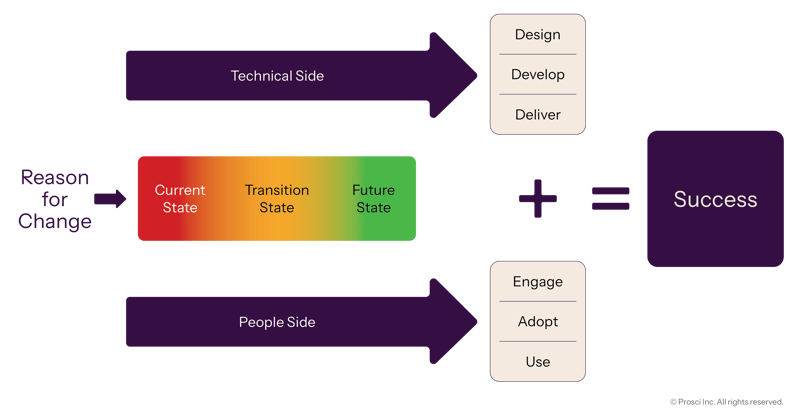
Transformation isn't just about structure and processes. It's fundamentally about behaviors and mindsets. Change muscle means your people are equipped to handle both the technical and human sides of transformation.
Prosci's Unified Value Proposition
How Leading Companies Build Change Muscle
The most successful organizations treat change capability as strategically important as their finance, technology, or operations functions. They invest in it to accelerate speed to value and reduce risk.
This strategic approach produces measurable results:
Matthews International
Matthews International built systematic capability that multiplied impact across their global organization. Their investment in 190 certified change practitioners created internal experts who then trained 900 managers and supported 11,000 employees worldwide. The multiplication effect meant their initial training investment continued delivering value across every subsequent transformation.
OTIP
OTIP demonstrates how change muscle works during complex, simultaneous transformations. While managing both an acquisition integration and digital transformation, they established a dedicated Change Management Office, applied consistent change methodology across all initiatives, and achieved enhanced change capability, increased adoption rates, and sustained leadership engagement.
The key success factors these organizations share:
- Executive commitment beyond funding: Leadership actively participates throughout transformations, not just at the beginning
- Role-specific capability building: Different skills for different responsibilities, from sponsors to managers to individual contributors
- Practical application: Training tied to real transformation initiatives, not theoretical workshops
- Measurement focus: Tracking capability building and adoption, not just project deliverables
Early investment in change capability saves money and helps organizations achieve ROI, but this connection between upfront investment and downstream success isn't always obvious to leadership teams.

The Competitive Advantage of Change-Ready Organizations
Organizations with strong change muscle enjoy three critical advantages:
- Speed to Value: When people know how to navigate change, adoption happens faster and benefits realize sooner. Change-ready organizations don't lose months to resistance, confusion, and rework.
- Risk Mitigation: Internal capability reduces dependency on external resources and eliminates the risk of starting from scratch with each transformation. Proven approaches reduce failure rates dramatically.
- Strategic Agility: Perhaps most importantly, organizations with change muscle can respond to market shifts quickly. The goal is developing change agility by helping people get better at managing change and thriving during moments of transformation rather than merely surviving them.
OTIP's results illustrate this advantage clearly. Enhanced change capability led to increased adoption of new systems, stronger leadership engagement, and successful integration of acquired organizations, all while maintaining operational continuity during major digital transformation.
Build Change Muscle With Enterprise Change Training
Building organizational change muscle requires systematic capability development across all levels and roles. This is where enterprise training becomes strategic, not tactical.
The most effective approach follows a systematic framework:
- Align: Secure executive commitment and establish governance for transformation initiatives. This means sponsor briefings that teach leaders the ABCs of effective sponsorship, which include being Active and visible, Building coalitions, and Communicating directly throughout initiatives.
- Architect: Design integrated solutions that address both technical and people sides of change. Project managers learn to integrate change management from the start. Change practitioners develop role-specific plans that enable others to succeed.
- Activate: Deploy role-based training that enables adoption across the organization. People managers learn the CLARC Model (Communicator, Liaison, Advocate, Resistance manager, Coach). Employees understand their part in change success rather than waiting passively for things to happen to them.
Matthews International's global transformation demonstrates this systematic approach in action. After establishing enterprise-wide training, their 190 certified change practitioners became internal experts who trained 900 managers and supported 11,000 employees across 250+ locations in 26 countries. This sustainable capability scaled across every subsequent transformation without starting from scratch each time.
This isn't about training for the sake of training. It's about measurable capability building. Organizations that invest systematically see concrete outcomes: faster adoption, reduced resistance, improved ROI, and most importantly, change readiness that becomes a competitive advantage.
The strategic question isn't what organizations can afford to spend on change capability. It's what they can afford to lose by not investing in it.

The Future Belongs to Change-Ready Organizations
The pace of transformation isn't slowing down. If anything, emerging technologies, market volatility, and shifting customer expectations are accelerating change requirements. Organizations that treat each transformation as a separate event will find themselves perpetually behind.
But organizations that build change muscle (that invest systematically in distributed capability, common language, and proven methodologies) turn constant transformation from a challenge into a competitive advantage.
The transformation is only as good as the change in behavior and outcomes it drives. Success requires putting resources toward adoption—helping people successfully navigate change rather than hoping they'll figure it out on their own.
The companies that thrive in the next decade won't be those with the best technology or the biggest budgets. They'll be the ones whose people can navigate change confidently, consistently, and successfully.
Ready to build your organization's change muscle? Discover how Prosci's Enterprise Training programs develop systematic change capability that turns transformation into competitive advantage.
Discover Enterprise Training Solutions

.webp?width=282&height=187&name=Blog%20Banner%20Image-Leadership%20focus%20(1).webp)