6 Mins
Published: May 25, 2026



What is change management in ERP implementations?
Enterprise Resource Planning (ERP) systems are the backbone of large organizations. They orchestrate complex processes across critical departments, from finance to supply chain management. Unfortunately, many ERP systems are outdated, hampering the ability to reduce costs and drive revenue.
Financial and IT executives are heavily involved in selecting and integrating new ERPs—but that’s only half the battle. Leaders often forget the role that change management plays in ERP lifecycles.
Technology changes begin with process changes. ERP change management is a structured approach that empowers employees to embrace the process changes and new systems faster and more efficiently. The result is that individuals, teams, and organizations move from the current state to your desired future state and then use the updated ERP systems in their daily work.

Why enterprises need ERP change management
ERPs are expensive, complex systems ingrained in your organization’s digital infrastructure. That means your workforce has built strong habits surrounding legacy systems across various business functions. The interconnected nature of ERPs and high employee resistance to change create an environment where progress is slow and efficient change is difficult.
For example, not having enough staff for the project is a major reason why costs exceed the budget, which happens for 38.4% of organizations. This highlights just how crucial it is to manage changes effectively.
According to leading ERP vendor Oracle, companies face a number of key challenges during ERP adoption and implementation:
- Project management and planning – ERP implementations involve multiple phases, from discovery and planning to testing, deployment and post-launch analysis. Many organizations underestimate the time and resources necessary for this change.
- Data integration and quality – Duplicate data sources represent a logistical and administrative challenge, while moving data can represent as much as 15% of the total ERP cost.
- Cost and timeline overruns – ERPs are notorious for expanding budgets and lagging milestones. Few companies have the internal resources to plan for and drive this level of organizational change. (only 49.7% of projects meet their original timelines, and the median project duration extends to 15.5 months)
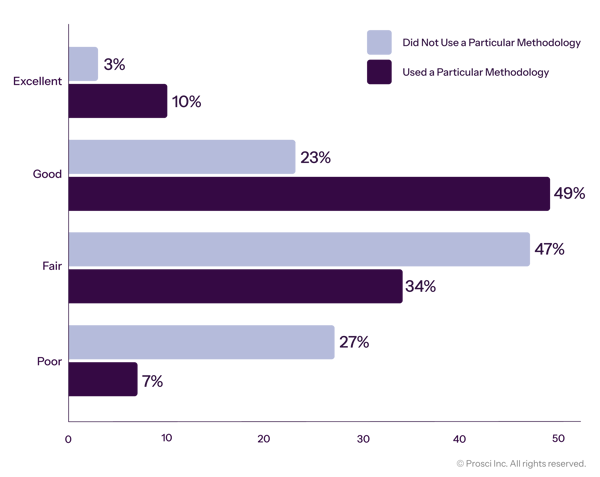
- Effective change management – Switching to a new software is par for the course. Driving adoption and overcoming resistance to change among key stakeholders adds another layer of complexity. A study from Panorama Consulting Group shows — executives who invest in a change management methodology are 33% more likely to achieve “good” or “excellent” outcomes from their transition than those who don’t.
These are all symptoms of underinvestment in proven change management methodologies. This highlights a major point that CIOs and CFOs must be aware of prior to the change: Building change capacity using a specific methodology significantly increases the chances of a successful ERP implementation.
Impact of use of a methodology on overall change management effectiveness
Change management for ERP implementation case study
Hear firsthand from EisnerAmper's change leaders on how they executed an integrated change management strategy for a complex ERP transformation touching 3,300+ employees. During this panel discussion, the program director, change lead, and CFO give an inside look into their 18-month journey of sunsetting legacy platforms and rolling out four new integrated systems, including SAP.
How EisnerAmper executed a complex ERP rollout and built lasting change capability
Key steps in EisnerAmper's change management journey:
- Integrating change management and project management – The team leveraged outputs of project milestones like solution design workshops to inform impact assessments and change plans.
- Bridging the Knowledge to Ability gap with user acceptance testing (UAT) – UAT and training were conducted in partnership between project management and change management to ready employees.
- Defining success metrics that matter – The team identified customized metrics to track adoption and usage indicators tailored to each impacted group rather than a one-size-fits-all model.
- Securing buy-in and preparing for resistance – In-person roadshows across 16 office locations proved invaluable for securing leadership commitment while addressing employee concerns.
- Supporting with a strategic communication approach – A multichannel communications strategy catered to varied preferences for consuming information and building desire for change.
The Prosci Methodology: A holistic approach to ERP change management
Prosci has more than 30 years of experience helping organizations across industries drive successful change, from undertaking large-scale digital transformation to implementing new initiatives. In that time, Prosci developed a proven set of tools for driving enterprise change, culminating in the Prosci Methodology.
The Prosci Methodology is a structured yet flexible approach to managing the people side of change. It consists of two key components that lay the foundation for successful long-term change:
- ADKAR® Model – a model for guiding individuals through the five building blocks necessary to achieve successful change: Awareness, Desire, Knowledge, Ability and Reinforcement
- Prosci 3-Phase Process – a dynamic framework for driving change at the organizational level through three key phases: Phase 1 – Prepare Approach, Phase 2 – Manage Change, and Phase 3 – Sustain Outcomes
The Prosci Methodology
/Methodology-EN.webp?width=600&height=621&name=Methodology-EN.webp)
Successful ERP implementation requires substantial buy-in across the organization. However, the actions of specific stakeholders across IT, Finance, and HR are critical. That’s why you need a holistic approach to ERP change management that connects the micro to the macro.
How Prosci drives ERP adoption across enterprise contexts
Prosci works with large-scale enterprises across industries, helping them successfully navigate complex transitions. Over the past 30 years, Prosci has helped companies from large multinationals to critical utility companies. Here’s how the Prosci Methodology improves ERP adoption:
An international entertainment company's ERP change management success
A rapidly growing international entertainment company faced the challenge of implementing a complex, long-lifecycle ERP system — its previous large-scale change attempts had been unsuccessful. Having grown from 500 to 1,200 employees in a short period, the stakes were high. The organization engaged Prosci to ensure this initiative delivered real results.
Key steps in the entertainment company's ERP transformation:
- Building change capability across the enterprise — Prosci provided customized training to more than 60 personnel in change management methodology and established a community of practice to build knowledge and ability across the organization.
- Using data to navigate complexity — Eight Prosci Change Triangle (PCT) Assessments and ADKAR surveys tracked project health throughout the multi-year lifecycle, enabling the team to identify and address barriers early — including low scores that signaled a threat to project success before they escalated.
- Activating sponsors — Sponsor Briefings helped executive and management teams understand their roles, building credibility and lasting change capability that extended beyond this project.
- Delivering tailored solutions — Custom training for sponsors and sponsor coalitions was delivered in phased increments over several months. A hypercare reinforcement plan provided additional support post-go-live and transferred sustainment ownership to the business.
- Sustaining outcomes — A comprehensive communications strategy — including all-company meetings, weekly email support, and executive-level communications at key milestones — maintained alignment and desire for change throughout implementation.
The ERP rollout was deemed a success. The organization moved from 500 to 1,200 change-capable employees, with 86% improvement in project success. Following the ERP initiative, the Entertainment Company engaged Prosci for another enterprise-wide change initiative — a strong indicator of the value delivered and the partnership established.
Read the full International Entertainment Company success story
A multinational food corporation's SAP implementation
A US-based multinational food corporation faced the challenge of updating its systems infrastructure to support an ambitious growth plan. This involved a new SAP implementation aimed at consolidating six legacy systems into one, streamlining payments, reducing errors, and providing more detailed data for better business decisions. The project, impacting 500 users across various departments, required a significant mindset shift and was complicated by an acquisition mid-flight.
Key steps in the SAP implementation:
- Starting with why – The goal was to improve efficiency and decision-making capabilities through a unified system.
- Identifying impacted processes – Understanding the processes affected by the new SAP system was crucial for targeted change management.
- Engaging stakeholders – The change lead engaged in direct conversations with impacted individuals, especially those resistant to the new system, transforming them into supporters and trainers.
- Integrating change and project management – The change team worked closely with the project team, ensuring alignment and effective collaboration.
- Metrics and measurement – Tools like the Prosci Change Triangle (PCT) Model and Best Practices Audit from Prosci tracked project health and adherence to best practices.
- Building a change agent network – A network of 40 change agents facilitated the change process and served as a feedback loop.
The SAP implementation was successfully launched on time, achieving its objectives despite the mid-project acquisition. The project exceeded expectations by eliminating legacy systems, streamlining payment processes, and providing granular data for improved decision-making. It also automated and streamlined previously manual processes.
The success of this SAP implementation served as a benchmark for future projects, demonstrating the lasting impact of Prosci's change management approach in complex ERP implementations. The focus on the people side of change was key to exceeding project goals and setting a new standard for organizational change initiatives.
Read the full Multinational Food Corporation success story
Sunflower Electric Power Corporation's ERP change management success
Sunflower Electric's experience with Prosci shows what's possible when the people side of change gets the same attention as the technical side. Faced with the challenge of implementing a new ERP system, Sunflower Electric partnered with Prosci to navigate this complex change. The key to their success was addressing the people side of change as much as the technical side.
Key steps in Sunflower Electric’s ERP transformation:
- Starting with why – Understanding the purpose behind the ERP implementation was crucial. For Sunflower Electric, it was about improving efficiencies and gaining a better organizational view.
- Identifying impacted processes – By identifying which processes were impacted by the new ERP system, Sunflower Electric could focus on the areas needing the most attention.
- Connecting change to business results – Using Prosci's 4 P's (Project, Purpose, Particulars and People), the connection between the ERP project and organizational benefits was made clear.
- Assessing and managing risks – Evaluating and addressing risks was essential, especially considering the organization's previous experiences with ERP implementations.
- Engaging stakeholders – Through stakeholder meetings and surveys, Sunflower Electric engaged employees, building awareness and desire for the ERP change.
- Integrating change management and project management – Despite joining the project late, change management was seamlessly integrated, ensuring alignment with project goals.
The results at Sunflower Electric were remarkable. The change management strategy led to increased awareness and desire for the new ERP system among employees. Impacted people found the training materials helpful, and the overall project was deemed a success, leading to a broader rollout of the Prosci Methodology and ADKAR Model across the organization.
Success at Sunflower Electric didn't end with the ERP implementation. The project served as a catalyst for building holistic change management capabilities within the organization, demonstrating the lasting value of Prosci's approach.
Read the full Sunflower Electric success story
Make Your ERP Implementation a Success With Prosci
The return on your ERP investment depends on one thing above all others: whether your people adopt and use the new system. According to Prosci's Unlocking ERP Implementations research, human factors matter six times more than technical factors in realizing ERP benefits — making the people side of change the highest-leverage investment you can make.
Your ERP implementation deserves more than a successful go-live. It deserves lasting adoption. Prosci brings 30+ years of research-backed methodology, proven tools, and experienced consultants to help your organization get there.
Ready to make change done right a reality? Contact Prosci today.