5 Mins
Updated: April 22, 2026
Published: December 23, 2025



Recent research conducted by Paycom suggests that the top priority for human resources (HR) teams in 2026 and beyond is HR tech upgrades and improvements, more specifically, “shedding the outdated systems and processes that now hold HR back.”New tools and technologies are reshaping HR operations and the focus for HR departments. But choosing the best systems isn’t enough. Optimizing HR processes, adopting new technologies, and bringing employees along requires effective change management.
In this guide, we explore what HR process improvement entails, its importance, and how to apply change management to achieve success.
What is HR process improvement?
HR process improvement refers to the systematic optimization of the HR function, encompassing recruitment, onboarding, performance management, and payroll, to enhance efficiency, reduce costs, save time, and enhance the overall employee experience. Knowing how to standardize and optimize HR processes effectively is a strategic differentiator for organizations seeking to hire and retain top talent, especially in an ever-changing, technology-driven workforce.
Following a structured HR change management approach sets organizations up for success by ensuring their employees adopt and sustain new processes for the long haul.

Understanding HR processes
HR processes include all structured activities and workflows that enable organizations to manage people effectively. These processes work together to form the foundation of employee experience, while ensuring alignment and compliance with the organization.
Some examples of standard HR systems include the following:
- Recruitment and talent acquisition management – How organizations attract, select, and hire the right people
- Onboarding process and orientation – Processes designed to integrate new hires into an organization at the desired pace
- Compensation and benefits administration and management – How an employer manages pay, incentives, and rewards, and the processes employees must follow to gain access to these
- Performance management – How managers work with employees to set goals, evaluate employee performance, and provide feedback
- Learning and development – Tools and techniques used to build employee skills and support ongoing career growth
- Employee engagement – Processes designed to foster a positive and productive workplace culture
- Employee relations – Processes designed to address issues between employees or matters that occur at the workplace
Challenges in HR process improvement
Despite the importance of HR processes across all types of organizations, many HR processes still involve manual task completion, rely on outdated systems, and lack efficiency due to limited data integration.
The need for HR process improvement
As organizations grow, technologies evolve, and workforce expectations change, the need for improving HR services becomes increasingly evident. Paying attention to inefficiencies as they arise enables HR departments to anticipate and address changes proactively. For example, process inefficiencies often manifest as redundant approvals, manual data entry, inconsistent policy application, or disjointed systems that create bottlenecks. For HR professionals, these inefficiencies also tend to feel time-consuming and increase the rate of human errors.
Benefits of HR process improvement
These process gaps drain HR’s capacity and frustrate employees, eroding trust in the effectiveness and support of HR operations. However, when teams standardize and optimize HR processes, organizations experience significant benefits, including:
- Increased efficiency through HR automation and simplification, allowing HR departments to focus on strategic HR operations
- Fewer human errors and consistent adherence to policies and regulations
- Higher employee engagement and satisfaction through efficient, transparent interactions with HR
- Reduced turnover, which contributes to a stronger and more positive organizational culture overall
- Greater agility and scalability for new business demands and future process changes
Steps for effective HR process improvement
The success of any organizational change depends on the success of change management in encouraging individuals to embrace, adopt and utilize a required change. Follow these steps for effective HR process improvement to increase the likelihood of lasting results:
1. Assess your current HR processes
A comprehensive process audit is necessary for understanding how existing HR workflows function in practice. Mapping out key activities, dependencies, and pain points across key HR categories allows organizations to first understand what needs to change and why.
Additionally, gathering feedback from employees and stakeholders on HR processes can help HR staff identify hidden inefficiencies that they may not be able to spot on their own. Use your audit and feedback gathering to prioritize which processes to start with.
2. Define objectives for continuous improvement
Once your team determines which HR processes to improve, the next step is to define objectives for the change by setting clear, measurable goals around what the improved processes will achieve.
The Prosci 3-Phase Process is one of three main components of the Prosci Methodology. It provides a structured process for driving organizational change. The first phase of the Prosci 3-Phase Process supports change and project teams in developing their change management strategy, and with the end in mind.
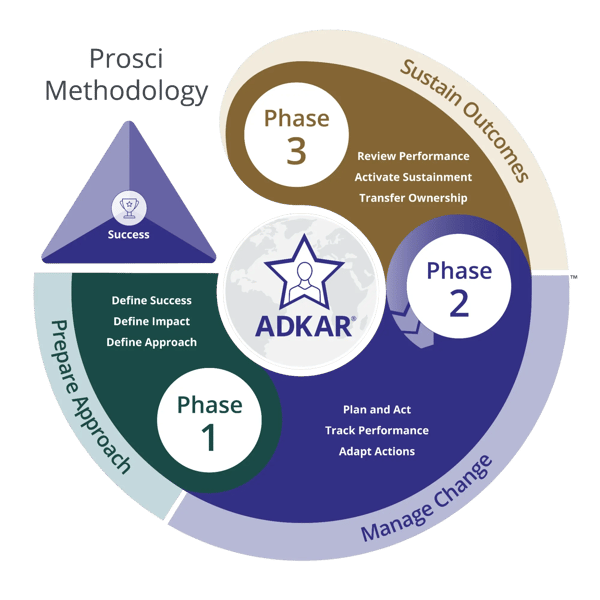
The three stages in Phase 1 — Prepare Approach include:
- Define Success – What are we trying to achieve?
- Define Impact – Who needs to do their job differently, and how?
- Define Approach – What will it take to achieve success?
This includes identifying the specific outcomes the HR process improvements will achieve—whether improving data accuracy or reducing manual task completion time. Regardless of the desired outcomes, objectives should align with the organizational strategy to ensure that HR improvements support broader business goals.
3. Analyze and redesign HR processes
Redesigning HR processes is a collaborative effort and requires involvement from multiple stakeholders. Ultimately, redesigning and implementing new processes requires people to change their ways of working. To achieve this, the technical and people sides of change work together to reach a common goal of success.
Unified Value Proposition (UVP)
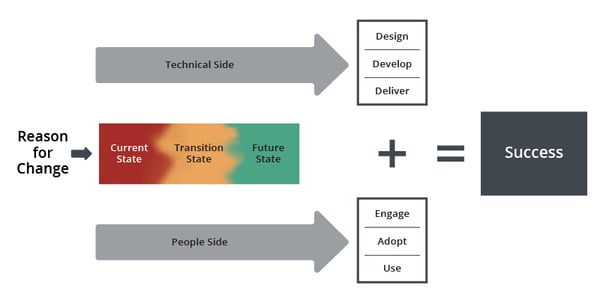
To successfully progress from the current to the future state as shown in the UVP model, organizations must focus on both the technical and people side of change as they redesign processes. That includes delivering a solution that addresses the reasons for the change and guiding and supporting individuals as they adopt the new ways of working.
4. Implement changes using a structured approach
Next, develop an implementation plan that includes communication strategies, training, and resistance management to support adoption.
In Phase 2 — Manage Change, teams achieve adoption and usage of the change by creating, implementing and adapting plan(s) that will move individuals and the organization through ADKAR® transitions. This model breaks down individual change into five key elements: Awareness, Desire, Knowledge, Ability and Reinforcement.
The Prosci ADKAR Model
.webp?width=560&height=430&name=image6%20(1).webp) The Prosci 3-Phase Process is a framework for organizational change, while the ADKAR Model focuses on individual change. Both work together to support the adoption of lasting process improvements.
The Prosci 3-Phase Process is a framework for organizational change, while the ADKAR Model focuses on individual change. Both work together to support the adoption of lasting process improvements.
5. Monitor and evaluate success
In the first phase of the Prosci 3-Phase Process, teams define objectives and goals to measure success. In Phase 3 — Sustain Outcomes, teams work to ensure the change is adopted and the organization is committed to sustaining it. Celebrate change management successes and establish ongoing ownership for reviewing and adjusting HR processes to ensure continuous improvement.
Best practices for HR process improvement
Improving HR processes is easier said than done. Consider the following best practices for evolving your HR strategies and increasing implementation success in your workplace:
- Involve stakeholders throughout the process – Engage employees, managers, and leaders early and often to ensure their perspectives shape the design and implementation of new methods.
- Emphasize continuous improvement – Regularly collect feedback, review outcomes, and refine processes to stay responsive to the needs of both the business and the workforce.
- Leverage technology and HR automation systems – Use digital platforms, automation, and data analytics to simplify tasks.
- Foster a culture of feedback and adaptation – Encourage open communication and empower employees to suggest process improvement ideas for consideration and implementation.
- Apply a structured approach to managing the people side of change – Using a structured, adaptable and repeatable approach, such as the Prosci Methodology, positions change for success.
Case studies: Successful HR process improvements
For 30 years, we have been laser-focused on change. Our research-backed methodology and ongoing study of the discipline keep us at the forefront of driving success and change. Here’s how Prosci has helped organizations successfully achieve HR process improvements.
Texas A&M Implements Workday
Prosci helped Texas A&M University System overhaul its outdated payroll system, which was costly to maintain and no longer met the needs of its employees. A structured change management approach delivered a smooth transition, with a coalition of sponsors and change agents providing training and communication. The implementation of Workday integrated HR, payroll, and other solutions to simplify processes while minimizing overhead.
University Executes Strategic Plan Through Change Learning & Development Initiative
The University of California, San Diego faced significant organizational changes across campus as a result of the Chancellor’s new Strategic Plan. UC San Diego turned to Prosci for support in training their team members on change management to support the plan’s success. The UC San Diego team collaborated with Prosci to tailor training to their specific environment. The campus hosted Learning and Development Days to develop change management competencies, and the effort was so successful that UC San Diego won an award from the Association of Talent Development.
Improve HR processes with a structured change approach
By combining structured HR process improvements and redesigns with a proven change management approach, such as the Prosci Methodology, organizations position themselves for change success. That’s the power of change done right.