7 Mins
Updated: September 26, 2025
Published: September 30, 2024



In leading organizational change, which approach should you choose? One with a structured, scalable framework? Or an approach rooted in experimentation and rapid adaptation?There’s no right or wrong answer, as it depends on the needs, size, goals, and culture of an organization. Every approach to organizational change presents benefits and challenges to consider.
In this article, we’ll explore and compare Lean Change Management and the Prosci Methodology, examining where each can help teams manage change effectively.
Editor's note: The original version of this article contained information which unintentionally misrepresented Lean Change Management as Lean Six Sigma for Change Management. We've updated the article and thank our community and Lean Change Management for their feedback.
Introduction to Lean Change Management
Lean Change Management is a feedback-driven, adaptive approach to organizational change, grounded in the principles of Lean Startup, Agile, and design thinking. Lean principles emphasize experiments, feedback loops, continuous improvement, and co-creation to help organizations define and implement changes together.
Organizations seek more agile approaches to change in today’s market for several reasons, including:
- Increasing complexity and responsiveness – Evolving market conditions, technological advancements, and the rapid rate of change are changing organizations’ needs and change implementation timelines.
- Greater perceived flexibility – Instead of relying on large, upfront change strategies, more agile approaches to change allow for quicker adjustments and planning along the way, with data from experiments influencing the direction of change.
- Employee ownership and empowerment – By involving employees in the design, decision-making, and execution of change through co-creation, agile change approaches like Lean Change foster employee empowerment and ownership throughout the entire change process.
Core Concepts of Lean Change Management
Lean Change Management employs an adaptive approach to creating and implementing change, emphasizing the importance of continuous feedback, collaboration, and iterative improvements to drive organizational change. Core concepts of this approach include:
- Co-creating agile approaches to change by discovering what the change is with people who will be affected by it
- Encouraging change managers to adapt their processes based on their learnings and real-world context
- Using change resistance as data based on the current reality, and adjusting changes accordingly
- Embracing the idea that a change strategy can and should change as you experiment and learn throughout the change cycle, emphasizing the need for continuous improvement
How Lean Change Works: Framework and Process
The Lean Change Management Engine follows an iterative but straightforward cycle comprising insights, options, and experiments. The goal is to use information and context from the current state to assess options for change and engage in experimentation. Here’s how it works:
- Insights – Gather a clear picture of the current state and make sense of the context of the information provided, including facts and assumptions
- Options – Using the information gathered, teams then co-create options and different approaches to address their challenges
- Experiments – Choosing from the selected options, teams can then put them into practice through small pilots and experiments, which they can measure and adapt as conditions change
Tools and Techniques for Alignment in Lean Change
To implement Lean Change Management, change agents use a set of mapping tools and techniques that make change visible, collaborative, and visually oriented.
First, Lean Change practitioners use change canvases, such as the Strategic Change Canvas, to answer questions about the change at the highest level. Another example is The Storytelling Canvas, which helps change agents craft co-created narratives to make sense of the change. Tools like these help teams capture insights, creating clarity and alignment.
Lean Change is feedback-driven, with changes guided by real-time feedback and insights from those directly affected. Informal feedback gathering, combined with qualitative measures, enables teams to learn quickly and effectively.
Visual management tools, such as Kanban boards and dashboards, make progress visible and transparent. This enables teams to identify patterns, track progress, and adjust quickly in response to real-world scenarios. Together, these mapping tools align teams with a shared understanding of change, keeping everyone informed throughout the process.
When to Use Lean Change Management
So, when should you use Lean Change Management? Lean Change Management excels in scenarios where uncertainty is high, the environment is evolving, and innovation is a key priority. Given that Lean Change is most effective when co-creation from the beginning is possible and fast feedback loops are necessary, ideal scenarios include:
- Startups and small businesses – When teams are small, co-creation is more realistic, as the organization can gather input from everyone on the team.
- Innovation and product development teams – Lean Change supports the experimentation, customer feedback, and adaptation these teams already use in their work.
- Departments or business units within a larger organization – In enterprises, co-creation with thousands of employees is often not feasible. However, Lean Change can support teams at the departmental or business unit level to engage a smaller number of employees.
- Organizations in volatile environments – Companies in industries such as technology and media, which face constant and widespread disruption, may opt for Lean Change to test and adapt quickly before scaling.
In contrast, the Lean approach may pose more limitations for highly regulated enterprises rolling out compliance-driven change, teams with rigid, hierarchical structures that might not support co-creation efforts, and enterprise-wide transformations involving thousands of employees.
That said, success depends on organizational readiness. A culture that values learning, transparency, and collaboration is more likely to embrace Lean principles and practices. Equally important is risk tolerance, as leaders and teams must be comfortable with experimentation, including the possibility that some ideas will fail.
While the Lean approach may not scale easily to thousands of employees in highly regulated or complex environments, it can still deliver value through targeted pilots, innovation labs, or small team change efforts.
Roles in Lean Change Management
In Lean Change Management, change is driven by change agents. They serve as facilitators and connectors, helping teams uncover insights, co-create options, and guide experiments without claiming ownership of the answers. Lean Change emphasizes that each change agent’s temperament, experience, and biases affect how they approach the change.
Change sponsors and leaders provide direction and support by connecting change efforts to purpose, creating space for experimentation, and modeling transparency. Rather than implementing pre-determined plans for change, they focus on setting context, empowering teams, and removing obstacles.
Finally, teams and stakeholders are active participants, not passive recipients. They bring critical insights about the current state, co-design practical options, and test experiments in real-time. In Lean Change, the people affected by change help shape it and take ownership of the way forward.
Benefits and Challenges of Lean Change Management
Like all approaches to change, Lean Change Management poses benefits and challenges that organizations must consider.
The significant advantage of Lean Change Management is its ability to bring speed and adaptability to change. By running small experiments and learning from feedback, organizations can adjust more readily and quickly, rather than sticking to static plans that may no longer be suitable. It also helps build a learning culture in which teams feel empowered to test new ideas and improve.
However, Lean Change isn’t without its challenges. In particular, scalability can be complicated, as what works for a small startup team may not translate neatly to thousands of employees. Risk management is another concern, since experimentation means some ideas will fail, and leaders must be comfortable with the level of failure this can present.
Prosci Methodology vs. Lean Change Management
While the Prosci Methodology and Lean Change Management offer approaches to organizational change, their angles and use cases differ. Lean Change emphasizes adaptability and thrives in environments where team members co-creating change have decision-making authority and autonomy. Prosci’s strength lies in its scalable, adaptable, and repeatable approach to helping individuals navigate complex change and organizational transformations. Here’s how to consider each approach.
Defining the change vs. implementing a pre-determined change
Organizations seeking Lean Change typically seek help in defining and co-creating the change (the technical side) with people, involving them in iterative learning cycles. It views change as an interactive, feedback-driven process rather than something that organizations can thoroughly plan and implement.
In comparison, the Prosci Methodology increases the adoption and usage of a change that the organization has already defined. The Prosci Methodology is not designed to help organizations decide what to change, unlike the co-creation portion of Lean Change.
For example, United Concordia Dental partnered with Prosci to achieve an 80% adoption rate of their generative AI technology (Sidekick) — a complex change that delivered measurable business impact and cultural transformation. Similarly, Ontario Teachers Insurance Plan (OTIP) engaged Prosci to bring a consistent approach to significant organizational changes following acquisitions. The engagement led to improved change capability, smoother onboarding for new organizations acquired by OTIP, and better adoption of new systems related to digital transformation.
Creating change vs. creating change outcomes
With a focus on insights, options, and experimentation, Lean Change emphasizes defining the change and seizing available opportunities. Learning occurs throughout the Lean Change cycle, and the team’s learnings directly affect the direction of the change. The focus is on defining and creating the change together.
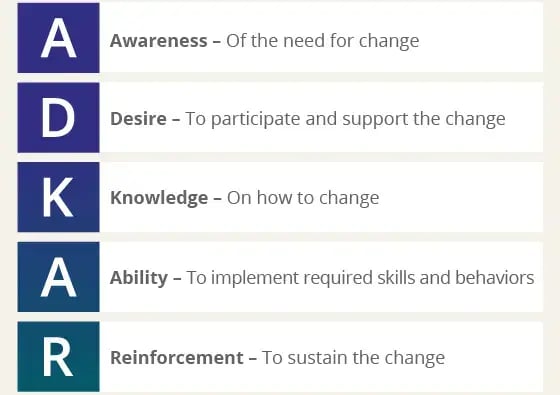
The Prosci ADKAR® Model — one of two foundational models of the Prosci Methodology — reflects five outcomes that an individual needs to achieve for a change to be successful: Awareness, Desire, Knowledge, Ability and Reinforcement. By outlining the goals and outcomes of successful change, the ADKAR Model enables leaders and change management teams to focus their activities on what drives individual change, ultimately achieving organizational results.
Speed and agility vs. comprehensive solutions for change success
Lean Change Management is best suited to uncertain, fast-moving contexts and environments where flexibility, rapid learning, and risk-taking matter more than upfront certainty and a clear path forward.
While the Prosci Methodology is adaptable, it works particularly well in large-scale enterprises and compliance-driven organizations. For example, UKG — one of the world’s leading human capital management (HCM) cloud companies — engaged Prosci for support with a system integration project that would affect 12,000 employees, as well as thousands of customers and partners. Prosci also helped Grand Hôpital de Charleroi build large-scale change management capabilities to support the people side of change through 150 concurrent changes, increasing organizational agility and change readiness.
Prosci’s change management solutions also work well when changes will affect large, diverse groups of employees who will feel the impacts of change differently. In other words, in environments where many people are impacted by change and leaders don’t have direct control over those affected, Prosci’s Methodology helps individuals navigate transitions and achieve success in organizational change.
Modern Change to Meet Your Organization’s Needs
Successfully navigating organizational change means finding the right balance between structure and flexibility for your team. Lean Change Management encourages experimentation, rapid learning, and co-creation, while Prosci provides a structured approach to ensure that individuals adopt change and sustain the desired outcomes, once an organization’s leaders have already determined what needs to change.
While Lean Change is effective in niche scenarios, Prosci offers a comprehensive range of change management solutions to meet the diverse needs of organizations and individuals. Our experts can provide the structure necessary to drive change forward, whether your organization is in the early stages of defining its change approach, working through changes and requiring change management, or seeking to scale change beyond smaller working groups and experimentation.
Our research-backed methodology and continued study of the discipline keep us at the forefront of change success. Change (done right) is all we do.