12 Mins
Updated: December 3, 2025
Published: August 29, 2025



A familiar scenario, all too common:
A global manufacturer launches an ambitious operational transformation. The goals are clear on paper: streamline workflows, digitize supply chains and reduce costs.
But how well does that “plan on paper” perform in practice?
Within months, cracks appear. Employees resist new processes. Managers feel unprepared to lead. Leadership underestimates the cultural friction that slows adoption at every level.
The pattern is common. Many organizations focus on process redesign or digital infrastructure, but overlook the one element that determines success: people.
Without workforce alignment, cultural readiness and leadership commitment, even the most sophisticated operating model fails to deliver lasting results.
Prosci’s approach stands apart: For us, operational transformation may start as a systems challenge, but its continued and lasting success depends on people.
This article explores what today’s leaders need to know to drive operational change successfully and how a structured, people-first strategy can turn complex change into measurable results.
What Is Operational Transformation & Why Does It Matter for Business Strategy Success?
Operational transformation is the deliberate reimagining of how an organization creates, delivers, and sustains value. It requires a strategic shift, along with the commitment to activate the new capabilities that transformation makes possible.
Leaders undertaking this level of change must rethink everything from supply chains to service models, team structures, decision-making frameworks, and the culture that connects them.
That’s why real operational transformation begins with people. Without workforce adoption, cultural alignment, and leadership commitment, even the best-designed model won’t deliver results.
No Operating Model Succeeds Without This Trifecta
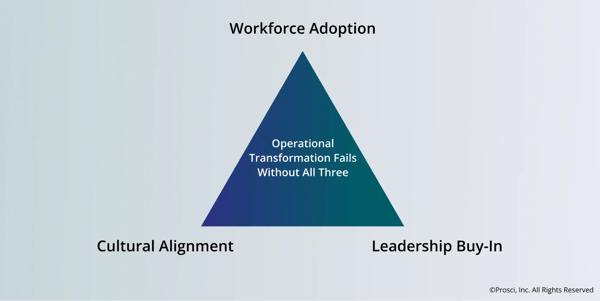
Yet many organizations approach transformation through a narrow lens, focusing solely on process redesign or new technologies. But process alone doesn’t drive change.
People do.
It’s essential to recognize this distinction and act on it through aligned projects and initiatives. Operational transformation is the process; operational excellence is the outcome.
And leadership is what connects the two.
It’s also what connects transformation to strategy.
Why operational transformation matters in a business strategy context
Defined this way, operational transformation naturally connects strategy execution and enterprise-wide resilience. Not only does it improve performance, it enables agility, adaptability and long-term value creation.
Done right, operational transformation brings measurable performance boosts that translate into greater revenue, efficiency and impact. It becomes a linchpin in turning an organization’s potential into performance. Based on their own sentiments, leaders today need more of this promise, with greater consistency.
A 2025 World Economic Forum study found that 84% of private-sector leaders feel underprepared for future disruptions. This highlights a dangerous gap in “disruption readiness”—the ability to bounce back quickly before disruption spirals into dysfunction.
But disruption readiness isn’t just about recovering from the shocks of a volatile market. It’s about building what Prosci calls change readiness: the systems, processes and behaviors that enable agility and responsiveness to change.
When operational transformation builds true change readiness, the impact extends far beyond financial performance.
Operational transformation is how that readiness becomes a reality: redesigning how work gets done and how quickly and cohesively the organization can adapt when facing rapid change.
It also enables leaders and organizations to:
- Eliminate legacy inefficiencies that stifle growth.
- Align people, systems and strategy under a single, unified direction.
- Unlock new value for existing assets, capabilities and talent.
However, these benefits only materialize when transformation involves people and processes. That outcome requires leaders to embed change management at the heart of the operational transformation. A structured, people-centric approach ensures the change takes root and makes the business strategy sustainable.
Uncovering and Resolving the Blockers to Operational Transformation
Many transformation efforts stall because they treat operational excellence as a technical finish line—something that can be achieved through process redesign, system upgrades, or new KPIs alone.
But operational excellence calls for a balance between systems outcomes and human-powered capability.
To get there, organizations need:
- Employees who understand the “why” behind new processes
- Leaders who model and reinforce desired behaviors
- Teams that collaborate across functions, not in silos
- Culture that embraces change as a competitive advantage
Even the most well-intentioned transformation efforts begin to falter here: it’s not because the technical plans are flawed but because the people side of change has been overlooked or underestimated.
Organizations must recognize and resolve the barriers to achieving lasting operational excellence. Let’s explore each barrier below.
1. Change fatigue and resistance
In organizations undergoing constant change, people often feel like the ground won’t stop shifting beneath them. One initiative hasn’t landed before the next begins. Over time, this relentless pace of change erodes engagement and morale.
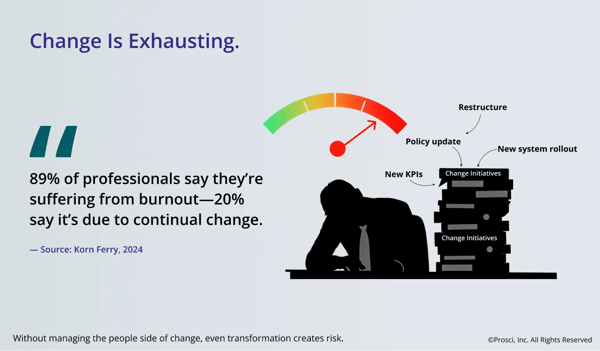
A 2024 Korn Ferry survey found that 89% of professionals report suffering from burnout, and 20% attribute it directly to continual change. The cumulative weight can lead to fatigue, frustration and quiet resistance, even when the changes are strategic and well-intended. And no matter how well-designed a new process may be, it won’t stick if people are too drained to engage with it.
Prosci’s own research reinforces this insight.
In our latest benchmarking study, 75% of respondents reported that high levels of change saturation directly increased resistance during transformation. As change saturation rises, employees become harder to engage, less responsive to communication, and slower to adopt new working methods.
And the impacts extend beyond exhaustion, taking on faces like:
- Non-project-specific resistance – Resistance isn’t always about one initiative. It often reflects how overloaded people feel by the volume of change happening across the organization. Employees may be excited about a change under different circumstances, but when they reach saturation, any new change can feel overwhelming.
- Lack of capacity – Change-saturated organizations often lack the capacity, time or resources to engage in additional change projects. Employees may decline further training or communication about new changes because their workload won’t allow for it.
- Increased failure – Organizations experiencing high change saturation tend to have more failed change projects, which can lead to a negative bias toward new initiatives, as employees may perceive them as likely to fail or a waste of time.
This is where the Prosci ADKAR® Model becomes an essential lead in operational transformation. The ADKAR Model is Prosci’s research-based framework for enabling individual change, and represents the five elements required for successful adoption:
- Awareness of the need for change
- Desire to participate and support the change
- Knowledge on how to change
- Ability to implement desired skills and behaviors
- Reinforcement to sustain the change
Prosci ADKAR Model
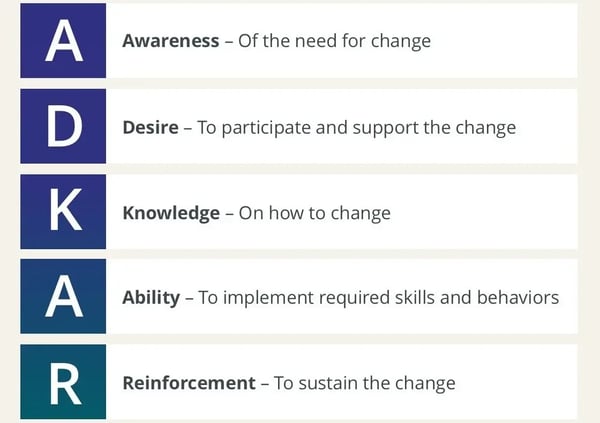
When leaders apply ADKAR to guide individuals through change, they don’t just reduce pushback. They equip people with the clarity and support they need to move forward. It reframes change from something that happens to employees into something they feel capable of navigating and contributing toward.
Later in this article, we’ll also explore how you can apply our ADKAR Model to your people-first operational transformation roadmap.
2. Lack of leadership alignment and visible sponsorship
When senior leaders aren’t aligned on the goals, messaging, or even the definition of “transformation,” it sends mixed signals that ripple across the organization. One leader outlines a bold future; another talks about incremental shifts. This lack of unity confuses employees, undermines confidence, and erodes trust before real change begins.
And the consequences go deeper than temporary confusion.
Inconsistent leadership messaging breeds skepticism, slows commitment, and can ultimately stall execution. When employees aren’t sure what to believe or whether leadership is fully behind the effort, they hesitate to engage.
That’s why active, visible sponsorship is such an influential success factor in transformation.
In fact, Prosci research shows that projects with exceptionally effective sponsors are 79% more likely to meet their objectives, compared to just 27% with ineffective ones. Consistent, aligned leaders do more than communicate—they lead by example. They make the strategy feel real by reinforcing it daily and showing teams what commitment to change looks like in action.
3. Insufficient consideration of culture and behavior change
Too often, organizations roll out new systems or reengineer processes without reshaping the underlying behaviors and cultural norms that make these changes stick. The result is an operational model that looks good on paper but fails in practice.
A BCG study on what it takes to increase the odds of a successful transformation found that 70% of these change initiatives fail—in large part because they’re undermined by the wrong culture.
Culture vs. Tech: Closing the Gaps
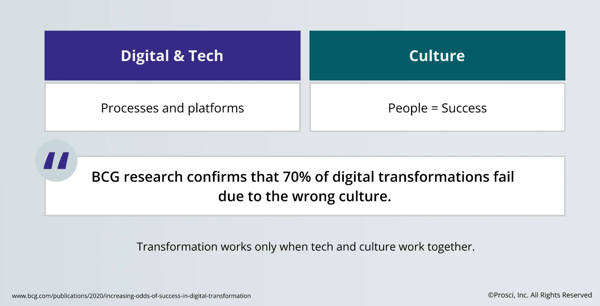
That’s not surprising. It’s easy to mistake “culture” as a backdrop, but its effects play out in the foreground every day. Culture exerts a very tangible force that shapes daily decisions, teamwork and the speed of adoption.
Keeping this reality in mind, Prosci’s approach treats culture and operational change as inseparable.
That shift from “procedural vs. personal” comes to life in real-world applications. Mateco, is a digital transformation example of applying our ADKAR Model to align global goals, mobilize local change agents, and embed new behaviors directly into workflows.
Their results were measurable and undeniable: Mateco’s change project achieved an 85% global alignment and a 30% reduction in admin time.
They saw the impact of shifting mindsets and establishing new team norms. Leaders modeled the change, and organizations reinforced it at the point of work through recognition programs, updated onboarding, or other practical tools.
When leaders adopt this structured, people-first approach and embed it in the organization’s culture, they can achieve the highest octave: operational excellence.
4. No structured approach for enabling adoption
A new system may be technically sound, but it won’t deliver the value without employee adoption. When change lacks structure, people are asked to leap before knowing where they’ll land, or why it matters.
This leads to quiet resistance, disengagement and ultimately, stalled transformation.
That’s why Prosci emphasizes a structured change management approach rooted in our ADKAR Model: Awareness, Desire, Knowledge, Ability, and Reinforcement. These aren’t afterthoughts. They’re essential checkpoints for driving adoption.
Organizations that skip these steps lose momentum. However, those who lead with a people-first strategy see stronger results. Research conducted as part of Prosci’s Best Practices in Change Management study revealed that organizations that effectively manage change are 4.6 times more likely to stay on or ahead of schedule.
The takeaway is clear: launching new tools or restructuring workflows is only part of the equation. Long-term success depends on how well people are supported to adopt and sustain the change.
5. Disconnected cross-functional networks
Operational transformation demands coordinated effort across the organization. But too often, change is led in silos. IT launches a new system, HR updates training programs, and operations redesigns workflows.
Each function moves forward, but not necessarily in sync. The result is chaotic but, unfortunately, familiar: Employees are left navigating conflicting priorities, mixed messages and misaligned goals.
Transformation loses traction when teams aren’t rowing in the same direction. According to a Harvard Business Review study, nearly 75% of cross-functional teams are dysfunctional, despite being critical for innovation and execution. That dysfunction shows up as information silos, role confusion and friction in day-to-day work.
This fragmentation is a people-side issue rooted in a lack of integration and alignment. Change management provides the connective tissue by building Awareness of shared goals, Desire to collaborate across silos, and Reinforcement of unified behaviors that keep transformation efforts moving forward.
Developing a People-First Roadmap for Operational Transformation
Operational transformation must go beyond high-level strategy to deliver measurable value and lasting performance. Leaders need a practical, end-to-end approach that pairs tactical execution with strong people enablement.
For executive leaders under pressure to deliver results, the challenge isn’t just what needs to change, it’s how to make it real. Amid the noise of buzzwords like AI, Lean, and agile operations, the real question remains:
“How do we actually pull this off in a way that works, and sticks?”
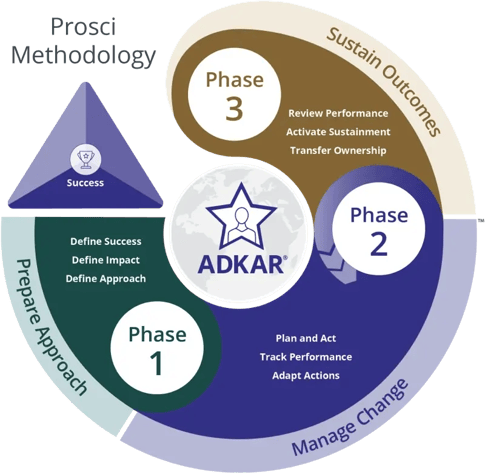
This roadmap provides the answer. Grounded in the Prosci ADKAR Model and the Prosci 3-Phase Process, it offers six straightforward steps to help transformation leaders plan, launch and sustain change across functions, with people at the center every step of the way.
Let’s walk through each phase.
Step 1 – Define the strategic vision & desired future state
Operational transformation begins with alignment at the top. The executive team must rally around a clear vision of what transformation looks like—and why it matters.
This vision should be:
- Specific – What operational goals (speed, efficiency, customer value) are being prioritized?
- Strategic – How do those goals support enterprise-wide objectives?
- Measurable – What outcomes will define success across both performance and adoption?
This clarity helps set expectations and align teams around a common direction.
In the Phase 1 – Prepare Approach, Prosci guides leaders to define success, assess readiness, and build a change strategy.
To do this well, leaders need to be clear and specific. High-level goals can often feel disconnected from day-to-day work.
The model below captures key elements to consider—your desired future state, how it connects to the current and transition states, and what each state means for both technical and people-related efforts. It also helps translate these insights into actionable projects focused on adoption, delivery and sustained use.
Prosci Unified Value Proposition
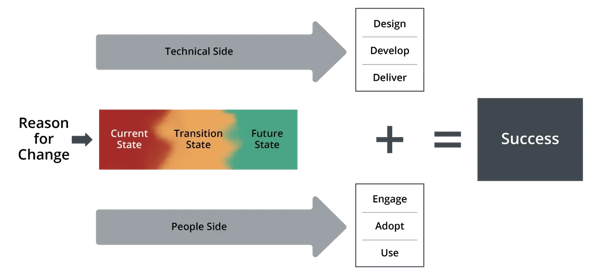
Without this step, transformation struggles. With it, leaders can start communicating early, keep messages consistent and involve employees through Awareness and Reinforcement while also supporting Desire, Knowledge and Ability.
The clarity developed during this phase supports using strategies and resources for change, such as our Communications Checklist.
This approach reflects Prosci’s focus on designing change to succeed by preventing issues rather than reacting to them.
Step 2 – Assess organizational readiness
Before launching a transformation, take stock of your organization’s ability to absorb and adapt to change. Use structured tools, like the Change Management Maturity Model or an organizational readiness assessment, to identify strengths and surface gaps.
Key areas to assess include:
- Cultural alignment – Are existing norms and behaviors aligned with the transformation vision?
- Historical response to change – How has the organization reacted to previous changes—successfully or not?
- Leadership support – Are leaders equipped and committed to driving the change?
- Capacity and capability gaps – Do teams have the bandwidth and skills to deliver?
In parallel, begin directly engaging stakeholders. Early involvement uncovers resistance, reveals unspoken concerns, and gives teams a voice in shaping the transformation.
Next, developing an understanding of communication’s central role when addressing resistance with our ADKAR Model, which we explore in our webinar here. Take a proactive approach to communications with employees by:
- Actively listening to people’s concerns and feedback
- Engaging all those impacted in co-creating the change journey
- Uncovering and removing emotional and operational roadblocks
- Clarifying options and outlining the risks of opting out
- Framing change as a path to growth, opportunity and shared success
Leaders often underestimate how complex people-driven change really is. Even the best business process redesign fails without employee commitment and adoption, which rests on the foundation of strong, consistent communication.
Step 3 – Activate leadership and sponsorship
Transformation efforts tend to fragment without sustained leadership involvement. That’s why Prosci embeds sponsorship activation into Phase 1 – Prepare Approach of the Prosci 3-Phase Process.
It guides executives to identify primary sponsors, clarify expectations, align messaging across leaders, and consistently reinforce those behaviors throughout the change's lifecycle.
To drive change with credibility and momentum:
- Confirm sponsors and ensure they’re visible, active and aligned across the leadership team.
- Equip middle managers and people leaders with the tools and clarity they need to guide and coach their teams.
- Reinforce sponsorship behaviors regularly. Passive endorsement erodes trust.
A clear pattern emerges: the need for leadership training. Nowhere is that clearer than in the MGIC transformation. As one of the top mortgage insurers in the U.S., MGIC saw the financial crisis as an opportunity to strengthen its change capabilities.
Led by Gina Zielinski and Patti Ulwelling, the company anchored its efforts in the Prosci ADKAR Model. Their transformation offers a clear example of what successful change looks like:
- They began by engaging senior leadership and then rolled out targeted Prosci training for managers and change practitioners alike.
- They emphasized real-world application. Tams were encouraged to share insights, apply concepts to active projects, and continuously refine their change strategies.
- They prioritized a hands-on approach that helped close the gap between knowledge and ability, enabling employees to embed change management into everyday operations.
MGIC’s experience shows that when leaders are equipped, engaged and intentional, change becomes part of how the organization works and wins.
Step 4 – Build the change management infrastructure
With strategy and sponsorship in motion, the next step is to build the infrastructure that turns intent into success. This is the focus of Phase 2 – Manage Change in the Prosci 3-Phase Process, where operational transformation is implemented, sustained and scaled.
That’s where Prosci brings a pivotal advantage: a repeatable, research-based methodology that makes complexity manageable. This structured methodology provides leaders with a proven playbook to guide adoption at scale, making the process both measurable and repeatable.
Rather than relying on generic playbooks, transformation leaders must equip the organization with tailored, role-specific enablement plans that support changes in behaviors across functions and levels.
That means delivering the four core plans that form the Master Change Management Plan:
- Sponsor Plan – Focuses on the roles and responsibilities of the primary sponsor and the sponsor coalition. It aims to ensure effective sponsorship, targeting the Awareness, Desire and Reinforcement elements of the ADKAR Model.
- People Manager Plan – A plan designed for people managers to help them support their teams through the change process. It addresses all elements of the ADKAR Model and outlines how managers can perform their CLARC roles (Communicator, Liaison, Advocate, Resistance Manager, and Coach).
- Communications Plan – This plan identifies key audiences, develops essential messages, and outlines the frequency and methods of communication to ensure that stakeholders are informed and engaged.
- Training Plan – This plan helps assess training needs, develop training content, and ensure that impacted people have the necessary skills and knowledge to adopt the change.
Change leaders can also deliver additional plans, like the Resistance Management Plan—an extended plan that addresses potential resistance by identifying sources and strategies to manage resistance effectively.
Your Change Enablement Toolkit
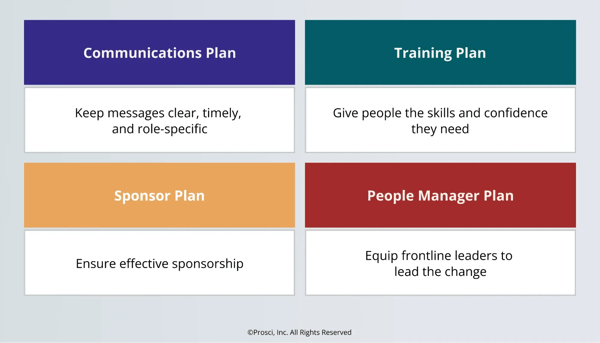
When these plans are built deliberately, they do more than support individual change. They create the conditions for team-wide adoption and give leaders real levers to pull when momentum stalls. It’s how change moves from intention to real results.
Step 5 – Execute, monitor and adapt in real time
Execution is where plans become reality, and where transformation efforts can crash without the right feedback systems in place.
The Prosci approach offers structure for this high-stakes stage. Our research-based tools enable leaders to track progress, spot resistance hotspots, and course-correct early, before small issues become systemic blockers.
As new workflows or structures roll out, leaders must embed real-time feedback loops to:
- Monitor employee adoption – Are people aware of the change? Are they engaging with new tools and processes?
- Surface early friction points – Where are users struggling? Are managers equipped to coach through uncertainty?
- Adjust communications and training – What messages need clarification? Which skill gaps need reinforcement?
Our change tracking tools can also help monitor three essential adoption metrics:
- Speed of Adoption – Are individuals embracing the change?
- Usage – Are they consistently using the new tools or processes?
- Proficiency – Are they using them correctly and effectively?
Operational transformation is resource-intensive, highly visible and often under executive scrutiny. By applying a framework that adds rigor and measurability to the people side of change, leaders can reduce risk and demonstrate ROI throughout the transformation, not just at the finish line.
Step 6 – Reinforce and sustain new ways of working
Transformation doesn’t end with implementation. Without intentional reinforcement, new behaviors and processes can fade, undermining progress and ROI. Our research found that organizations that proactively plan and allocate resources for reinforcement activities are significantly more likely to achieve or exceed their change objectives.
Impact of Planning for Reinforcement and Sustainment on Meeting Objectives
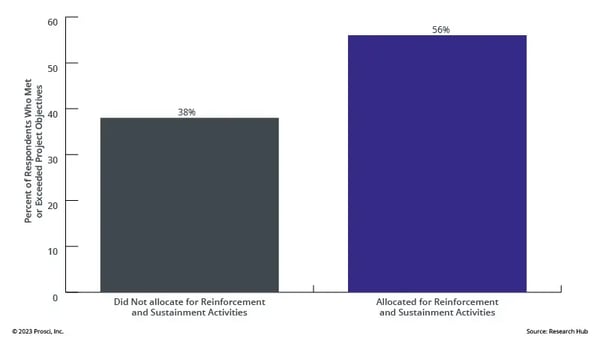
That’s why the 3-Phase Process’ Phase 3 – Sustain Outcomes is so important: it ensures that change becomes embedded and institutionalized.
Cultural reinforcement is the key to unlocking the reinforcement of the values, habits, and leadership behaviors that make new ways of working the norm rather than the exception.
To sustain transformation over the long term, organizations should:
- Recognize and reward individuals and teams for behavior change, milestone achievements and leadership follow-through.
- Embed new processes into performance management, onboarding and day-to-day operations to normalize expectations.
- Establish mechanisms for continuous feedback and improvement to track progress, address misalignment and maintain momentum.
When transformation is supported by systems and reinforced through culture, it becomes a durable capability. Organizations that prioritize this final phase position themselves to sustain change and to adapt more effectively in the future.
People Remain the Best Pathway to Operational Excellence
“Plans on paper” are the right starting point, but you’ll need people in power to translate them. So, it’s time to take a 50,000-foot view and use our roadmap to assess honestly: Are your current frameworks for operational transformation equipped with the capacity for people-enablement?