
5 Mins
Updated: April 13, 2026
Published: July 30, 2025



Digital tools are rapidly reshaping how care is delivered, coordinated, and experienced. From virtual visits and AI diagnostics to cloud-based data systems and patient-facing apps, healthcare organizations are investing heavily in technology to meet rising demands—from both patients and providers. But what is digital transformation in the healthcare industry, really? It’s not so much about the latest tools as fundamentally reimagining how systems operate to balance three critical priorities: patient experience, clinical outcomes, and operational efficiency. Successful transformation efforts align cutting-edge technology with the human side of care, so that innovation supports the mission of healing.
The opportunity is massive: artificial intelligence, machine learning, and deep learning alone are projected to unlock $200 billion to $360 billion in annual net savings across U.S. healthcare systems. But capturing that value demands a deliberate strategy for change.
In this article, we explore what digital transformation in healthcare really looks like, the challenges systems face, and how proven change management strategies help ensure that technology delivers lasting impact.
Putting Patients at the Center of Change
At the heart of every successful digital transformation in health services is a simple question—Does this make care better for the patient? Whether implementing telehealth platforms, automated appointment reminders, or remote monitoring tools, digital technologies must serve the goal of enhancing patient outcomes, access, and experience.
But prioritizing patients isn’t just about deploying new tools, but rather building a culture that listens to and evolves with them. Organizations that embed patient feedback into their design and rollout processes are better equipped to meet real-world needs, not just internal metrics.
To drive lasting adoption, these initiatives must also connect to what motivates people to change. In the Prosci ADKAR® Model, the Desire element plays a pivotal role: individuals are far more likely to embrace transformation when they understand how it directly benefits the people they serve. Framing digital initiatives around patient impact (e.g., reducing waiting times, improving communication, or increasing care access) helps build genuine buy-in across the organization.
Fostering a culture that values patient collaboration isn’t a one-time effort. It’s a shift in mindset, where every new system or process is seen through the lens of those who rely on it most.
Investment in the Integration of Advanced Technologies
Electronic health records (EHRs), telemedicine platforms, remote monitoring tools, and data analytics systems are transforming how care is delivered and coordinated. But these digital technologies only create value when they’re purposefully integrated into clinical practice and aligned with organizational goals.
- EHRs centralize patient information, enabling clinicians to make more informed decisions and improving continuity of care while protecting data privacy and security.
- Telemedicine expands access to services, especially in rural or underserved areas, by allowing patients to consult with providers remotely.
- Remote monitoring supports chronic disease management by capturing real-time health data between visits, helping detect issues early.
- Data analytics helps organizations identify trends, allocate resources more effectively, and close gaps in care.
When implemented thoughtfully, these tools don’t just digitize processes—they improve workflows, elevate patient outcomes, especially for those with chronic conditions, and enhance operational efficiency.
But adoption alone isn’t success. For these technologies to stick, organizations must invest in structured training aligned with Knowledge and Ability in the Prosci ADKAR Model. That means supporting clinical teams with hands-on, role-specific guidance and showing how each system tangibly improves their work.
Without this foundation, even widely adopted tools can become a source of friction. In fact, while 75% of U.S. hospitals now use electronic health record (EHR) systems, many clinicians report negative side effects from digital tools due to misuse or insufficient training. In some cases, this leads to workarounds that risk undermining patient care.
To truly deliver value, digital systems must be integrated not just into the IT infrastructure but the daily behaviors, workflows, and culture of care delivery as well.

Driving Digital Transformation: Leadership Engagement and Support
No digital transformation effort in healthcare succeeds without strong, visible leadership. While technology can enable change, it’s leaders who drive it. Their commitment signals that transformation doesn’t impact IT alone. It’s a strategic, organization-wide priority.
And yet, a recent McKinsey survey reveals a critical gap: nearly 90% of healthcare executives, including CIOs, CEOs, and CFO, rank digital and AI transformation as a top priority. But 75% admit they haven’t sufficiently allocated the resources to deliver on that vision. That disconnect stalls progress and undermines credibility.
To close this gap, healthcare professionals must act as sponsors by actively championing digital initiatives from start to finish. This requires consistent, strategic engagement through the ABCs of sponsorship:
- Active and visible participation: Leaders should be present throughout the change process, attending key meetings, acknowledging milestones, and modeling desired behaviors.
- Building a coalition of support: Engaging other leaders, influencers, and stakeholders creates alignment across departments and ensures that frontline teams hear a unified message.
- Communicating directly and consistently: Regular, transparent communication from leaders builds trust, reduces resistance, and reinforces the purpose behind each initiative.
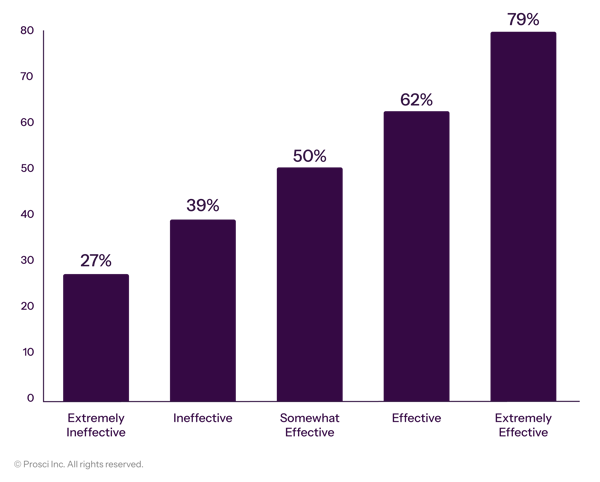
Prosci’s research has repeatedly shown sponsorship to have the greatest direct impact on whether projects meet their objectives. An effective executive sponsor can increase a project’s chances of achieving its intended business benefits from 25% to 85%. When executive sponsorship is strong and sustained, teams are more likely to feel confident, aligned, and motivated. Leadership engagement also leads to accountability, helping transformation efforts stay focused, on budget, and on track toward measurable outcomes.
The Correlation of Sponsor Effectiveness With Meeting or Exceeding Objectives
Addressing Resistance and Fostering Engagement
Resistance is a natural response to change, especially in the healthcare sector, where established clinical practices and routines are built for precision, safety, and efficiency. Digital transformation can feel disruptive, introducing unfamiliar tools and workflows into already demanding environments. Left unaddressed, this resistance can undermine adoption and stall progress.
That’s why it’s essential to take a structured, people-first approach to managing resistance. The ADKAR Model provides a practical framework that identifies where individuals are struggling in the change process. Whether it’s a lack of Awareness about why the change is happening or a gap in Ability to apply new tools confidently, targeted interventions can help close these gaps and build lasting support.
In addition to using ADKAR, healthcare organizations can strengthen engagement by creating dedicated spaces for open dialogue, where staff can express concerns and offer input early and often. Appointing peer champions—trusted colleagues who model desired behaviors and provide guidance—can further encourage commitment and reduce uncertainty among healthcare providers. And by offering ongoing coaching and just-in-time support, leaders can create a supportive environment for individuals as they adapt to new tools and processes.
Measuring Outcomes and Continuous Improvement
In healthcare, where every improvement touches lives, the ability to track progress is essential. It’s how change leaders prove the value of transformation and guide the next wave of impact.
Digital healthcare initiatives should be tied to specific, meaningful metrics. For patient outcomes, this might include reductions in hospital readmission rates, improvements in chronic disease management (like A1C levels for diabetes), or faster recovery times post-surgery. These indicators show whether new tools and workflows are actually helping patients get healthier, faster.
When it comes to care quality, KPIs may include patient safety metrics (such as fall rates or infection rates), adherence to clinical guidelines, or patient-reported experience measures (like HCAHPS scores). These metrics reveal how effectively care is being delivered and how patients perceive it.
For operational efficiency, healthcare leaders often track appointment wait times, average length of stay, staff productivity, or the time it takes to complete documentation in electronic health records (EHRs). These numbers highlight where digital tools are reducing friction and where there is room to improve.
The most effective change leaders align these KPIs with their transformation goals and use them as a feedback loop. When progress shows up in the data, they celebrate it to reinforce momentum. When something stalls, they adjust with speed and clarity.
Change managers in healthcare know that measurable results elevate patient care, empower clinicians, and make the entire health system stronger from the inside out.

Real-World Impact: Enabling Patient Care Through Seamless Digital Integration
A Chicago-based academic health system offers a compelling case study in how effective change management can transform even the most complex digital initiatives. When the organization acquired two new entities that included nearly 100 locations, it faced the massive task of integration, including a system-wide ERP rollout.
Rather than risk disruption to patient care, leaders partnered with Prosci to certify change practitioners, build sponsor coalitions, and use ADKAR assessments to guide strategy and address adoption gaps. Through structured coaching and training, both leaders and frontline staff were supported every step of the way.
The impact was clear: employee engagement remained high, and adoption rates exceeded those of prior integrations. Most importantly, the smoother implementation meant healthcare professionals could focus their time and energy on caring for patients instead of troubleshooting new digital technologies.
Driving Sustainable Change in Healthcare
Digital transformation offers extraordinary promise but people must remain at the center. No matter how advanced the technology, the true measure of success lies in how well it supports patients, clinicians, and the broader mission of care.
That’s why patient-centered care must remain the north star of every transformation effort. Whether you’re implementing new tools, redesigning workflows, or introducing AI into clinical decision-making, the goal is the same: improve outcomes, enhance experiences, and do so sustainably.
But technology alone doesn’t create change. Success depends on both technical readiness and a thoughtful, people-centered change strategy that builds awareness, earns trust, and supports clinicians and staff through the journey.