
8 Mins
Updated: April 13, 2026
Published: August 20, 2025



70% of logistics companies are already investing in digital transformation. Yet the majority struggle with adoption and sustainability. Not because of the technology, but because of the people side of change. Understanding the human factors that drive transformation success is key to lasting change impact.
Today’s logistics customers expect fast service and seamless digital experiences. However, legacy systems and outdated processes leave many logistics companies struggling to meet these demands. Digital transformation in logistics can help you stay ahead of your customers’ evolving expectations.
In this article, we’ll explore the benefits of digital transformation in logistics and the people-centric challenges of successful transformation. We’ll also share specific change management best practices that help you smoothly adopt new technologies.

What is Digital Transformation in Logistics?
Digital transformation in transportation and logistics involves using digital technologies to enhance supply chain operations by improving efficiency, visibility, and agility. When undertaken, logistics organizations will adopt tools like AI, machine learning, automation, and Big Data Analytics as strategies to streamline operations and improve customer experience.
Currently, digital transformation plays a central role in the longevity of logistics companies—a reality that leaders are well aware of:
- The global digital logistics market is predicted to grow from $37.64 billion in 2025 to $120.33 billion by 2032.
- 70% of enterprise logistics companies have already undergone some degree of digital transformation.
- 97% of these organizations report dedicating resources to developing their digital transformation strategy.
- Many also use the Internet of Things (IoT), such as IoT sensors. A survey revealed that 55% of logistics companies utilize between 1000 and 10,000 IoT devices, while 38% operate smaller networks of 500 to 1,000 IoT sensors.
Operating in a rapidly expanding and competitive industry, businesses now view digital transformation as an urgent strategic imperative for their long-term viability.
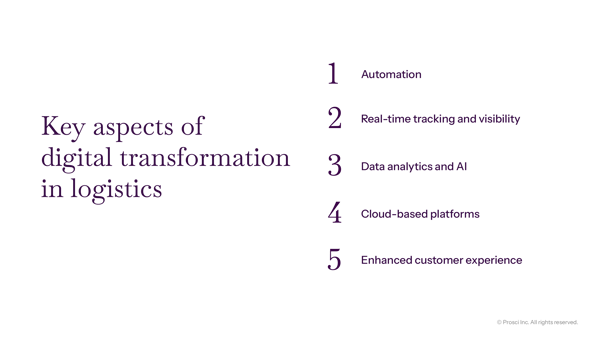
Key aspects of digital transformation in logistics
From automating manual processes to enabling greater transparency, digital transformation uses various tools and technologies to improve supply chain operations.
The key aspects of digital transformation in logistics include:
- Automation – Replaces manual processes for faster, more streamlined operations.
- Real-time tracking and visibility – Enable shipment monitoring and proactive decision-making.
- Data analytics and AI – Transform raw data into predictive, actionable insights.
- Cloud-based platforms – Centralize operations and facilitate easier access to systems and data.
- Enhanced customer experience – Improves service quality through faster, more transparent logistics.
These tools reshape logistics operations. And their success depends on how well people can use them.
The Benefits of Digital Transformation in Transportation and Logistics
Digital transformation initiatives offer significant benefits to logistics companies. It’s unsurprising that global digital transformation spending in the logistics industry, about $3 billion in 2020, is projected to reach $84.6 billion by 2027.
When implemented correctly, your transformation can improve productivity, decision-making, competitiveness and even employee engagement.
Benefits of Digital Transformation in Logistics
- Increased efficiency and productivity
- Reduced costs and improved profitability
- Greater transparency and visibility
- Better agility and responsiveness
- Improved customer satisfaction
- Empowerment through data
- Higher employee engagement
- Enhanced skills development
Increased efficiency and productivity
Streamlined digital operations replace manual work, speeding up fulfillment, tracking, and last-mile delivery.
However, lasting improvements only occur when employees adopt new ways of working. Prosci research shows that effective change management significantly enhances adoption rates. Projects that implement excellent change management practices are seven times more likely to achieve change success.
Correlation of Change Management Effectiveness with Meeting Objectives

Reduced costs and improved profitability
From route optimization and robotic process automation to better inventory management, digital transformation in transportation and logistics can drive down operational costs and boost profitability.
Realizing this benefit relies on employees having the skills to operate new systems effectively. Targeted training and support are essential to maximize ROI.
Better agility and responsiveness
Digital solutions like demand planning software enable faster responses to market shifts and customer needs, helping logistics teams adapt more quickly and precisely.
Sustaining this agility requires a culture that embraces change and innovation. Change management fosters mindsets and behaviors that support continuous improvement and adaptability.
Multinational logistics company Crowley adopted a structured approach to change management to improve agility and build change capability. Equipped with Prosci’s tools and training, the company grew its organizational change maturity score from 1.8 to 3.0 (on a 5-point scale) in a single year.
Improved customer experience
Digital solutions like machine learning and predictive analytics enable faster, higher-quality service, clearer communication, and improved traceability opportunities, leading to better customer experiences.
To achieve this, employees must feel confident using new tools in real-world interactions. Change management builds that confidence through tailored training and hands-on practice.
Competitive advantage
Digitizing systems and processes can allow logistics companies to offer quicker and more cost-effective services, providing a stronger competitive edge.
Change management helps maintain this advantage by providing employees with ongoing support to sustain change. Organizations that prioritize employee engagement and support are more likely to see higher adoption rates and lasting results.
Danish company DSV Global Transport and Logistics increased competitive advantage by integrating change management into its organizational culture using the Prosci Methodology. DSV improved results across key change initiatives after establishing a Business Change Management unit and certifying 50 change practitioners across 22 countries.
Stronger decision-making
Access to real-time data is an important aspect of digital transformation. This visibility enables faster, more informed decisions.
However, to act on insights, employees need to trust the tools they’re using. Change management helps build trust and confidence by communicating clearly about advanced technologies and how they help.
Higher employee engagement
Digital solutions can enhance communication and collaboration among team members, fostering higher employee engagement.
Change management reinforces this employee engagement by creating an environment that values communication, involvement and recognition of employees throughout the transformation journey.
While the benefits of digital transformation are clear, achieving them requires a people-centric approach to overcome common challenges.
Challenges of Digital Transformation in Logistics and Supply Chain
From complex supply chains to constantly evolving compliance requirements, logistics companies face unique challenges. These challenges can impact digital transformation initiatives, resulting in implementation delays and stalled adoption.
Here are some of the most common challenges logistics companies encounter and how they affect digital transformation.
Challenges of Digital Transformation in Logistics
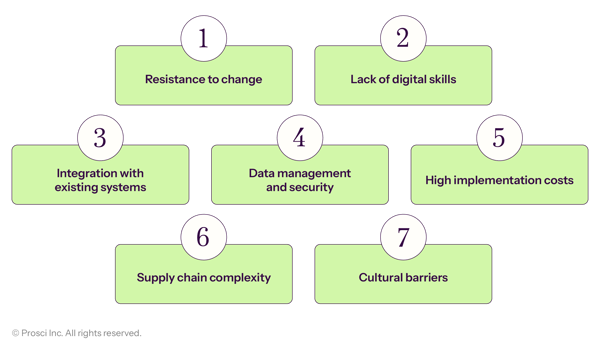
Resistance to change
People may resist adopting new technologies due to fear of the unknown, lack of understanding or comfort with existing systems.
Resistance is normal. But when ignored, it delays implementation, lowers adoption, drives up costs, and hurts morale.
Lack of digital skills
A Prosci study, Keys to Unlocking AI Adoption, found that almost 40% of adoption challenges stem from a lack of proficiency and training.
Without sufficient digital skills, employees can’t fully leverage new technologies, leading to poor adoption, lost ROI and stalled transformation efforts.
Integration with existing systems
Integrating new digital solutions with legacy systems and outdated processes can be complex and costly.
Poor integration leads to inefficiencies, frustration, and missed opportunities to realize the full benefits of new technologies.
Data management and security
Ensuring data accuracy and security can be complex, especially in an industry like logistics that deals with sensitive information.
Ineffective data management can also increase compliance risks and cybersecurity threats, impact employee trust in new systems, and lead to adoption issues due to resistance.
High implementation costs
Upfront investment for digital transformation can be significant. Logistics companies may hesitate to allocate the necessary budget, especially if the return on investment is uncertain.
High implementation costs may lead to a reduced scope of transformation. This can result in a less comprehensive approach that doesn’t fully address the needs of your organization or its people.
Supply chain complexity
Logistics often involves complex supply chains with multiple stakeholders and systems. Coordinating digital transformation efforts across various partners and suppliers can be daunting.
Complex supply chains are more susceptible to disruption, whether from geopolitical events or natural disasters. This can complicate transformation efforts, as you may need to divert resources to address immediate issues instead of focusing on long-term digital initiatives.
Addressing the many challenges of digital transformation in logistics and transportation isn’t easy. But with a structured approach that puts people at the center, you can overcome common issues and facilitate a smooth transformation journey.

Why Change Management Is a Catalyst for Digital Transformation in Logistics
Change management plays a central role in digital transformation by equipping and supporting people through technological change.
Here’s how effective change management can spark successful transformation in your digital initiatives.
Facilitates adoption
Digital transformation requires employees to adopt advanced technologies. Change management ensures people understand the need for change and are equipped to use new tools.
This human-centric approach is essential for achieving high adoption rates, which are critical for realizing the benefits of digital initiatives. For example, Microsoft saw a 450% increase in adoption rates after adopting the Prosci Methodology for change management.
Minimizes resistance
Resistance is a natural part of the change process, especially when large-scale digital transformation projects involve significant shifts in how people perform their jobs.
Change management focuses on addressing concerns and ensuring everyone understands the reasons for change. This reduces the likelihood of disruption due to resistance.
Aligns stakeholders
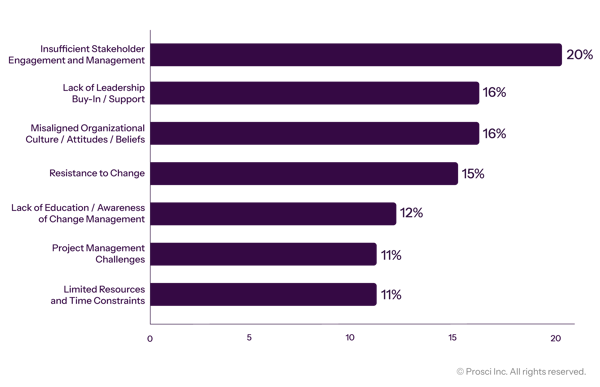
In Prosci’s Best Practices in Change Management – 12th Edition study, 20% of participants identified insufficient stakeholder engagement as an obstacle to effectively managing change.
A structured approach brings everyone into alignment around the transformation’s purpose, making implementation smoother and collaboration stronger.
Challenges to Change Management
Enhances communication
Successful transformation relies on clear and consistent communication to ensure people understand what’s changing and why.
Change management provides a framework for communicating the reasons for the transformation, progress, and benefits, helping to maintain engagement and motivation.
Builds skills and competencies
Digital transformation strategies typically require employees to learn new competencies to use new technologies effectively.
Change management includes training and development plans to equip employees with the necessary knowledge and skills, enhancing employee performance and confidence.
Sustains outcomes
Delivering lasting impact from your digital transformation project depends on sustaining the results in the long term.
To ensure ongoing success, change management initiatives reinforce new behaviors, monitor performance and support leaders to adjust over time.
Improves ROI
Prosci research shows that projects with structured change management processes are significantly more likely to achieve their change objectives.
This is particularly relevant in logistics, where digital transformation can improve efficiency, cost savings and customer satisfaction.
Best Practices for Successful Digital Transformation in Logistics With Change Management
The following change management best practices will help your people adopt new technology competently and confidently.
Best Practices For Achieving Digital Transformation in Logistics With Change Management
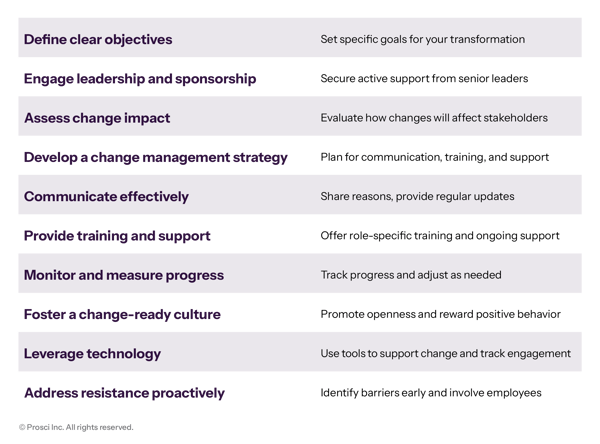
Define clear objectives
An effective digital transformation strategy requires the establishment of specific goals. These could include improving efficiency, enhancing customer experience or strengthening demand forecasting.
For example, a third-party logistics provider might set goals to automate warehouse operations and improve inventory management accuracy across multiple distribution centers.
Engage leadership and sponsorship
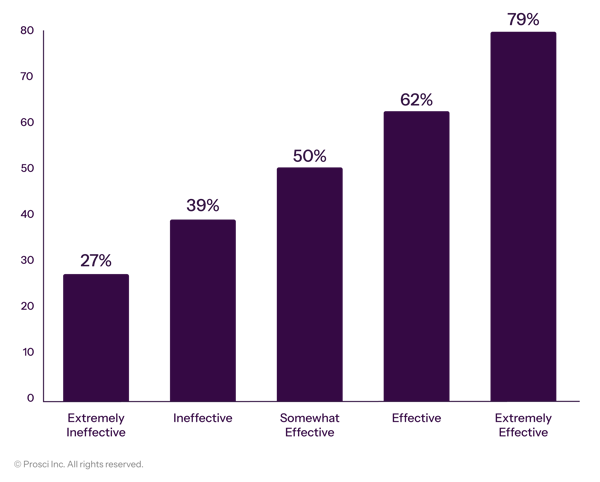
Prosci research shows that change initiatives with extremely effective sponsors are 73% more likely to achieve their objectives.
Secure strong support from senior managers and sponsors who can champion the change. Active leadership involvement is crucial for building commitment and obtaining resources across the organization.
Correlation of Sponsor Effectiveness With Meeting Objectives
Assess change impact
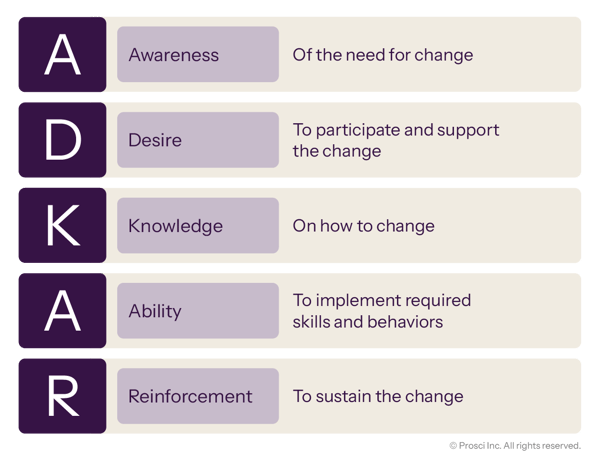
Research-backed change management tools, such as the Prosci ADKAR® Model, can help you understand individual transitions and provide tailored support at each stage.
Conduct an assessment of how the digital transformation will impact people across the organization. Based on this, develop an action plan for addressing potential resistance.
Prosci ADKAR Model
Develop a change management strategy
A comprehensive change management strategy guides your digital transformation journey. It should include communication, training and support mechanisms.
Ensure your strategy addresses the human side of change, with a plan to prepare and equip people to adapt to new technologies.
Communicate effectively
Your digital transformation efforts should be supported by clear, open communication about the reasons for the change and its specific benefits for those impacted.
To ensure understanding and keep everyone aligned, provide regular updates to alleviate concerns and build trust.
Provide training and support
Skills training equips employees with the knowledge they need to thrive in a new digital environment.
Offer tailored programs to suit the needs of different groups. Consider ongoing support to address questions and challenges as they arise.
Monitor and measure progress
Implement metrics to track the success of your digital transformation efforts and the effectiveness of change management initiatives.
Review progress and adjust your transformation strategies based on feedback and performance data.
Foster a change-ready culture
A culture that embraces change and innovation will keep your organization ahead. To encourage this, you must promote a mindset that values continuous improvement.
Recognize and reward employees who contribute to change initiatives and share success stories to highlight positive behaviors.
Leverage technology
Digital tools and predictive analytics can help you facilitate the change management process and provide visibility into its effectiveness.
Use tools to measure engagement, track progress and gain insights into employee adoption rates.
Address resistance proactively
Preparing for resistance is the first step in addressing it. Identify potential barriers to change early on and develop strategies to overcome these concerns.
This could include involving resistant employees in the change process to foster a sense of ownership or providing additional support where needed.
Digital Transformation in Logistics: FAQs
What is digital transformation in logistics?
Digital logistics transformation optimizes supply chain operations through tools like AI, IoT, real-time tracking, predictive analytics, and cloud computing. As a result, digital transformation in logistics improves efficiency, transparency, and profitability.
What are the 5 main areas of digital transformation?
Digital transformation can be applied to different areas of an organization. The five main types of digital transformation are:
- Business process transformation – Digitizing workflows to improve efficiency, accuracy and speed.
- Business model transformation – Reinventing how value is delivered through digital channels.
- Domain transformation – Expanding into new markets enabled by digital capabilities.
- Cultural transformation – Shifting mindsets to embrace change and innovation.
- Cloud transformation – Adopting cloud computing platforms for scalability, access and flexibility.
Why is digitalization important in logistics?
Digitalization is crucial for logistics companies to stay competitive and satisfy customer demands. Digital transformation efforts help optimize supply chain management processes, allowing companies to operate more efficiently, reduce operational costs, gain better visibility, and scale their businesses.
What is a digital logistics strategy?
A digital logistics strategy is a detailed plan involving technology to optimize and streamline your logistics operations. This includes planning, procurement, transportation and delivery. A comprehensive digital logistics strategy involves digitizing traditional logistics processes, automating routine tasks, and using predictive analytics and predictive maintenance to improve efficiency and visibility.
Driving Sustainable Digital Transformation in Logistics With a People-Centric Approach
Successful digital transformation in the logistics industry depends on how well you support your people through change. A structured, human-centric approach can help you overcome the unique challenges of digitization in logistics, such as supply chain complexities and integration challenges.
Digital transformation only delivers long-term value when people are equipped and aligned. Strong leadership, clear objectives, and targeted support make that possible.