
13 Mins
Updated: April 13, 2026
Published: June 17, 2025



What if your biggest barrier to digital transformation isn’t technology, but how your people experience change? Enterprises pour billions into new systems, platforms and AI-driven tools. Yet, time and again, these investments stumble—not because the tech fails, but because the organization behind it isn’t ready. Employees resist, adoption lags, and expected benefits remain out of reach.
Prosci’s research confirms a hard truth: projects that invest in change management and achieve excellence are seven times more likely to meet their objectives than those that don’t.
That’s because effective change management focuses on the people side of change. It equips and engages individuals to adopt new ways of working, which drives faster adoption, minimizes resistance, and increases ROI and organizational resilience.
In this article, we'll explore the significance of enterprise digital transformation, the challenges organizations face, and how integrating effective change management strategies can drive digital transformation success.
What Is Enterprise Digital Transformation?
Enterprise digital transformation is the integration of digital technology and products into an organization’s existing digital ecosystem. It fundamentally reshapes and optimizes operations, workflows and value delivery. In addition to process and technical changes, enterprise digital transformation requires a cultural shift, as it involves individuals changing the way they work and their daily routines.
As John Chambers, the former CEO of Cisco Systems, said, "At least 40% of all businesses will die in the next ten years... if they don't figure out how to change their entire company to accommodate new technologies."
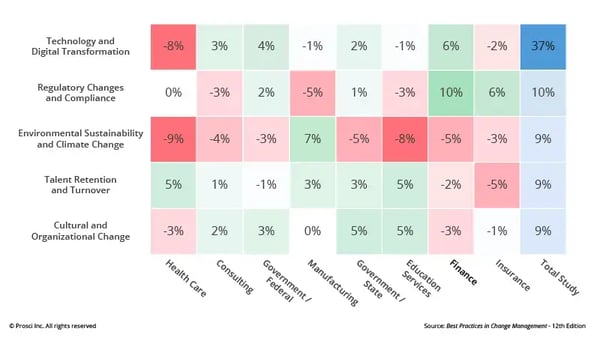
Leaders and change professionals across industries agree with this sentiment, with participants in our Best Practices in Change Management research ranking technology and digital transformation as the top expected change.
Top 5 Expected Changes By Industry
Digital transformation takes many forms—automation, system integration, artificial intelligence (AI), machine learning, and upgrading analog systems to digital. These changes are essential for businesses of all sizes, but the scale and complexity grow exponentially in changing everything from infrastructure to supply chains at the enterprise level.
While adopting new software is a major step for any organization, enterprise transformations involve coordinating across multiple teams, locations and hundreds of employees. Success hinges not just on the technology itself, but on how people adopt and sustain new ways of working.
That’s where a people-centered approach becomes essential. With clear business strategies, structured change roadmaps, and proven methodologies like the Prosci Methodology, business leaders can manage both the technical and human dimensions of transformation, increasing the chances of success and long-term value realization.
Benefits of Digital Enterprise Transformation Solutions
Digital enterprise transformation enables businesses to use technology to their advantage. With it, they can stay competitive by meeting changing market demands effectively. Well-executed digital transformation, supported by the right digital tools and technologies, can provide the following benefits:
- Improved operational efficiency – Organizations can optimize workflows, reduce human error, and improve overall business performance by automating manual processes through digital tools like ERP systems, RPA (Robotic Process Automation), and cloud solutions. GE Appliances' (GEA) digital transformation is a great example of how digital changes can positively impact different areas of an organization. Their transformation started with 3D scanning in 2016 and more recently it led to end-to-end digital engineering that improved their product quality, performance speed and innovation.
- Data-driven decision-making – Advanced technologies for predictive analytics provide actionable insights into business operations, customer expectations and market trends. These data-driven insights allow leaders to make informed, real-time decisions to improve strategic planning, operational effectiveness and employee experience.
- Better customer experience – Through digital transformation, organizations can adopt personalized and data-driven approaches to cater to customer expectations and preferences. Businesses can offer responsive customer support and tailored digital services through AI, chatbots and omnichannel platforms, leading to higher customer loyalty.
- Increased agility and scalability – Digital solutions, like cloud-based infrastructure and server systems, allow enterprises to adapt quickly to market changes and scale operations on demand. This agility is crucial in a competitive, fast-paced business environment.
- Optimized costs – Transitioning to digital tools and cloud solutions reduces the need for expensive on-premise infrastructure and maintenance. Automation also minimizes operational expenses, delivering significant long-term cost savings.
- Increased innovation – Digital transformation allows businesses to experiment with emerging technologies like AI, IoT and blockchain. This innovation opens up new opportunities to differentiate themselves in a competitive marketplace.
More organizations are prioritizing digital transformation as a foundational part of their strategy—84% now identify it as a core pillar of their business plans. As these initiatives expand, success depends on more than implementing new technologies.
Effective change management connects digital innovation with human adoption. It enables organizations to achieve long-term success. By aligning people, processes and technology, change management turns ambitious strategies into sustained performance.

Enterprise Digital Transformation Examples
Here are three real-life examples that highlight the importance and benefits of combining change management and enterprise digital transformation services:

1. SURA Asset Management
SURA Asset Management, a Latin American subsidiary of Grupo SURA, is a financial services leader specializing in pensions, savings and investments. The company manages assets worth $131 billion (2.6 trillion pesos) and serves over 19 million Latin Americans. But they needed a way to manage enterprise-wide changes without causing disruptions.
SURA took on multiple large-scale digital projects to deal with regulatory changes, digitize its pensions department, and revamp its product sales strategy. SURA's leadership identified change management as vital for the success of these projects and partnered with Faculta, now Prosci Latin America, to build its enterprise change capability.
By adopting the Prosci Methodology, SURA succeeded in its critical projects. It gained 2.3 million new customers and reduced client turnover by 44%, saving 14 million pesos.
2. UKG
UKG, a product of a merger between Ultimate Software and Kronos in 2020, is among the world's leading human capital management (HCM) cloud companies and serves over 80,000 organizations. Any change at an enterprise of this size needs an evidence-based approach like the Prosci Methodology to ensure adoption.
After the merger, the two companies' systems for sales, customer service, and billing operated separately. To fix its scattered operations, the company created "UKG 1," a large-scale system integration project that involved over 1,000 individuals.
With the help of Prosci Certified Change Practitioners, UKG implemented the Prosci Methodology and supporting models, tools and resources to help individuals prepare for and adopt the new integrated system.
While the integration project is ongoing, UKG is already seeing massive results from Prosci’s structured approach to change management in its digital ecosystem. With integrated systems, employees can consistently provide great service to customers, meet customer preferences and attract new ones. When UKG Community, a customer platform, was launched, over 56,000 users logged in 45 days after going live.
3. Insurance provider
A Fortune 500 provider of supplemental insurance serving over 50 million people worldwide was struggling to maintain its change management capabilities. Its core change team was shrinking, but the number of initiatives grew. It also dealt with change saturation, which increased employee resistance and lowered adoption rates.
To tackle these challenges, the company formed a centralized change management function and digital transformation strategy, and launched the "Building Change Capability" initiative in partnership with Prosci.
The insurance company hosted multiple Prosci Change Management Certification Programs to certify employees and help them become proficient in applying change management best practices.
The company also used Prosci's solutions for organizations, like the Change Portfolio Workshop, the Integrating Agile and Change Management Workshop and the Prosci Train-the-Trainer Program.
By leveraging Prosci tools and resources, the company improved from a score of 2.41 to 3.56 on the Prosci Change Maturity Model within a year, indicating its progress in becoming a change-ready organization.
This has led to multiple successful change initiatives, including the shift to remote work in 2020, the launch of a new agent enrollment platform, and the deployment of a central quality management system (QMS).
People and Process Challenges in Enterprise Architecture Digital Transformation
Enterprise digital transformation requires rethinking the very systems, processes, and structures that underpin the organization. These foundational shifts bring substantial complexity, and without a disciplined approach, they often lead to stalled momentum and unrealized value. Key challenges include:
- Budget constraints – Justifying the upfront investment to modernize legacy systems can be a barrier, especially when business cases focus solely on technical costs. Yet the real risk lies in underestimating people-side impacts—productivity dips, resistance, and rework. Over 90% of executives who implemented ERP systems admit they didn’t do enough to manage the organizational change, leading to unforeseen costs. A compelling case for change must quantify both the measurable returns and the hidden costs that effective change management can mitigate.
- Resistance and adoption barriers – Change introduces uncertainty. Employees may feel anxious about role changes or question their ability to succeed in new workflows. Leaders, if unconvinced, may withhold support. Prosci research shows that insufficient stakeholder engagement (22%) and lack of leadership buy-in (16%) are leading obstacles to successful change. Unchecked resistance breeds workarounds, shadow systems and missed outcomes.
- Process transformation – Technology alone doesn’t create value; how people use it does. Enterprise transformation demands new capabilities in areas like cloud computing, data analytics and cybersecurity. Yet many organizations focus on technical training while neglecting process redesign and mindset shifts. To enable adoption at scale, change leaders must address evolving roles, redesign workflows, and deliver targeted upskilling where it matters most.
- Integration issues – Seamless transformation requires alignment between technical implementation and human adoption. Yet too often, project teams and change practitioners operate on separate tracks, leading to misaligned timelines, unclear expectations, and delayed outcomes. When the technical and people sides of change aren’t coordinated, confusion takes hold and momentum stalls.
This misalignment has measurable consequences. Prosci’s Keys to Unlocking AI Adoption study found that 16% of AI adoption challenges stem directly from system integration issues—a reminder that even the most advanced technologies falter without structural and strategic coordination within your digital ecosystem. Like a quarterback and receiver, project and change management must move in sync to execute effectively and deliver lasting value. - Organizational silos and alignment – Functional silos often stall enterprise-wide initiatives. When change is fragmented across departments, communication falters and adoption suffers. A connected change ecosystem—empowered people managers, and coordinated change agents—improves alignment and raises adoption by 30–50%, according to Prosci research.
To overcome these challenges, change must be led with intention. The path forward requires more than implementation—it requires integration, alignment and a structured change strategy that brings people along with purpose.
Enabling Human Adoption Through Legacy System Transformation
Legacy systems architecture often hold organizations back, not just technologically, but behaviorally. The greater challenge isn’t in the outdated tools but in the outdated habits. A team accustomed to spreadsheets and manual workflows that has to transition to integrated platforms may find it disruptive. Without proper guidance, users may try to force new systems to behave like the old ones, which defeats the purpose of the change.
Change management addresses this challenge by preparing people—not just systems—for change. Using the Prosci ADKAR® Model, change leaders can help individuals build awareness and motivation before moving into training and hands-on learning. When people understand the “why” behind a system change, they’re much more likely to engage with it and less likely to resist.
Prosci’s 10 Aspects of Change Impact provide clarity on how changes will affect day-to-day work, from roles and processes to tools and expectations. This insight allows teams to deliver focused support where disruption will hit hardest.
Practical strategies such as sandbox environments give users the chance to experiment and build competence before go-live. Coupled with a strong network of sponsors, managers and change champions, people are supported throughout the journey.
When change management is embedded from the start, transformation efforts gain traction where it matters most—through adoption. This approach ensures legacy system upgrades translate into sustained enterprise-wide progress.
You can learn more about using a structured methodology for major changes like ERP changes here:
Change Management for Successful Enterprise Digital Transformation
Change management plays a key role in planning, executing and evaluating digital enterprise transformation solutions. It helps organizations navigate change while aligning their people, processes and digital technologies. Here's how:
Defines clear objectives and vision
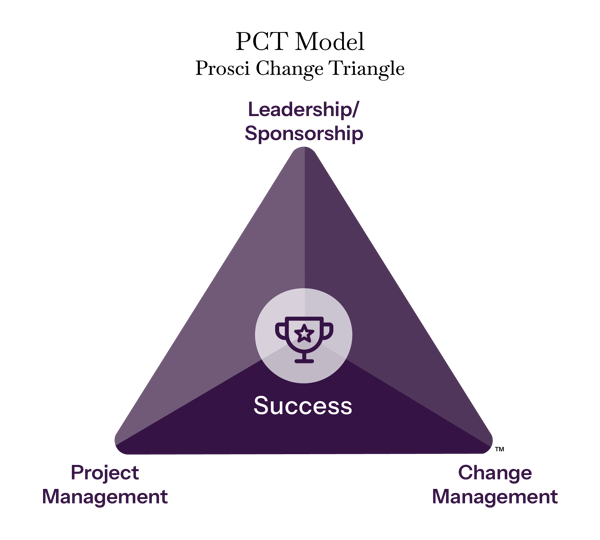
Your transformation starts with a clear vision and definition of long-term success. Using the Prosci Change Triangle (PCT) Model, you can assess project health, identify gaps, and align leadership and stakeholders around shared goals.
This foundation allows you to:
- Understand the key business drivers and opportunities that demand change.
- Align the transformation initiative with your overall strategy.
- Define a shared definition of success.
- Set smaller, specific and measurable business objectives that lead to success.
Change management helps you create a roadmap that guides your efforts and provides a benchmark for success.
Engages sponsors
Engaged leadership and sponsorship are vital for the success of digital transformation. Sponsors include the primary sponsor, who authorizes and leads the change, and other sponsors who champion the change across different areas in the organization.
Our research shows that sponsors struggle to allocate time and resources to participate actively in the change and they underestimate the people side of change.
Sponsor Challenges

Practitioners in a change team should engage with sponsors to help them manage their limited time and resources. This includes creating a Sponsor Plan together to plan and schedule their activities in advance. You must also be selective of the tasks you want sponsors to carry out, with a focus on time-critical and high-impact activities.
Prosci’s sponsor engagement toolkits and workshops provide structured guidance for building sponsor capability, clarifying expectations and prioritizing sponsorship activities that directly influence success. These resources are especially helpful when sponsors are new to the role or supporting multiple initiatives.
By activating sponsors early, you can ensure they are committed and visible participants. This leadership will help drive the cultural transformation needed to embrace new technologies and processes.
Apart from senior leaders and executives, you must also engage key stakeholders to ensure they are aligned and committed to the change. You can use tools like the 4 P's exercise (Project, Purpose, Particulars, People) to document and communicate the case for the transformation. Combining tools with a detailed communications plan can increase alignment, clarity and consistent messaging across departments through every interaction.
Assesses needs and opportunities
Assessing your current state is essential to identifying gaps hindering digital transformation for enterprises or discovering opportunities to smooth the transition.
For a digital transformation, the change team must work with IT and other impacted individuals to evaluate the technology infrastructure, business processes and organizational culture. Identify how the digital initiative will impact and expand your organization's revenue streams.
You can use the Prosci Change Triangle (PCT) Model to examine the four critical aspects of change success: success, leadership/sponsorship, project management and change management. An effective transformation project is strong in all four areas.
To set a baseline for project health, you can use the PCT Assessment. This assessment also helps identify risks and opportunities so practitioners can create action plans to improve project health. You can track progress and maintain momentum using the PCT Assessment throughout the transformation process.
Develops a robust strategy for change
There are two change management strategies integral to enterprise digital transformation. The first strategy is at the portfolio level or program level and guides the entire transformation process.
Practitioners use a structured, scalable approach, like the Prosci Methodology, to create their overarching digital transformation strategy. Then, they develop strategies to manage the individual projects within the portfolio or program.
For example, adopting AI technologies includes a portfolio of multiple projects. The overarching strategy defines how each will be implemented and used across departments and functions. Then, the change team creates a plan and describes the strategies for managing each individual project.
Your digital strategy also needs plans to manage and help people adopt change at the individual level. To do this, practitioners use the Prosci ADKAR Model. It helps people through their individual change journeys by enabling them to achieve Awareness, Desire, Knowledge, Ability and Reinforcement.
Prosci ADKAR Model

The Prosci 3-Phase Process, on the other hand, offers a clear structure for both strategic and tactical change management. It guides teams through preparing for change, managing implementation and sustaining outcomes. This process connects directly with ADKAR by aligning organizational actions with the individual journeys required for successful adoption.
Practitioners enable people to move through these five elements, which cover how they learn about and understand the change, motivating them to participate in it, and learning and using the new skills to implement the change for the long term.
By implementing this model, you can prepare, equip and support employees through the transition. This creates a resilient culture where employees have the opportunities, skills and mindset to embrace change and innovation.
Leverages technology and data
Change management methodologies enable organizations to use digital products and data effectively during an enterprise transformation.
For example, assessments can identify areas where automation will have the most significant impact. Change management strategies help implement this automation by ensuring employees understand and adopt new workflows. These strategies provide individuals with the necessary training and support to transition smoothly to automated systems, avoiding confusion and preventing resistance.
Successful transformations build the foundations and processes for future change. For example, implementing the latest data management tools enables an organization to predict future digital transformation trends (and other market trends) and implement smaller change projects to adapt to them.
But, without proper change management, organizations struggle to sustain the improvements from the initial transformation over time, so later projects may also fail. Implementing reinforcement activities, like performance monitoring, rewards and feedback can lead to a culture of innovation and continuous learning, which is crucial for ongoing success.
Roadmap for Implementing Enterprise Digital Transformation
Below is a streamlined roadmap for executing enterprise digital transformation, integrating Prosci’s change management tools to align technical delivery with people adoption:
1. Define vision & assess current state
Start by clarifying what success looks like—for example, faster response times, improved data visibility, or simplified operations—and communicate it across the organization. Assess where you are today using the Prosci Change Triangle (PCT) Model to evaluate success metrics, leadership support, project health and change management support. Define success metrics and KPIs early so you can track progress.
Practical Tip: Directly involve employees who work closest to impacted processes or technologies in your current-state assessments. These team members often have the clearest insights into everyday pain points and hidden challenges. By engaging them early, you not only gain valuable information to inform your vision but also create stronger employee commitment to the digital transformation journey.
2. Secure leadership sponsors
Engage a primary sponsor and build a coalition of leaders across departments. Create a sponsor plan to clarify roles, schedule sponsor activities, and ensure leaders actively support the transformation with communication and engagement.
Practical Tip: Encourage sponsors to regularly share business-related reasons for the change. Prosci research shows this builds trust and early commitment.
3. Develop an enterprise architecture strategy
Create a high-level architecture plan aligned with your goals. Evaluate options with both technical and user adoption in mind. Solutions should be scalable, easy to integrate, flexible and cost-efficient so you can adapt as your business models continue to evolve.
Practical Tip: Prioritize technology that fits your current environment and minimizes disruption. Consider total cost of ownership—including upgrades, support and user training.
4. Evaluate and select the right technologies
Use defined criteria to evaluate tech or vendors. Consider:
- Scalability
- Integration with existing systems
- User-friendliness and required training
- Vendor support and security
- Total cost of ownership
Apply the PCT Model to align technology choices with readiness, and ADKAR to build adoption plans.
Practical tip: Clearly define your integration needs upfront, especially in critical areas like supply chain management, to prevent costly compatibility issues down the road.
5. Address legacy system integration
Decide whether to phase out or integrate legacy systems. A phased rollout (piloting new systems) helps mitigate risk. Plan thoroughly for data migration, interfaces and user transition.
Practical Tip: Build a communications plan that starts early and targets Awareness. Use it to inform people impacted by the change about why the changes are happening and how they will improve their work.
6. Implement & support adoption
Roll out systems while actively supporting users. Deliver training and coaching aligned with ADKAR’s Knowledge and Ability elements. Use Prosci change plans and toolkits to prepare managers and front-line teams.
Practical Tip: Don’t stop at go-live. Keep change agents or super-users visible and available for hands-on help. Fast support improves adoption.
7. Reinforce & sustain the change
Monitor adoption using your chosen KPIs. For example, use rate, error rate, help desk requests, or training completions. Celebrate wins and share results. Reinforcement is key to cementing new behaviors. Use ongoing training, feedback loops, and recognition programs to maintain momentum and support deeper cultural transformations.
Practical Tip: When adoption gaps appear, re-engage with targeted training or support. Reinforcement isn’t a one-time task—it’s how you build long-term change capability.
FAQS
What is the first step in a digital transformation journey?
The first step is to define a clear vision and assess your current state. Begin by understanding the core reason for the change (e.g., new market opportunities, competitive pressures, customer demands) and establishing what success will look like.
Work with those affected by the change to evaluate the organization’s readiness and identify gaps or problem areas that need to be addressed.
Why is Digital Transformation Important for Businesses?
Digital transformation is vital for staying competitive. It simplifies and optimizes internal processes, increasing efficiency and cost savings, improving customer experiences, and enabling businesses to adapt quickly to market dynamics.
How can businesses measure the success of digital transformation initiatives?
Change teams and leaders track key performance indicators (KPIs) to measure the success of digital initiatives. Example metrics include performance improvement, customer satisfaction, revenue growth and employee engagement.
How does digital transformation impact employees?
Digital transformation initiatives can cause anxiety for employees because they alter operational processes, job roles and responsibilities. This uncertainty, the lack of awareness about the reasons for change, and the need to learn new skills can lead to resistance behaviors. Effective change management prevents resistance by supporting and communicating clearly with employees.
Use Prosci Enterprise Digital Transformation Services for Success
Digital transformation is reshaping the business landscape and, to succeed, you need more than just technology. You need to focus on change adoption at an enterprise level. This means implementing a structured change management approach that empowers every individual within your organization to embrace new ways of working.
With Prosci, you don’t have to guess what works. Our globally recognized, research-backed models, toolkits and training equip your teams to deliver lasting change.
Let’s unlock the full potential of your digital transformation together, with change done right.