7 Mins
Updated: April 13, 2026
Published: October 20, 2025



Digital transformation is the bold reimagining of how organizations create value in a digital-first world. It reaches into every corner of the enterprise, from how you interact with customers to your back-end systems, and it demands new ways of working, leading, and thinking. However, a crucial truth that’s often overlooked is that the people involved in digital transformation are actually just as, if not more, important to realizing its full potential than the technology itself. Change leaders—the trailblazers helping your team embrace disruption, adapt to new processes, and unlock the full potential of digital tools—are the key. They combine the technical side with structured change management to ensure your digital transformation doesn’t fall flat.
Understanding Digital Transformation
Digital transformation is a deliberate business model shift that integrates technology across operations, reshapes business processes, and empowers people to work in new ways. For change leaders, it’s a chance to guide your organization into the future.
The three essential components
Here are three things you need to know to drive a successful digital transformation:
-
Digital technologies are the enabler: Cloud platforms, AI, automation, and data analytics provide the horsepower for transformation. They make innovation possible, but they can only go so far as your personnel will carry them.
-
Processes are the connectors: Transformation succeeds when processes are redesigned to break silos, speed up decision-making, and align to customer and business needs. IT leaders help build this connective tissue, but it’s change leaders who ensure it sticks.
-
Culture is the differentiator: Technology and processes mean little if your people aren't ready to embrace a new way of working. Culture is what determines whether employees resist or rally behind transformation. As a change manager, this is where you have to put your skills to the test by helping individuals move through their ADKAR® journeys and successfully adapt.
The Role of IT in Digital Transformation
IT is the engine that powers digital transformation initiatives. Technical leaders and their teams lay the foundation by selecting the right tools to safeguard sensitive data so organizations can adapt, scale, and thrive in the digital era.
Technologies Driving Digital Transformation
Whether upgrading hardware, migrating on-premises resources to the cloud, or deploying AI solutions, IT ensures that digital innovation becomes part of daily operations. Here are some of the ways digital technology is helping companies compete:
- Enabling data-driven decision making – With robust data protection, governance, and analytics, IT equips organizations with the insights needed to respond to shifting markets and customer demands in real time.
- Automating processes for efficiency – From inventory management to supply chain workflows, automation reduces manual effort, accelerates delivery, and frees people to focus on higher-value work.
- Fostering collaboration and scalability – Cloud platforms, collaborative tools, and interoperable systems break down silos so teams across geographies and functions can move faster together.
- Securing the enterprise – As digital footprints grow, IT strengthens defenses with cybersecurity, encryption, and compliance frameworks.
Each of these IT-driven changes represents a shift in how people work. Moving to the cloud means teams must adapt to new platforms. Leveraging analytics requires data literacy across functions. Automation changes roles and responsibilities. Your role as a change leader is set people up for success in this shifting work environment.
Benefits of Digital Transformation in IT
- Improved efficiency and productivity – The digital experience afforded by cloud platforms, automation, and AI streamlines workflows, cuts down manual effort, and gives teams more time to focus on higher-value work.
- Enhanced customer experience – Modern IT infrastructure and advanced analytics enable personalization, faster service, and seamless digital interactions, all of which shape how customers perceive and trust your brand.
- Greater agility and innovation – With legacy constraints reduced, organizations can pivot more quickly, scale solutions across the enterprise, and test new ideas faster.

Challenges of Implementing Digital Transformation Projects
Resistance to change within organizations: People naturally fear the unknown and new technology can be particularly scary (hello, automation). It makes employees worry about job security, new skill requirements, or losing familiar processes. Clear communication and visible sponsorship are the best ways to overcome the resistance that can stall even the best-designed initiatives.
Integration of new technologies with legacy systems: Many organizations carry years of technical debt, which makes it difficult to integrate modern tools like cloud, AI, and automation. On top of the technical headaches, there are cultural ones that can come into play as teams may cling to old systems because they’re “comfortable.”
Need for skilled personnel: Digital transformation depends on talent with the right mix of technical and business skills. Yet many organizations face a skills gap in areas such as analytics, cybersecurity, and agile delivery. Building capability through upskilling and reskilling is vital.
Steps to Achieve Digital Transformation in IT
Digital transformation can feel overwhelming, but when broken into clear steps, it becomes a journey you can lead with confidence. Here’s how to move from vision to execution:
1. Assess current IT capabilities
Every transformation starts with a clear-eyed view of today. Map out your infrastructure, systems, and processes to understand where bottlenecks occur and which tools no longer serve your goals. But look beyond the technology to your workforce too. Do employees have the digital literacy to navigate new systems? Are teams culturally ready to embrace innovation, or do they cling to “the way we’ve always done it”?
This is also the time to apply the Prosci Change Triangle (PCT) Model, which evaluates whether your project has the right balance of leadership, project management, and change management. The PCT Model ensures that technical readiness is matched by people readiness, which is critical factor if you want your IT foundation to support long-term transformation.

2. Define a clear digital transformation strategy
With your baseline in place, set a strategy that ties every initiative directly to business outcomes, such as better customer experience, reduced costs, or faster speed-to-market. Identify the customer journeys, processes, or functions that will deliver the most value, then prioritize them.
This step mirrors the first phase of Prosci’s 3-Phase Process, Phase 1 – Prepare Approach, where you define success, assess risk, and develop your change management strategy. The result is a roadmap that balances quick wins with longer-term initiatives that won’t overwhelm your teams.

3. Engage stakeholders early and often
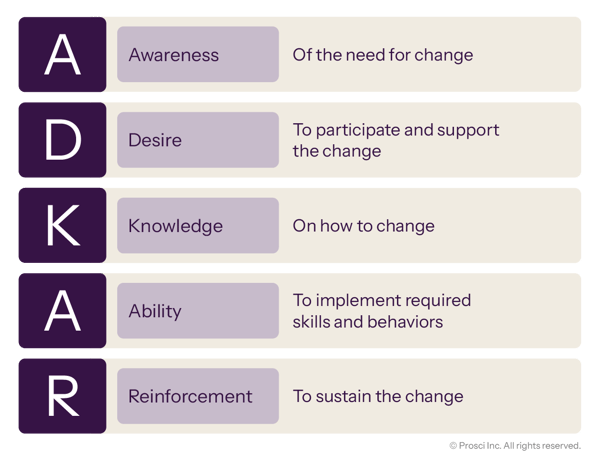
Visible sponsorship from senior leaders secures buy-in, while coalitions of support across departments keep momentum alive. This is where you will begin to follow the ADKAR® Model: build Awareness of why transformation matters, spark Desire to participate, and providing Knowledge of how the change affects them.
With that, you set the stage for employees to develop Ability and sustain Reinforcement. Leading with the “why” turns an abstract digital transformation strategy into a shared purpose that makes adoption far more likely.
The Prosci ADKAR Model
4. Foster a culture of innovation and agility
Transformation is sustained by teams who feel safe to experiment, learn, and adapt. Invest in reskilling and upskilling programs so employees see training as an investment in their future. Recognize and celebrate early adopters of the digital technologies who model new behaviors as they often become the most powerful influencers in sustaining momentum.
Digital Transformation Case Studies
UKG: Integrating Systems and Cultures After a Merger

When Ultimate Software and Kronos merged to form UKG, they faced the enormous challenge of unifying 12,000 employees across multiple regions and thousands of customers and partners while operating on duplicate systems in HR, payroll, sales, billing, and customer service. The ERP integration project, “UKG 1,” required a technical rollout powered by a cultural shift that touched nearly every process in the organization.
UKG’s change practitioners knew that success would hinge on people as much as technology, so they embedded the Prosci Methodology into the project plan from the start. They aligned project and change management into a single strategy, and applied the ADKAR Model both broadly across the program and within each impacted business area.
The team invested heavily in training and communication, delivering hundreds of role-based learning modules, self-paced training, and “Meetings in a Box” for people managers. A Champions Program recognized employees who modeled change, while functional readiness leads provided continuous feedback and alignment. This “organic” approach made change management part of everyday business rather than an added layer of process.
The results were transformative. Within 45 days of go-live, 56,000+ users logged into the new UKG Community platform. More than 1,000 team members were actively driving transformation. UKG’s culture evolved toward resilience and adaptability, helping the company earn recognition as one of Fast Company’s Most Innovative Companies of 2024.
Microsoft: Delivering a Flawless Earnings Release Through Change
/microsoft-logo-png-2396.png?width=299&height=70&name=microsoft-logo-png-2396.png)
Every quarter, Microsoft’s Investor Relations (IR) team delivers an earnings release to millions of investors, analysts, and media outlets. The margin for error is zero as each report must meet stringent accuracy, security, and performance requirements, all while being published within a two-minute SLA.
When IR leaders decided to replace their legacy platform with a new Azure-based application, the risk was immense. The solution needed to aggregate sensitive financial data, enable secure previews, and withstand massive traffic spikes all during one of the most closely watched corporate events on Wall Street.
The IR team leaned on Microsoft’s long-standing partnership with Prosci and embedded the Prosci Methodology into every stage of the rollout. They performed detailed stakeholder impact analyses, mapped dependencies across accounting, IT, and business support teams, and developed change management plans aligned with the technical project. Leaders were engaged early and often, managers were equipped to coach their teams, and employees rehearsed every scenario through 12 dry runs that simulated earnings day.
On release day, the system worked flawlessly. Every one of the 50+ tightly sequenced steps was executed on time. The release went live within the SLA, and financial media even noted the speed of Microsoft’s reporting. Employees had the confidence to deliver without hesitation, thanks to months of preparation that addressed not just the technology but the people adapting to new roles and processes.
United Concordia Dental: Driving AI Adoption at Scale

For United Concordia Dental, the challenge was to deploy generative AI technology while winning over a workforce of 1,200 employees who were skeptical, fearful, or uncertain about what AI might mean for their roles.
To tackle these concerns head-on, United Concordia partnered with Prosci to build a structured, people-centered approach to AI adoption. They certified 170 Prosci practitioners (nearly one in ten employees) to create a robust internal network of change champions. They developed tailored ADKAR blueprints for each business unit, secured sponsorship from the CEO, and launched a network of super users who provided one-on-one coaching.
Hands-on support proved critical. Instead of leaving employees to “figure out” the AI tool (Sidekick) on their own, change practitioners sat with them, identified daily challenges, and demonstrated real-world use cases. This approach not only demystified AI but also showcased its benefits, like drafting meeting agendas, summarizing documents, and saving employees an average of eight hours per week.
The cultural shift was dramatic and within eight months, United Concordia achieved an 80% activation rate and 60% regular use of the AI tool. Employees who once doubted the value of AI became advocates, using it not just for productivity but for strategic tasks like goal setting and performance reviews. As one leader noted, the ADKAR Model gave employees a framework to “calibrate where they are in their change journey” and made adoption feel achievable.
Shaping the Future of IT
Digital transformation is no small undertaking, and it shouldn’t be thought of as such. It’s an enterprise-wide effort to reimagine how your organization creates value, serves customers, and empowers employees. The case studies we explored show a consistent truth: organizations that weave change management into their digital transformation efforts achieve stronger adoption, greater ROI, and lasting cultural shifts.
It’s a big challenge, but it’s also an opportunity. IT can combine technical excellence with people-centered change to create the conditions for sustained agility, productivity, and growth.