4 Mins
Updated: April 29, 2026
Published: November 5, 2025



Twenty-six percent. That's the success rate for transformations that improve performance and sustain results. For enterprise leaders finalizing 2026 budgets, the question isn't whether transformation will happen—it's whether your organization can execute it.Market conditions leave no room for failure. Organizations are running multiple high-stakes transformations simultaneously while 53% of employees report feeling overwhelmed by too much change happening at once. The executives who succeed won't be those who predict the future most accurately. They'll be those who build the capability to adapt quickly regardless of what emerges.
We interviewed Prosci's executive leadership team—spanning finance, operations, people, and regional leadership—to understand how they guide enterprise clients through this challenge. Their collective insights reveal five strategic decisions that separate transformation success from budget waste.
1. Fund Change Capability Like Infrastructure, Not Projects
Most organizations treat change management as a variable project cost. But this approach fails when facing an uncertain 2026 landscape where strategic priorities may shift mid-year.
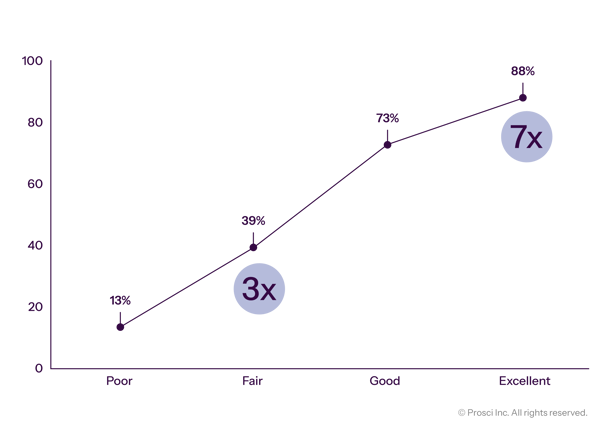
Prosci research shows the financial impact of this decision. Organizations executing excellent change management practices see an 88% success rate in meeting project objectives, compared to only 13% for those with poor change management practices. The difference represents significant value at stake.
Correlation of Change Management Effectiveness with Meeting Objectives
 "No matter what those bets are, they still require that people are changing to actually make that come to life," explains Romona Brown, President of Prosci North America. "That is the piece that's consistent. The adoption still needs to happen to actually get to the ROI."
Michelle Haggerty, Prosci's COO, cuts to the core of how executives should reframe this investment: "It's not what can we afford, but how can we afford not to. More now than ever, transformation is happening every single day. It's incredibly important to put intentionality in your relationship with your project management and change management office."
Building baseline change capability delivers measurable financial benefits. Once established, it reduces per-project investment while accelerating time-to-value. Organizations avoid starting from zero with each transformation and instead leverage existing organizational muscle memory.
2. Plan for Dual Transformation Realities
The transformation challenge has fundamentally changed. Organizations now face continuous AI-driven change alongside discrete strategic projects. A single approach to resourcing and planning won't address both effectively.
"You have to do both," says Laura McGann, Chief People Officer at Prosci. "You have to do the ongoing continuous transformation and then you have to get really clear on must-win projects. They overlap 100%, but you actually treat them differently."
Haggerty reinforces why this distinction matters: "Transformation isn't about structure and processes. That's a key component, but it's also about behaviors and mindsets. The best leaders really focus on the people side of it and really where execution comes to life is through those humans and their adoption."
Business-as-usual changes require workforce adaptability—AI is reshaping daily work, regulations are evolving, market forces are shifting. These changes demand different resource allocation and planning than structured transformation projects like ERP implementations or organizational redesigns. Organizations that apply the same strategy to both underperform on both.
3. Consider People Impact During Budget Planning
The sequence matters. Organizations that assess people impact during project planning—not after technology selection—build realistic timelines and avoid late-stage budget overruns.
Prosci research on change management maturity shows a clear difference in outcomes based on timing. Organizations that incorporate change management practices from the outset experience a greater success meeting their objectives than those that treat it as an afterthought.
Correlation of When Change Management Begins with Meeting Project Objectives
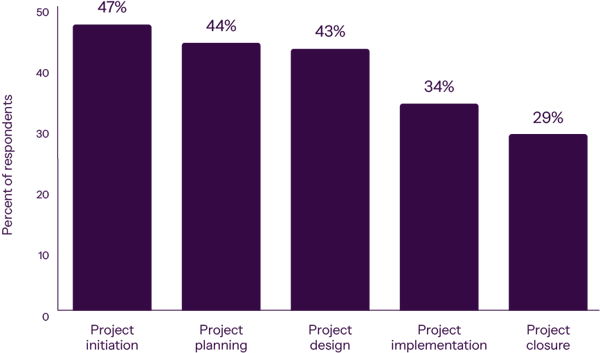 "We see in very mature organizations that early into the process as they're planning out initiatives, they're considering the people side impact," notes Randy Herrera, EVP of Global Growth at Prosci. "We also know from our research that change management mature organizations have a higher degree of success on their initiatives."
When we asked what sets successful executives apart in their planning approach, Haggerty was direct: "They're really looking beyond the milestones and focusing on outcomes and adoption. Where I see leaders struggle is when they underestimate that human element around adoption."
Early adoption planning prevents late-stage budget overruns and schedule delays. The business case is clear.
4. Develop Leaders as Change Capability Multipliers
Leadership requirements have evolved beyond traditional project management. Leaders now navigate continuous market change while executing transformation initiatives simultaneously.
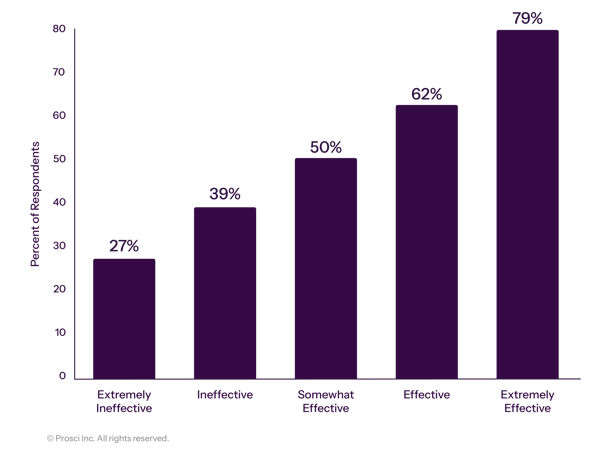
Prosci research demonstrates the multiplier effect of leadership engagement. Organizations with active executive sponsorship and visible leadership support report a 73% success rate in their change initiatives, compared to only 29% for those lacking such support.
Correlation of Sponsor Effectiveness With Meeting Objectives
 McGann emphasizes this shift: "Being a leader, you are managing that ongoing continuous transformation and change for your team members. Leaders really have to understand that both of those are going to co-exist going forward."
When we asked what leadership capabilities matter most during transformation, Haggerty identified three critical components: "Active and visible sponsorship throughout the entire transformation. Building a coalition—making sure that return you're hoping for is a team sport, not something individuals achieve in silos. And communication. Why, why now, what if we don't. Continually repeating those at different elements and milestones."
Change-capable leaders become force multipliers who enable adoption across multiple initiatives simultaneously. This approach scales capability without proportional resource increases.
5. Measure Adoption in Real Time, Not Just at Project End
CFOs increasingly focus on transformation ROI, but many lack the data and metrics connecting adoption levels to business outcomes.
"Getting buy-in across the organization is so important," explains Shelley Pino, CFO at Prosci. "If people don't believe, you are constantly vying for resources and dollars. It's not the most fun place to send your money."
Real-time adoption tracking enables course correction before problems compound. Organizations can identify resistance early, adjust approaches mid-stream, and demonstrate incremental value to maintain executive support and resource commitment.
Haggerty adds a critical operational perspective: "There's a high level of expectation around data and metrics to measure adoption in real time, not just at the end. That's a key component of successful transformation. You're seeing those adoption metrics, you're seeing return on investment metrics throughout the life cycle, not just hoping they'll be there at the end."
Organizations that measure adoption iteratively throughout the transformation lifecycle protect their investments and capture value faster.
Turn Change Capability Into Competitive Advantage
The organizations thriving in 2026 will be those that invested in change capability during their 2025 planning cycles. They understand a fundamental truth: building change capability isn't about managing individual projects more effectively. It's about organizational resilience that converts uncertainty into competitive advantage.
As Haggerty puts it, "You need some space to build in the unpredictable because we know for sure it's coming. We just don't know when or what it will be."
The 2026 planning window is closing. Executives who invest in change capability now will lead from strength while competitors scramble to adapt. Prosci's proven methodologies and enterprise solutions help organizations turn the people side of change into a strategic asset.
These insights come from conversations with Randy Herrera (EVP Global Growth), Laura McGann (Chief People Officer), Shelley Pino (CFO), Romona Brown (President, Prosci North America), and Michelle Haggerty (COO) conducted in September 2025.