
5 Mins
Updated: April 29, 2026
Published: October 20, 2025



As today’s business leaders and organizations face continuous transformation driven by new technologies, evolving customer expectations, shifting economic realities, and shifts in workforce preferences, organizational resilience is a necessity rather than a trend. In this article, we explore organizational resilience and strategies for developing resilient teams that view change as an opportunity.
What is Organizational Resilience?
Organizational resilience refers to an enterprise’s ability to adapt and thrive in the face of change. It’s what allows teams to remain focused, deliver results, and grow stronger through disruption, rather than feeling derailed by it. Building this capability emphasizes the value in equipping employees to respond with confidence, agility, and purpose when change inevitably occurs.

Core Pillars of Organizational Resilience
Building organizational resilience involves strengthening the core capabilities that allow teams to respond effectively to change. These core pillars create the foundation of a resilient organization:
Leadership and vision
Organizational resilience requires competent change leaders who can effectively guide professionals through the change process. Leaders who communicate a clear vision and model adaptability set the tone for how the rest of the organization responds to disruption. When employees understand the why behind changes and feel empowered by leaders navigating uncertainty with purpose, they’re more likely to stay aligned and motivated through transformational change.
Culture and employee engagement
Employee engagement fuels resilience. When people believe in the organization’s mission and trust leadership, they can overcome challenges together. Healthy cultures prioritize ongoing communication, employee recognition, and opportunities for providing feedback and feeling heard. When resilience is part of an organization’s culture, every hire becomes an opportunity to strengthen the team’s capability to navigate change.
Adaptability and innovation
Resilient organizations view change as an opportunity for growth rather than a threat to stability. They encourage continuous learning, experimentation without fear of failure, and cross-collaboration. When teams embed adaptability into their organization’s DNA, new ideas and improvements emerge naturally, even in uncertain times.
Risk management and preparedness
While it’s impossible to anticipate every disruption, resilient organizations prepare for the unexpected by identifying risks early and developing flexible response plans. Effective risk management fosters change readiness, encompassing organizational readiness, open attitudes toward change, and individual readiness. When challenges arise, resilient organizations can adjust course quickly and maintain momentum without losing sight of their business goals.

Building Organizational Resilience
Organizations build and strengthen resilience through deliberate actions, including developing the systems, skills, and structures that support adaptability. Here’s how:
1. Assess your organization’s current capabilities
Conducting a thorough assessment of your organization’s strengths, opportunities, and change readiness provides baseline metrics of current resilience and identifies areas for focus. This includes evaluating leadership commitment, communication effectiveness, employee readiness, and the maturity of your change management practices. Change readiness is a strategic advantage for organizations of all kinds.
2. Develop crisis management plans
Preparedness reduces uncertainty. Crises that have significant organizational impacts range from natural disasters and socio-cultural events to market shifts and economic downturns. Establishing crisis management and business continuity plans enables organizations to respond quickly and effectively when disruption occurs. The goal is not to create a perfectly laid-out plan, but rather to identify critical components, including key decision-makers, communication plans, and the proper course of action when managing rapid change in a crisis.
3. Invest in technology and infrastructure
Having the right systems and technologies in place is a powerful enabler of resilience, especially during times of crisis. Modern, flexible systems support remote and hybrid work, data-driven decision-making, and cross-functional collaboration. That’s why many organizations are prioritizing digital transformations. Investing in an infrastructure that can scale, adapt, and help employees stay connected and operational under changing conditions is crucial for navigating the unexpected.
4. Train and empower employees
Change is inevitable, but with the right approach, it’s always an opportunity. Ongoing training and skill development help employees build confidence in navigating change, solving problems, and adopting an open-minded approach to change. Empowered employees adapt to and drive change. When individuals feel equipped, trusted, and empowered, the organization as a whole becomes more capable of thriving in uncertain times, and the company develops strong human capital.
Strategies for Sustaining Resilience
Sustaining resilience requires ongoing attention and commitment beyond the initial stages of building the foundations. Resilient organizations view change as a constant and maintain their resilience by integrating learning, communication, and support into their daily operations.
The following strategies help develop organizational resilience and human capital as a lasting capability:
Strengthen communication and relationships with transparency and clarity
Communication and trust are at the core of both successful change and sustained resilience. The Prosci ADKAR® Model – Awareness, Desire, Knowledge, Ability and Reinforcement – puts people at the center of change and highlights clear, transparent, and consistent communication throughout every stage of the individual change process.
Prosci ADKAR Model
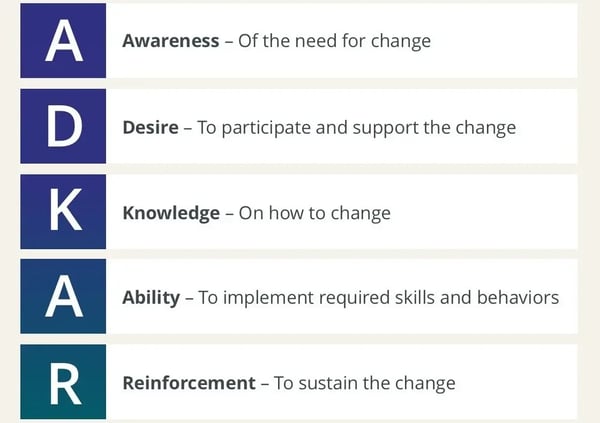
Strengthening communication channels between leaders, managers, and employees helps maintain alignment and engagement, especially during ongoing transformation, creating trusting relationships to navigate uncertainty together. Build strong relationships among teams to create a supportive network during times of change and transition.
Implement robust support systems
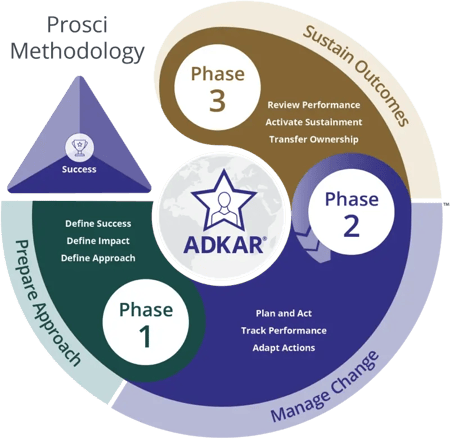
Robust support systems ensure that employees have the necessary resources to adapt successfully. Provide resources for employee well-being, such as mental health support and coaching. Develop a structured transition plan by following a change management framework, such as the Prosci Methodology, to guide employees through changes and ensure they have the necessary support and resources.
Foster a culture of continuous learning
Sustained resilience depends on an organization’s ability to learn quickly and adapt to the pace of change. Business leaders play a key role in fostering learning cultures by modeling curiosity, encouraging reflection, and celebrating growth and improvement. Encourage ongoing training and development to enhance skills related to adaptability and problem-solving.
Additionally, embedding flexibility into daily operations, encouraging experimentation without fear of failure, and implementing feedback mechanisms ensure that learning occurs throughout the change process.
Benefits of Organizational Resilience
When organizations invest in building and sustaining resilience, they reap both short and long-term benefits, including:
- Enhanced adaptability to change – Organizations that prioritize resilience are better equipped to respond to challenges such as supply chain disruptions, talent shortages, and shifts in customer demand, all of which can have a lasting impact on operational continuity.
- Improved employee engagement and retention – A resilient organization fosters a supportive work environment with higher levels of engagement, job satisfaction, and loyalty, ultimately reducing turnover.
- Long-term competitive advantage – By effectively managing risks and capitalizing on opportunities, resilient organizations can outperform competitors and achieve long-term success.

Challenges in Building Organizational Resilience
While the value of organizational resilience is clear, achieving it can be a complex process. Many organizations face obstacles that limit their ability to respond effectively to change. Challenges to prepare for include:
- Resistance to change – Resistance is a natural human reaction to change. Prosci research shows that preventing resistance to change is more effective than addressing it reactively. Strong sponsorship, effective communication, and addressing cultural barriers can help mitigate resistance.
- Resource constraints – Competing priorities and teams stretched too thin often lead to change saturation, which occurs when disruptive changes exceed an organization’s capacity to adopt them. To overcome this, leaders must prioritize strategically, allocate resources intentionally, and integrate change management into existing processes rather than treating it as an add-on.
- Balancing stability and innovation – Organizations must find the right balance between stability and innovation that works best for their teams. Strengthening leadership alignment and organizational readiness ensures that innovation occurs within a framework that supports people through change, not one that overwhelms them.
Case Studies in Building Organizational Resilience
We have a philosophy of building organizational resilience to make you stronger for every future change. Here are some examples of how Prosci can help your organization become more resilient.
Building organizational change capabilities following a crisis

Following the COVID-19 pandemic, employees at The Washington State Department of Health faced overwhelming burnout, turnover, and change fatigue. With a focus on building executive commitment and support, creating lasting change management capabilities, and helping the department regain momentum, Prosci developed a comprehensive strategy to support these capabilities. This enabled the department to embed change management principles and processes into their daily work, building a change-ready team for the future.
A more agile and resilient organization

Oregon Lottery embarked on a transformational journey involving a series of significant change initiatives. By engaging Prosci as a trusted partner for change, delivering formal change management training to employees, and leveraging Prosci’s structured approach to change, Oregon Lottery became future-ready. The team encountered fewer barriers to adoption, achieved higher levels of employee participation and adoption of new systems, and achieved a 95% participation rate in their engagement survey.
Organizational Resilience Best Practices and Key Takeaways
The most resilient organizations take a strategic, intentional approach that weaves resilience into every layer of how they operate and lead change. They:
- Embed resilience into strategy – Integrate resilience thinking into strategic planning, risk management, and decision-making processes to embed it into the organization’s identity.
- Commit to continuous learning and adaptation – Encourage teams to evaluate outcomes to strengthen organizational change maturity and agility over time.
- Align resilience with organizational goals – When resilience initiatives align with what matters most to the business, they gain leadership support, employee buy-in, and measurable impact.
Building Change-Ready Organizations for What’s Next
Organizations that weave resilience into their strategy, culture, and leadership practices position themselves to thrive in the face of constant change. By equipping people with the necessary tools, mindsets, and support, leaders can transform uncertainty into opportunity. The future belongs to those who are change-ready.