6 Mins
Updated: October 31, 2025
Published: February 14, 2018



For over 25 years, Prosci's Best Practices in Change Management research has consistently identified active and visible executive sponsorship as the number one contributor to change success—most recently by a three-to-one margin. Yet despite this clear evidence, one of the most common challenges practitioners face is activating sponsors to fulfill their critical roles.
Prosci completed a research deep dive on the topic of executive engagement and its correlation with change success. We asked both executives and change practitioners to share what attributes, skills and activities they believe are required to engage with sponsors effectively. By understanding both the perspectives of change practitioners and sponsors, we can begin to identify gaps in our approach to collaborating and seeking support.
These insights, paired with the research from the Best Practices in Change Management research, offer fresh perspectives and best practices for engaging executives and leaders in their sponsorship roles.

Most Effective Tactics for Creating
Active and Visible Sponsorship
During the webinar Bridging the Gap: Strengthening Executive Engagement in Change Initiatives, three Prosci leaders discussed the skills, attributes and strategies change professionals can cultivate to better align with executives’ expectations and priorities.
1. Provide the sponsor with ongoing support
Supporting your sponsor effectively means more than just staying in touch—it's about understanding what they implicitly need from you at each stage of the change. Based on Prosci's 2023 research with over 300 senior executives, we identified five categories of support that sponsors need but rarely articulate directly. We call this the DREAM framework:
- Define Success
- Realize Progress
- Elevate Impact
- Advance Personally
- Mature Professionally
These five areas give you a shared language to diagnose where your sponsor relationship is strong and where critical gaps exist. For instance, helping your sponsor Define Success early means facilitating alignment workshops and creating success scorecards that tie technical milestones to adoption metrics. Supporting them to Realize Progress involves regular check-ins with data-driven insights that show where people are in the change journey—not just where the project stands technically.
When change practitioners were asked about the most important activities for engaging sponsors, their responses aligned closely with the DREAM framework: communicate regularly, build relationships, educate and train, define clear roles, listen actively, demonstrate value, involve early, align with strategy, be transparent, and provide resources.
However, these activities aren't static—they ebb and flow based on the phase of the project lifecycle. Early on, risk is about identifying challenges, but then it evolves into addressing and mitigating those challenges. Communication evolves over the project's lifecycle based on when and where information distribution becomes more critical. You need to pay attention to these engagement activities but also give space to allow them to shift as your change progresses.
More tangible ways change managers can offer sponsors support are developing a sponsor roadmap or action plan, involving the sponsor in hands-on work to show visible support, drafting sponsor communications (e.g., newsletters, emails), preparing talking points, scheduling or inviting the sponsor to meetings and creating opportunities for the sponsor to be active and visible (e.g., town halls, roadshows, staff meetings and walk-arounds).
“It’s the power of we,” says Michelle Haggerty, Chief Operating Officer. “This isn't just one person's or team's work.”
2. Coach the sponsor on their role
The second most common tactic for creating active and visible sponsorship is to explain the role of effective sponsorship, establish expectations for the role and equip the primary sponsor with tools, advice and coaching to make their job as sponsor easy to fulfill.
“Executives are meant to live in a future state, thinking about what's next and how to continue to evolve to achieve the outcomes of the organization or the project,” says Haggerty, who often serves as a sponsor on Prosci’s change initiatives. “What I really need at times is to come back into the transition state, and I can't actually do that if I don't have a coach telling me where we are in the marathon.”
While it can be intimidating to coach upward, know what you offer and that it’s backed by data.
“As a practitioner, it's so common that we look at the executives and assume they know it all,” says Scott Anderson, Senior Principal, Global Research & Analytics at Prosci. “There's no way that an executive can have all the answers to every problem and challenge. They're relying on other people to provide them with the most important data to help them make the best possible decisions.
“We have a unique perspective that many executives may not be seeing,” Anderson adds. “And we know a lot of it because it’s research-based. We know if they implement XYZ, they will see improved outcomes in their ability to lead within the organization.”
Of course, this coaching relationship requires trust.
“Trust is very important because the work and conversations an executive has with their practitioner are about people,” Haggerty says. “If I don't fully trust the practitioner to keep the conversation between us and to really keep respect for the individuals that we're helping transform and change at the center of our conversations, that becomes really difficult. We're not going to have as effective change plans, because we're talking around the core issues.”
3. Hold regular meetings
Engaging with the sponsor through regular meetings or communications was the third most common tactic. Activities during these meetings or correspondences included: discussing project updates and progress, reiterating key messages, asking and answering questions, sharing successes and giving feedback on the sponsor’s involvement on the project.
During these meetings, use data-driven approaches to guide conversations.
“We use ADKAR Assessments at Prosci,” Haggerty says. “It shows where people are in the change journey, and that’s incredibly important and helpful data.”
ADKAR represents the five outcomes an individual needs to achieve for successful change: Awareness, Desire, Knowledge, Ability and Reinforcement. With this data, a practitioner can show where barriers exist, whether on awareness, knowledge, etc., and work with the sponsor to devise plans to remove those barriers.
Regularly meeting and sharing data helps create a bidirectional relationship, in which both parties understand the priorities and can challenge each other if needed.
4. Ensure the sponsor communicates directly with employees directly
Research participants indicated that ensuring that the sponsor communicates directly with employees (e.g., through face-to-face communications, live or recorded speeches, videos, written communication, etc.) is another tactic for having the sponsor actively and visibly engage in the change. This includes communicating the need for change across all levels of the organization and having personal discussions about the change with impacted employees.
5. Hold the sponsor accountable in their role
Study participants indicated that holding primary sponsors accountable and ensuring that they show support for the change management efforts were tactics for creating active and visible sponsorship. Suggestions included alignment to their personal interests, Key Performance Indicators (KPIs) or personal initiatives.
When formally evaluating the effectiveness of a sponsor, research participants used three methods:
- Clearly outlined objectives
- Observation and feedback
- Use of formal tools or methodologies
Sponsor Activity Model
Participants also described the most important types of activities a change sponsor can perform. The data was broken into three major project phases: start-up (planning), design and implementation. The activities and steps were further categorized by the primary target audiences:
- Project team
- Managers (including business leaders)
- Employees (or front-line stakeholders)
Prosci's Sponsor Activity Model illustrates the responsibilities sponsors undertake during each project phase (start-up, design and implementation). The activities required for each box in this figure are intended to be general descriptions for the category.
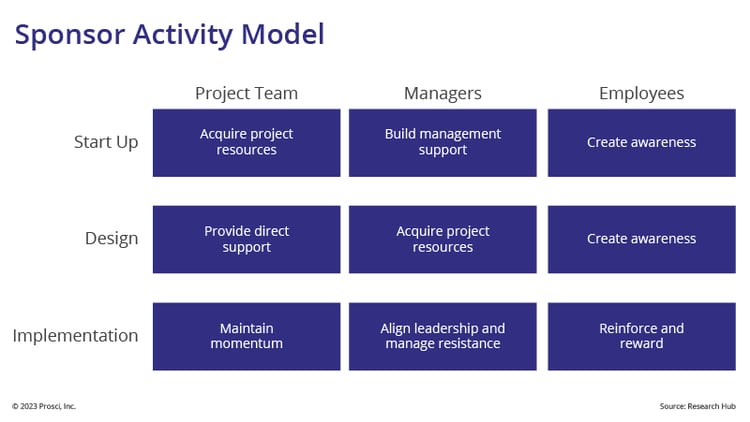 For each unique change project, change management teams should collaborate with sponsors to outline and agree on the specific sponsorship activities sponsors should perform with each audience at each phase of the project. This checklist provides a simple framework for getting started. More extensive lists of specific activities in each of the model's nodes are available in Prosci’s Best Practices in Change Management report in Research Hub.
When it comes to implementing the Sponsor Activity Model, the change management team can enable the successful outcome of each activity by acting in a role similar to an executive assistant, scheduling events, preparing for the events and making sure the sponsor is fully prepared.
Gaining Sponsor Access
Change sponsors are busy people, but their role in the change process is invaluable. If you struggle to get time on your sponsor’s calendar, try the following tips:
Attend existing meetings
Start regularly attending meetings that are already on the executive’s calendar. Request time on the agenda to give a status update. After the meeting, send the sponsor a follow-up chat or email.
“You can tell them what you noticed in the meeting and reinforce what’s going on from a change perspective,” Haggerty says. “If you’re not getting a standalone meeting with them, anywhere you can plant seeds will garner attention. Typically, they’ll start to notice. That tactic of joining existing meetings tends to serve as an entry point into more consistent touchpoints with the sponsor.”
Focus on what you can control
If you can’t get time with your sponsor, see if you can get time with someone in their inner circle, like another executive or their assistant.
“Thinking back to an executive whose schedule I had a hard time getting on, I focused on what I could control,” Anderson says. “What I could control is that I was able to meet with other senior-level executives who I knew could have indirect influence on the sponsor. It was an issue of me identifying what scope I could control and then operating within that framework.”
Use your time
Never skip an opportunity to meet with your sponsor. If they have the same hour block open every week, take it.
“Once you've got that time, don't let go of it,” Anderson says. “Build it in as a recurring thing, and then make sure you provide value during that time. Make it as easy as possible for them to fulfill their role.”
Know their language
Michelle Haggerty emphasized the importance of business acumen during the webinar: "Know their language. If you're talking to someone from a part of the business where utilization matters, know what the utilization pain points are for that leader and be able to talk to how does change help? How is the change management activity connected to the results that they're trying to drive?"
Building Organizational Change Capability
If you're reading this article and thinking, "I'm doing all of this, but I'm the only one"—you've identified the real issue.
The challenges outlined in this research—gaining sponsor access, coaching upward with confidence, speaking the language of business impact—often signal a broader opportunity for capability development. When these challenges appear consistently across your organization, it may be time to build more systematic change management capability.
Organizations that invest in enterprise-wide change management see measurable differences. According to Prosci's research, projects with active and visible executive sponsorship are six times more likely to meet or exceed objectives. Achieving this consistently requires equipping both practitioners and sponsors with shared methodologies, tools and coaching support.
Ready to build change capability at scale? Prosci's enterprise solutions—including comprehensive training programs, expert consulting, and licensed methodologies—help organizations develop the systematic capability needed to achieve sponsor engagement excellence across every initiative.