
5 Mins
Updated: April 13, 2026
Published: August 7, 2025



Businesses worldwide are integrating advanced technologies, such as artificial intelligence (AI), to revolutionize their business models and operations, as well as other types of digital transformations. However, adopting these technologies and staying competitive isn’t as easy as it seems, especially when dealing with integration problems and adoption challenges. Digital transformations are often far more complex than other types of business changes. What many organizations fail to account for are the human factors they must overcome when pursuing digital transformations, not just the technology itself.
The difference between companies with failed digital transformation initiatives and those that overcome the challenges and navigate change successfully? Addressing human factors through structured change management strategies.
This article explores the top digital transformation challenges and how organizations can overcome them by using the Prosci Methodology to achieve long-term success.
Top Digital Transformation Challenges
Digital transformation presents immense potential for business growth and adaptation in surviving evolving markets, but it also poses several challenges that organizations must prepare for when developing a digital transformation strategy. Here are the top five challenges of digital transformation, along with change management strategies for overcoming them.
1. Resistance to change
Digital transformation isn’t a matter of simply incorporating new technologies into business operations. It’s much bigger than process changes alone and requires a shift in the mindset and behaviors of employees as the business pursues new ways of working.
Due to the drastic shift involved, one of the most significant challenges organizations face during digital transformation is employee resistance. There are many reasons for employee resistance in digital transformation, including:
- Fear of the unknown
- Fear of job displacement
- Discomfort with unfamiliar systems and the learning curve required to adopt them
- Lack of understanding of the transformation’s purpose
- Belief that change is happening to them and not with them
Resistance to change arises because employees lack Awareness of the need for change. When employees are unsure about or don’t understand how the change will affect their day-to-day work or what the business expects of them, they may revert to more comfortable, legacy systems and familiar ways of working. A fear of uncertainty, although normal, can cause employees to view digital transformations as a threat to their job and well-being, rather than growth opportunities.
Successful digital transformations require managing the people side of change head-on, starting with the barriers to adoption and addressing fears by answering questions and communicating frequently and clearly.
Communicating the rationale behind the digital transformation creates readiness for change. The Prosci ADKAR® Model, which stands for Awareness, Desire, Knowledge, Ability and Reinforcement, is designed to build awareness among employees, ensuring they understand the reasons for change and feel motivated to support the digital transformation.
The Prosci ADKAR Model
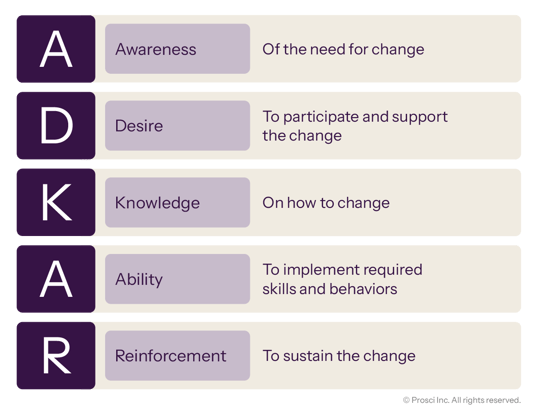
ADKAR represents successful transformation on an individual level. By understanding where employees are in the digital transformation journey, leaders can pinpoint barriers and provide targeted support to ensure no one is left behind.
2. Lack of leadership support
Prosci research demonstrates that sponsorship is so critical to change efforts that their participation or lack thereof can make or break a change initiative. This is especially true when implementing a digital transformation.
Digital transformations require bold, visible leadership and ongoing engagement and commitment from leaders. Enterprise-wide changes as significant as a digital transformation require effective change leadership to ignite the desired cultural shift and propel the business toward a new business model. It involves more than incorporating digital technology into daily business operations.
In guiding a digital transformation to its completion, leadership must model its belief in the change by providing visible proof that the shift matters through active championing and participation in the change. That includes showing up, speaking out, and demonstrating commitment to change through their actions.
Tips for overcoming leadership challenges
In some cases, leaders may fail to provide support due to cost concerns and their fear of disruption. However, sometimes they simply require additional support and training to fulfill their roles effectively. Some ways to empower stakeholders include:
- Clarify their role: Explain how leaders are expected to lead throughout the digital transformation, including removing obstacles, building coalitions, making key decisions, and modeling new behaviors and mindsets.
- Provide change management training: Effective change leaders also need strong change management skills to drive alignment from the top down. Prosci equips leaders with practical frameworks and models, as well as role-specific coaching, to help them show up and engage effectively.
When leaders understand the “why” behind a digital transformation and possess the necessary knowledge and tools to remain visible and actively engage, it builds confidence and reinforces the importance of the initiative to employees.
3. Insufficient training and digital competency development
Without a well-designed digital transformation plan and an effective change management strategy to support the work, initiatives are at risk because new digital tools typically require new skills that may not be available internally.
Digital transformation succeeds when new technologies are fully adopted. Tools like AI, IoT (Internet of Things) and cloud computing can revolutionize how businesses operate, but only if people are supported in learning, adapting and applying digital tools.
Adoption doesn’t happen automatically. It requires clear communication, leadership alignment, and structured support at every step. The Prosci ADKAR Model helps organizations monitor and address knowledge gaps and ability barriers, ensuring employees are equipped to navigate the changes effectively. Targeted training and coaching programs are essential for helping employees adopt new digital behaviors and mindsets as they adjust their day-to-day workflows.

4. Change saturation and time management
We know the rate of change initiatives has increased significantly across organizations with no signs of slowing. However, this rapid rate of change in organizations can lead to change saturation, which has the potential to harm the success of a digital transformation.
Change saturation occurs when multiple change initiatives are implemented within a business simultaneously, and it can be a significant roadblock. This often occurs when leadership fails to keep track of the number of changes, allowing them to happen at an overlapping pace. The result? Poor adoption, change fatigue, wasted money, and in some cases, increased employee turnover.
When employees are overwhelmed by too many changes at once, it can result in disengagement and reduced effectiveness in implementing new business initiatives. Since digital transformations require a shift in behaviors and mindset, employees need to have sufficient motivation and mental space to dedicate to learning how to use new digital technologies and adjusting their work practices.
Change practitioners should prioritize and manage the pace of change, ensuring that change management resources are adequately allocated to support employees through transitions. Practitioners can work with senior leaders to understand an organization’s change capacity using a portfolio view.
5. Measuring success and demonstrating ROI
Unlike traditional projects and change initiatives, the ROI of digital transformations can be more challenging to quantify, especially during the initial stages of the work. Incorporating new digital technologies to benefit improved customer experience, increased productivity, or enhanced agility is a long-term and sometimes intangible endeavor.
However, a lack of clear metrics and tangible benefits weakens executive commitment, resulting in a lack of leadership support and resistance to change. That’s why organizations must define clear metrics from the outset, including both qualitative outcomes (such as employee engagement) and quantitative results (like efficiency gains across workflows). These outcome-based KPIs help organizations track progress over time, ensuring the digital transformation is moving in the right direction.
Digital transformation ROI must also incorporate adoption metrics because even the most advanced digital solutions lack impact without widespread and consistent employee use. Monitoring deployment is a great place to start, but leaders also need to assess how well teams adopt and use new technologies for long-term success.
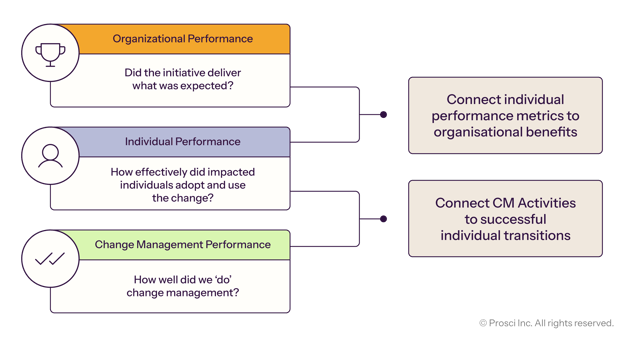
Prosci helps organizations overcome measurement challenges with structured outcome tracking designed to measure the real impact of change. Across organizational, individual, and change management performance, Prosci shows teams how to link adoption and usage to business results.
Prosci Performance Levels
Overcome Digital Transformation Challenges with Prosci
Change is inevitable, but with the right approach that puts people alongside the digital technology implementation plan, it presents opportunities that offer immense promise and potential for businesses and their employees.
Organizations that succeed think about more than the flashy tools and advanced technologies—they’ll put people first during change to achieve long-term adoption and lasting transformation, and they’ll leverage change management solutions to help them do that.
That’s where a structured, adaptable, repeatable change management approach, such as the Prosci Methodology, makes a difference. The Prosci Methodology leverages our understanding of people, change, and results to empower new ways of working and overcome common barriers to digital transformation adoption. That’s the power of change done right.