8 Mins
Updated: April 13, 2026
Published: August 8, 2025



A successful digital transformation effectively “forces” everyone involved to rewire how they work. It’s a dramatic and complex change, and guiding your team through it will require knowledge and structure.
A detailed digital transformation roadmap can provide that structure. It lays out each step of your transformation tailored to your team’s needs and culture.
But too many great plans stall because they prioritize platforms and tech over people. This guide puts humans first, showing you how to align your strategy, culture and technology to succeed in your digital transformation.
What Digital Transformation Roadmaps Are and Why They Matter
A digital transformation roadmap is a structured plan that connects business priorities. It maps out a timeline of initiatives, assigns ownership and defines success in measurable terms. With a single, shared view, executives stay aligned, teams work toward common goals, and employees see their role clearly within the bigger picture.
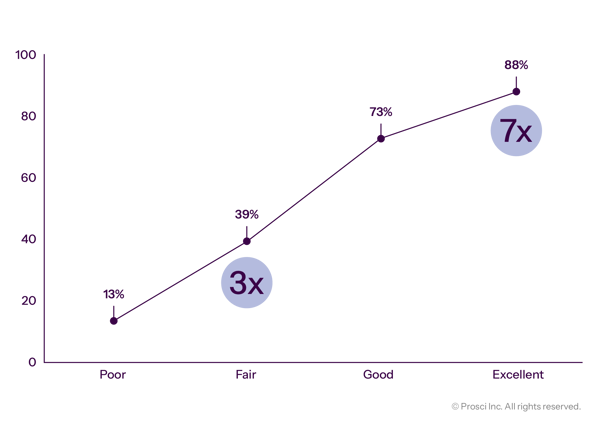
Why does that unity matter? Prosci research shows initiatives with excellent change management are seven times more likely to meet their objectives.
Correlation of Change Management Effectiveness With Meeting Project Objectives
A roadmap turns that discipline into daily action by:
- Clarifying priorities so effort translates into value
- Sequencing work to prevent overload and fatigue
- Surfacing dependencies early, saving time and budget
- Tracking adoption in real time, not at go‑live
Harvard Business Review reports that fewer than 30% of digital programs meet targets when guidance is vague. Roadmaps close that gap.
Key Components of a Successful Roadmap
A well-built digital transformation roadmap bridges strategy with execution, aligning technology, people and culture.
The Prosci 3‑Phase Process transforms intent into coordinated, purposeful action. Within this structure, nine essential components drive measurable progress. Each component should be treated as a commitment—with designated ownership, tangible outcomes and a visible timeline.
1. Define success
This step establishes a shared understanding of what the organization is trying to achieve, linking business goals with people-focused outcomes. Success might include improved efficiency, stronger customer experiences or higher employee engagement.
Defining these outcomes early gives the transformation a clear destination and helps stakeholders align their efforts. Without a common definition, teams risk pursuing parallel but disconnected goals.
2. Define impact
A transformation affects people differently across roles, teams, and departments. This step is about identifying who will be impacted, how their work will change, and where potential challenges may arise. It uncovers hidden resistance, training needs, and cultural dynamics—information that can be used to design more targeted support.
When organizations skip this analysis, they often encounter avoidable friction that slows progress.
3. Define approach
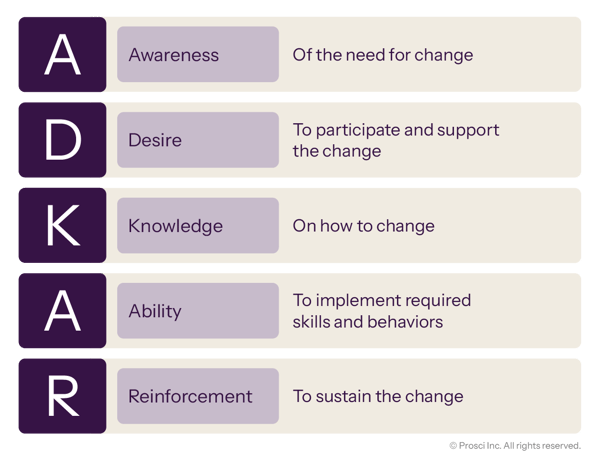
Once the vision and impact are understood, this step focuses on selecting a change management strategy that fits the organization’s culture and maturity. It provides the scaffolding for how people will be guided through the change, often using frameworks like the Prosci ADKAR Model.
A defined approach brings consistency to how change is communicated, reinforced, and supported, especially across large or complex initiatives.
Prosci ADKAR Model
4. Plan and act
This step integrates the technical rollout with the people side of change into one coherent roadmap. It ensures that communications, training, sponsorship activities and system deployments are timed and coordinated.
Planning in this way helps minimize confusion and ensures that people are prepared when new tools or processes go live. It also reinforces accountability and keeps momentum moving forward.
5. Track performance
Measuring success involves understanding how people are engaging with the change. This step includes tracking both system metrics (like tool usage or error rates) and human indicators (like sentiment or behavioral adoption). These insights show whether the transformation is gaining traction or stalling, and they give leaders the data needed to respond quickly and effectively.
6. Adapt actions
Even the most thoughtful plans require adjustments. This step creates space to evaluate what’s working and what needs to change based on feedback and performance data. It encourages teams to reflect regularly and respond to roadblocks with flexibility rather than force.
Organizations that build this adaptability into their roadmap become more resilient and better able to course-correct without losing momentum.
7. Review performance
Transformation efforts should be compared to initial success criteria at regular intervals. This step focuses on evaluating progress at 30, 60, and 90-day marks or other milestones that fit your context.
These reviews help sustain visibility, recognize progress, and pinpoint gaps that might otherwise go unnoticed. They also offer opportunities to reinforce behaviors and realign teams when needed.
8. Activate sustainment
Change is most vulnerable after launch, when attention shifts and old habits resurface. This step is about embedding new ways of working into everyday routines through updated documentation, continued learning or recognition of new behaviors. Sustainment keeps the change alive beyond its initial push and signals that it’s a permanent evolution, not a temporary project.
9. Transfer ownership
Eventually, the transformation must become part of how the business operates. This final step ensures that long-term responsibility moves from the project team to operational leaders who will manage and improve the new ways of working. It also reinforces that change management isn’t a one-time event, but an ongoing capability that should live within the organization.
Together, these components represent the underlying structure that helps organizations align people with purpose and navigate the emotional and cultural realities of change. Understanding what each step is for and why it matters builds the foundation for executing the roadmap with clarity and confidence.

Why Roadmaps for Digital Transformation Fail
Even with strong sustainment plans and clear ownership, digital transformations can still falter. To ensure your roadmap delivers a lasting impact, you need to know the common pitfalls and proactively avoid them.
Overemphasis on technology alone
Many organizations prioritize cutting-edge tools but neglect employee readiness. According to MIT, only half of the companies that say a strategy for AI is urgent actually have one. This needs to change: Transformation failures happen because leaders underestimate the cultural and human factors. Technology is only effective when people embrace it.
Neglect of cultural and employee adoption challenges
Stanford Social Innovation Review emphasizes that digital culture is built with intention. Effective digital transformations require “openness, participatory behaviors, and peer‑driven power,” rather than top‑down mandates. To build this culture, you can:
- Regularly assess and discuss cultural barriers
- Invest in continuous employee feedback and communication
- Create safe environments for experimenting with new behaviors
Without this, a natural reaction is employee resistance.
Lack of leadership and employee support
Without strong sponsorship and support at all levels, transformation initiatives struggle. The World Economic Forum emphasizes that successful leaders visibly demonstrate the desired behaviors, build coalitions of support, and engage employees directly. Implementing this means you should:
- Ensure executives remain actively involved and visibly committed
- Align digital projects clearly with business priorities
- Reinforce change through direct leader communication and involvement
Ultimately, a roadmap succeeds by engaging employees to prevent resistance to change. A significant amount of resistance is avoidable, both at the employee level and higher.
Avoidable Employee Resistance and Avoidable Manager Resistance

In fact, purpose-driven transformations that authentically integrate culture, leadership and technology consistently outperform competitors.
Remember, digital transformation begins and ends with your people.
Create Your Customized Digital Transformation Strategy Roadmap
Now you know the stakes and the building blocks. The next move is turning insight into a practical, people‑first roadmap adapted to your transformation. This section walks through how to put those elements into motion using the Prosci 3-Phase Process. Each phase includes specific tools, actions, and coordination points to help your team move with clarity and confidence.
Prosci 3-Phase Process
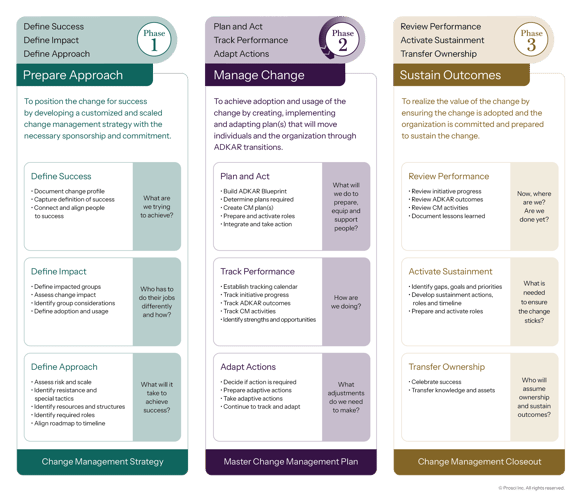
Phase 1 – Prepare Approach
Harvard Business Review warns that skipping the “walk‑before‑you‑run” stage dramatically increases failure risk. "The key to more successful digital transformation is to not skip ahead: Start with step one and invest the focus and resources to get it right.” This first phase focuses on laying a solid foundation. You’ll clarify your vision, assess who is impacted, and build a change strategy that fits your organization’s culture.
1. Define success
Write a shared definition of success with leadership and stakeholders. Use the 4 P’s Model worksheet to frame the vision, define the end state, outline the path, and clarify each person’s role. With that clarity:
- Select three to five business KPIs (e.g., revenue growth, cost‑to‑serve drop)
- Pair them with people-centered metrics (e.g., adoption rate, engagement uplift)
These combined indicators ensure your transformation delivers both operational value and human impact
2. Define impact
Run a readiness assessment to gauge whether a change initiative will be successful or whether additional resources and support are needed. Capture:
- The most impacted groups and the scale of change for each
- Key roles and responsibilities and how they might shift
- Cultural factors, like speed of decision making or openness to experimentation, that could accelerate or slow adoption
Hold early interviews with frontline managers to uncover hidden resistance, training gaps, or operational constraints. Their insights often reveal friction points that surveys alone can’t detect.
3. Define approach
Choose a structured change management approach that matches your organization’s readiness and ambition. Many teams use the Prosci ADKAR Model to guide awareness-building, training, and reinforcement activities across roles.
Map specific activities to each ADKAR element. For example:
- Run early Awareness campaigns through internal channels
- Boost Desire with recognition programs or stretch assignments
- Deliver Knowledge modules through targeted training
Write your choices into a short change management strategy to keep the whole team aligned on how people will be supported throughout the transformation.
Phase 2 – Manage change
With your strategy ready, it’s time to start making change happen. This phase focuses on activating the plan. That includes building timelines, tracking momentum and staying agile as things evolve. During this phase, communication is paramount. Keep everyone impacted informed by using a communications checklist to ensure everyone involved stays on the same page.
4. Plan and act
Develop one integrated project plan that combines the technical deliverables with change management activities in one master Change Management Plan. Anchor communications, training and stakeholder engagement to specific product or system milestones. For example:
- During design freeze, host virtual demos for early feedback
- At pilot launch, activate peer coaches for floor support
- For enterprise rollout, record video messages from leaders acknowledging early adopters
Use a Gantt-style view to clarify timing and dependencies. Make sponsor roles visible and time-bound. This builds transparency and reinforces accountability across workstreams.
Encourage your executive sponsors to practice the ABCs of sponsorship:
- Actively and visibly participate in milestone events
- Build a vocal network of change champions
- Communicate directly with impacted groups
This helps align your process with your enterprise digital transformation methodology, increasing the likelihood of project success.
Impact of Use of a Particular Methodology on Change Management Effectiveness

5. Track performance
Monitor performance using adoption metrics (such as logins, sentiment surveys, or help desk tickets) and business outcomes (like productivity gains or error reduction).
Set up a cadence for dashboard reviews. Share a weekly snapshot through short video updates or leadership check-ins. This keeps momentum visible and allows for proactive corrections.
6. Adapt actions
Agility is essential. Use short retrospectives to gather team feedback and adjust course. Involve sponsors, change agents and project leaders in quick sessions that ask three key questions:
- What’s working well?
- What’s getting in the way?
- What should we try next?
Use this input to fine-tune communications, update training or simplify workflows. These feedback loops turn problems into learning opportunities and build confidence in your team’s ability to adapt and thrive in uncertain situations.
Phase 3 – Sustain Outcomes
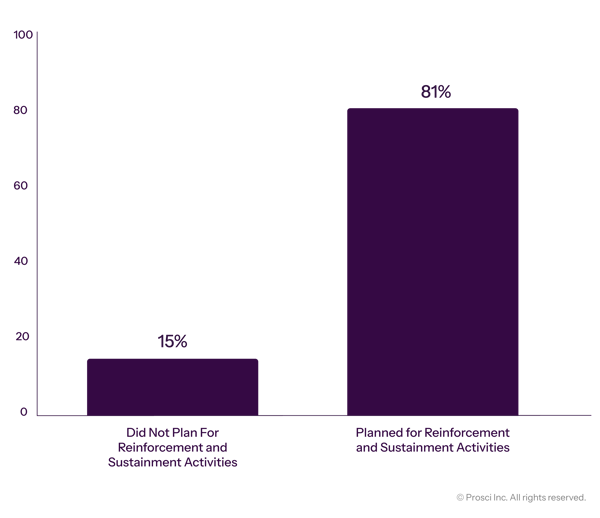
Taking action isn’t the end of a change. Organizations that don’t plan for reinforcement see much lower change success. This final phase ensures that change becomes part of daily work, not just a temporary initiative. It focuses on reinforcing adoption and gradually handing over ownership to long-term business leaders.
Impact of Planning for Reinforcement on Project Success
7. Review performance
At 30, 60, and 90 days post go‑live, compare results to the KPIs you set in Phase 1 – Prepare Approach. Where gaps appear, use recent ADKAR Assessment data or feedback trends to understand the cause. Then respond with targeted support, such as refresher training or focused coaching.
8. Activate sustainment
Lock in new habits by weaving them into daily routines. You might:
- Update SOPs, job aids or quick‑reference tools
- Schedule quarterly micro‑learning refreshers
- Create a dedicated channel where employees share tips and celebrate wins
These mechanisms keep knowledge fresh and prevent regression to legacy practices.
9. Transfer ownership
Once performance is stable, shift responsibility to operational leaders.
- Hold a formal transition meeting to review sustainment activities, clarify escalation paths, and confirm who owns what moving forward
- Provide a simplified handoff playbook that outlines success criteria and key responsibilities
This reinforces that change management is not a one-time event. It’s part of how the organization operates.
When your roadmap is built this way, with both strategy and execution working together, you create a transformation process that’s practical, adaptive and truly people-first.
A People-Centered Approach for Successful Transformations
Technology may launch transformation, but people make it successful. At Prosci, we’ve seen that change only sticks when employees feel prepared, supported and involved.
Our research-based methodology aligns strategy with execution and puts people at the center of the transformation. The Prosci 3‑Phase Process and Prosci ADKAR Model provide the structure and tools to guide individuals through change, so adoption rises and results accelerate.
With a people-first roadmap, your organization is ready, not just for change, but to lead it.