7 Mins
Updated: April 13, 2026
Published: September 19, 2025



Enterprises across industries and sectors are prioritizing digital transformation, integrating technology across business functions to reshape operations, enhance customer experiences, and remain competitive in an always-changing marketplace. However, digital readiness varies across organizations, presenting adoption challenges and unsuccessful transformations. A digital transformation maturity model helps organizations assess and measure digital maturity to effectively plan, measure success, and achieve digital transformation goals. They provide a framework for evaluating capabilities and encourage organizations to view digital transformations as an evolving effort rather than a one-off change.
In this article, we’ll explain the significance of digital transformation maturity models and offer stages to assess your organization against.
Understanding Digital Transformation Maturity
A maturity model is a structured framework businesses use to assess their team’s capabilities in a specific area of focus, often through a staged approach. In the case of digital transformations, a digital transformation maturity model helps organizations assess and understand their current state in terms of digital readiness, identify areas of improvement, and track progress toward higher levels of digital maturity.
In digital transformation, a maturity model evaluates not just technology, but also people, processes, and culture, because successful transformation is about mindset and tools. That’s why digital transformation change management, or a combined focus on the technical and people side of change, is essential.
Key components of a digital transformation maturity model
While digital maturity models vary based on the approach and focus, the most effective frameworks include the following:
- Clearly defined maturity stages – Levels ranging from no digital transformation to organizational competency
- Dimensions to assess – People, processes, technology and culture are a few of the standard categories
- Evaluation methods and tools you can use – Methods for evaluating the current state across various dimensions, including surveys, interviews, performance metrics and audits
- Guidance on how to move to the next stage – Specific actions and investments that will move an organization from one stage to the next
Benefits of using a maturity model in digital transformation
Understanding where an organization is along its digital transformation journey is crucial for planning a digital transformation strategy and increasing the chances of success. Enterprises that follow a framework experience several benefits, including:
- A structured path to follow – Digital maturity models offer a shared frame of reference to achieve alignment between the technical and people side of change as the organization progresses through each stage.
- Stakeholder engagement and alignment – Frameworks provide a common language and strategy for leaders, managers and teams to follow and adopt.
- Prioritized resource allocation – Leaders can use a digital transformation maturity model to ensure technology spending aligns with organizational readiness and strategy.
- Progress tracking – Maturity models provide a measurable way to demonstrate improvement and the return on investment (ROI) over time.
- Support for a culture of continuous change – Following a digital maturity model encourages digital transformation as an ongoing journey, not a one-time project, building organizational change capability.
Stages of the Digital Transformation Maturity Model
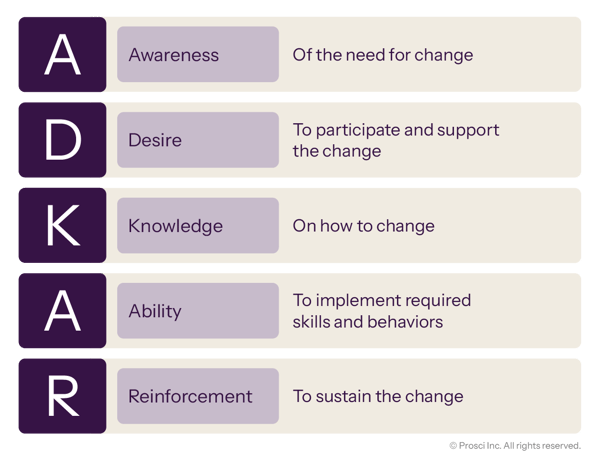
Below are five stages, or levels, of a digital transformation maturity model your organization can follow, and how to apply the Prosci ADKAR® Model—Awareness, Desire, Knowledge, Ability and Reinforcement—to accelerate digital transformation efforts.
The Prosci ADKAR Model for Individual Change
Stage 1: Initial or Ad Hoc
At Stage 1 of the digital transformation maturity model, organizations are typically in the earliest days of their digital transformation journey or just getting started. Digital capabilities may be minimal and scattered. Technology decisions are viewed as reactive, and little, if any, alignment exists between digital transformation initiatives and overall business strategy.
Teams at this level can have one or more of the following characteristics:
- Isolated digital tools with poor integration create data silos
- Inconsistent processes and a lack of standardization across departments hinder cross-team collaboration
- Ad hoc investments and reactions to immediate needs, leading to low adoption
- Executive support is only evident through technology investments; there is no active and visible sponsorship for digital transformations
- Employees have limited digital skills and awareness of digital opportunities, and can be very resistant to change
- People view technology as an IT problem rather than a business enabler and core component of business strategy
Tips for success at Stage 1
- Focus on building Awareness of the importance of digital initiatives and the risks of not doing so
- Engage leaders and secure active and visible sponsors
- Communicate a compelling case for change
Stage 2: Developing
At Stage 2, an organization experiments with digital tools, often in isolated pilots or ad hoc departmental projects. There’s early momentum, but efforts are not scaled or fully coordinated, leading to inconsistent digital execution and adoption across teams. Leaders and decision makers recognize and understand the need for cross-team collaboration, data-sharing, and a coherent digital transformation strategy.
Characteristics of organizations pursuing digital projects at this stage include:
- Adoption of basic digital tools with some automation
- Early process mapping and standardization for digital implementations, largely department-specific and variable across the organization
- Growing interest in digital upskilling
- Early adopters influence their peers to increase interest in digital transformation efforts
- Mixed buy-in across the organization
Tips for success at Stage 2
- Foster willingness to engage and build Desire by celebrating early wins and showing tangible benefits of digital transformations
- Increase change management knowledge by attending change management training, purchasing change management tools and resources, or engaging change management consultants to support digital transformation efforts
- Begin building support for using change management with executives and senior leaders to focus on the people side of change
Stage 3: Established
At Stage 3, teams have implemented digital tools across the organization. Most core systems are integrated, reducing data silos and breakdowns, and processes are standardized enterprise-wide for consistency. In many organizations, at this stage, digital transformation is linked to business objectives, with governance and measurable goals in place. Ultimately, digital literacy is growing, and cross-functional collaboration is the norm, not the exception.
Organizations at this level have one or more of the following characteristics:
- Introduction of enterprise-level platforms (e.g., ERP, CRM, data analytics)
- Senior leaders play a more active role in sponsoring digital transformation changes and consider this a critical role in their responsibilities
- Employees are more confident in using digital tools; digital literacy is increasing across teams
- There’s an acceptance of digital change as part of the business model
- A formalized digital strategy links directly to business objectives for progress tracking and proving ROI
Tips for success at Stage 3
- Focus on Knowledge, which includes equipping employees with the training and resources to use new systems and digital tools effectively, further growing digital literacy
- Provide clear guidance on roles, responsibilities, and expected behaviors in the digital environment
Stage 4: Advanced
When an organization reaches Stage 4, it makes decisions based on data and predictive analytics, with emerging technologies such as artificial intelligence (AI) and the Internet of Things (IoT) embedded in its operations. At this level, the workforce may include specialized talent to support digital initiatives, reiterating the narrative that digital transformation is a valued and ongoing process. Innovation and cross-functional collaboration are defining aspects of the company culture.
Enterprises at Stage 4 have one or more of the following characteristics:
- Operations with advanced analytics, AI, cloud-first approaches, and IoT solutions embedded in them
- Automated, data-driven decision-making is a core aspect of business strategy planning and development
- Specialized digital roles, including data scientists and automation engineers, are part of the team
- Employees contribute new ideas for digital improvements and rally behind the importance of digital transformation
- Digital investments tie back to measurable business value
- A strong change management standard and capability exists, allowing the organization to prioritize continuous improvement and innovation
Tips for success at Stage 4
- Strengthen employee capabilities through hands-on application, coaching, and process reinforcement, helping them move from Knowledge to Ability
- Focus on addressing barriers to change that prevent full adoption and performance at this new level of sophistication
Stage 5: Optimized
Finally, at the highest stage of the maturity model, digital transformation is part of the organization’s DNA and an organization is considered digitally mature. The business model continuously adopts emerging technologies, has a robust digital transformation strategy, and fosters an environment where organizational agility is a core competency. Continuous improvement and innovation are embedded into processes, culture, and digital technology implementations.
Digitally mature organizations at Stage 5 possess one or more of the following characteristics:
- Continuous adoption of emerging technologies and an architecture designed for scalability and flexibility
- A culture rooted in continuous process improvement with embedded feedback loops for ongoing iteration
- Organization-wide digital fluency and a supporting talent strategy that supports continuous skill development
- Embedded change agility where digital innovation is part of the organization’s identity and culture
- Digital transformation is a core business competency, and effective management of change supports digital goals
- Extensive training exists at all levels of the organization
Tips for success at Stage 5
- Prioritize Reinforcement by embedding digital behaviors into recognition, performance metrics, and leadership priorities
- Continue scanning for innovation opportunities to maintain momentum

Assessing Your Organization’s Digital Maturity
There are several ways to conduct a digital transformation maturity assessment. First, selecting the right tools and frameworks, including an established maturity model or industry-specific benchmarks, can help define clear criteria for each stage of maturity to work toward.
No matter which frameworks or models you choose, effective digital maturity assessments look at key performance indicators (KPIs) across multiple dimensions to monitor progress. KPIs should fit your organization’s specific digital transformation goals. Some examples include technology adoption rates across the organization, data quality and usage, and customer satisfaction or experience scores.
While a structured self-assessment can help build internal awareness and ownership of the digital transformation journey, pairing it with an external maturity assessment adds objectivity, validates findings, and uncovers blind spots. Together, these approaches provide both an honest baseline and a credible roadmap to measure digital maturity.
Strategies for Advancing Digital Maturity
Leaders play a crucial role during a digital transformation. To excel in their role, digital transformation leaders need effective change management strategies to help them get commitment and support from senior leadership and motivate employees to adopt digital change. Equipping digital transformation leaders with a structured change management framework, like the Prosci Methodology, can help set them up for success.
Developing a robust change management capability within an organization is also crucial for long-term success. Establishing leadership support, integrating change management practices into project management, and providing ongoing training reinforces this capability. Strive to create a culture that embraces change, where employees are equipped with the necessary skills and knowledge to navigate transitions effectively.
Digital Transformation Case Studies
Prosci has enabled many client successes in digital transformation, including the examples below. Explore our other case studies to learn more.
Texas A&M Implements Workday
Prosci helped Texas A&M University System overhaul its outdated payroll system, which was costly to maintain and no longer met the needs of its employees. A structured change management approach delivered a smooth transition, with a coalition of sponsors and change agents providing training and communication. The Workday platform launched successfully across all campuses. It successfully unified HR with payroll and related business processes, reducing operational risk and embedding a scalable, people-first change capability that will support ongoing transformation efforts.
Mateco’s People-First Digital Transformation
A leading provider of rental equipment and access solutions, Mateco set out to unify systems and processes across five countries—part of an ambitious digital transformation to replace outdated business processes. Prosci provided customized training, expert advisory support and practical change management tools. The project achieved 85% global alignment, a 30% reduction in admin time and a scalable, people-first approach to transformation.
Moving Ahead with Digital Transformation
By assessing your current digital maturity level and using structured frameworks, you can identify gaps, prioritize investments, and address both the technical and people sides of change. Change readiness alongside growing digital maturity is a strategic advantage for organizations of all kinds.