
6 Mins
Updated: April 13, 2026
Published: September 15, 2025



Digital transformation trends continue to reshape the business landscape as organizations navigate an increasingly complex technological environment. What began as a competitive advantage has become a business imperative—companies across every industry are now implementing sophisticated digital transformation initiatives to stay relevant and profitable. The pace of these digital transformation trends shows no signs of slowing, fundamentally changing how organizations deliver customer experiences, streamline operations, and engage employees.
Technology alone doesn't guarantee success. An effective digital transformation change management approach addresses both systems and people. The most sophisticated digital transformation framework means nothing without proper attention to how these changes impact the way people work.
In this article, we explore the key digital transformation trends shaping workplaces in 2025 and beyond, and why putting people at the center of these changes through digital transformation change management is essential for lasting success.
Digital Transformation Trends for Future-Proof Organizations
Successful digital transformation integrates technology trends across business functions, reshaping operations, customer experiences, business processes, and company culture. These are the key trends touching entire organizations and company business models across today’s workforce.
Trend 1: Artificial intelligence (AI) and machine learning integration
Teams on digital transformation journeys are integrating AI into operations, reimagining every aspect of business, from customer service to supply chain management. From leveraging generative AI to improve customer experiences to streamlining manual creative processes with AI-driven automation, many digital transformations center on today’s AI technologies.
While AI tools can evolve organizations, AI adoption presents several significant digital transformation challenges that organizations across industries must prepare for. Employee concerns over AI data and information quality, lack of AI proficiency and training, and ethical considerations can slow adoption without a proper change management strategy to support the work. To unlock AI’s value, organizations must reshape culture, processes and mindsets—with people at the center.
Trend 2: Cloud-native and multi-cloud strategies
Organizations are moving away from legacy systems in favor of agile, scalable cloud solutions. With cloud-native applications, teams can scale faster to stay ahead of the competition. Not to mention that flexible multi-cloud strategies, which combine multiple cloud services, enable businesses to mitigate security risks through diversification.
Moving away from the onerous task of managing data centers to the cloud requires a cultural shift that demands reskilling, team collaboration, and leadership alignment around a digital-first vision. Fostering an environment of continuous learning and innovation can help prepare employees for the cloud-native cultural shift.

Trend 3: Edge computing and the Internet of Things (IoT) expansion
Personalized experiences, both for customers and employees, help organizations differentiate themselves from their competitors. An effective and meaningful personalized, connected digital experience that caters to the needs and behaviors of customers and employees allows organizations to create relevant and intuitive interactions. It’s about anticipating what people want before they ask and being ready to support those predictions.
For example, businesses may turn to edge computing to provide faster, more responsive interactions by reducing latency when processing data. Additionally, organizations can leverage IoT to automate processes, track assets, and deliver experiences that respond to real-world events in real-time.
Trend 4: Hyperautomation
Hyperautomation combines robotic process automation (RPA), AI, machine learning, and process orchestration to scale and automate entire business processes. As organizations implement digital transformations across various areas, including financial services, customer support, and human resources, employees can shift from manual, task-driven workflows to more strategic ones. The transition to hyperautomation involves not only reskilling employees but also addressing fears around job displacement and resistance to change.
Aligning stakeholders, setting expectations, and embedding automation into an organization’s fabric are critical for success. A successful hyperautomation implementation requires a combined focus on both the technical and people side of change for effective integration.

Trend 5: Digital twin and simulation technologies
In asset-intensive industries, such as manufacturing, urban planning, and healthcare, a fundamental shift is underway in existing business models with the implementation of digital twins and simulation technologies. Digital twins are virtual representations of a system or object, such as a wind turbine, designed to accurately reflect a physical object. After applying the information to the digital copy, teams can leverage the digital model to conduct simulations and analyze performance.
The return on investment (ROI) of implementing these technologies as part of a digital transformation can be significant for businesses, including reduced costs through addressing issues early, improved operational efficiencies, and enhanced safety. At the same time, implementations can be complex and costly. Not to mention that creating digital twins that accurately simulate complex challenges can be daunting without the right talent, data, and resources.
Trend 6: Cybersecurity and zero-trust architectures
As technology advances, security remains a high priority that impacts every part of a business. Protecting sensitive information and ensuring regulatory compliance, particularly in the face of emerging technologies, is essential for building trust with customers and establishing a sustainable business.
Robust protection frameworks, including zero-trust architectures in which every user and device must continuously authenticate before accessing systems, are central to today’s digital transformations. New AI-powered thread detection, with real-time, adaptive measures, is also increasing in popularity as organizations prioritize filling gaps in human error with digital technologies.
To ensure enterprises adopt these technologies, leaders must support employees in understanding and consistently following secure practices and integrate security into the company culture.
Trend 7: Data fabric and real-time data analytics
The shift toward data fabric and real-time data analytics represents a pivotal shift in how organizations manage and use business data. As more organizations operate across hybrid environments, a data fabric architecture provides employees with unified data access, enabling seamless integrations across systems, regardless of their location. Additionally, teams that democratize data with self-service analytics tools give employees at all levels the information they need to make data-driven, informed decisions.
A digital transformation of this magnitude requires leaders to guide teams through new processes that facilitate cross-functional collaboration. Training and support are crucial for fostering adoption and overcoming traditional silos and latency issues. Successfully navigating this type of digital transformation requires clear communication, effective stakeholder engagement, and a well-defined vision, positioning data as a shared and strategic resource throughout the enterprise.

Trend 8: Augmented and virtual reality (AR/VR)
While AR/VR technologies enable immersive training opportunities, enhanced remote collaboration experiences, and new ways to engage with customers, these digital transformations require a thoughtful change management approach to drive adoption. In most cases, businesses integrate these digital technologies into existing workflows, which means leaders must prepare their teams for hardware and software readiness, as well as equip them with the knowledge to use these tools effectively within their workflows.
Embedding AR/VR into day-to-day operations also requires clear metrics for measuring value, impact and ROI. Change management plays a critical role in aligning people, processes, and technology to ensure these immersive tools enhance—not disrupt—core business activities.
Trend 9: Sustainable digital transformation
Organizational sustainability has transitioned from a "nice-to-have" to a critical business imperative. Sustainable digital transformations emphasize the importance of ensuring today’s businesses operate in a way that doesn’t jeopardize resources for future generations. Organizations are seeking to adopt greener IT solutions through cloud efficiencies and circular hardware practices, while also measuring their environmental impact.
As part of a sustainable digital transformation, businesses typically introduce new key performance indicators (KPIs). Examples include energy consumption and carbon footprint, which challenge legacy mindsets and require enterprise-wide education. Aligning digital transformations with ESG (Environmental, Social, and Governance) goals ensures sustainability is a core business priority that can be embedded into the culture.
Trend 10: Human-centric transformation and culture
As organizations undergo digital transformations, there is a heightened emphasis on training and developing competencies related to change management. This includes equipping leaders, managers, and employees with the skills necessary to navigate change effectively. Investing in change management training is essential for fostering a culture that promotes transformation and enhances employee engagement.
Leveraging Digital Transformation Trends in Your Organization
Digital transformation success depends on how well people adapt, adopt, and apply new ways of working, which is why change management is critical for achieving the desired outcomes in digital transformation initiatives. While digital transformation strategies and plans vary across organizations, the following are some general best practices to consider when leveraging digital transformation trends within your organization.
Conduct a trend-gap analysis aligned with business needs
Successful, lasting digital transformations begin with a clear vision and a well-defined definition of long-term success. You can assess project health, identify gaps, and align leadership and stakeholders around shared digital transformation goals using the Prosci Change Triangle (PCT) Model.
Prosci Change Triangle (PCT) Model
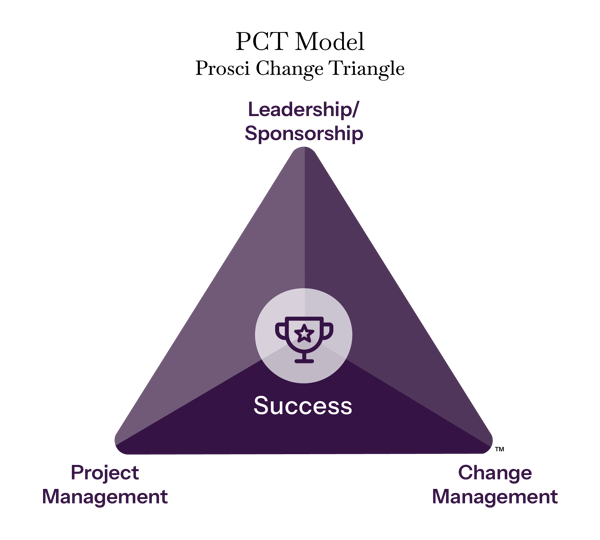
This allows you to:
- Understand the key business drivers and opportunities that demand change
- Align the digital transformation with your overall business growth strategy
- Define a shared version of success for the digital transformation
- Set smaller, specific and measurable business objectives for your digital transformation initiative
Start pilots for high-impact digital transformation strategies
Not all digital transformation trends apply to or are beneficial for every organization, meaning not every trend is worth pursuing. To remain future-forward without causing undue disruption, consider implementing pilot programs to test and refine your approach.
Pilot programs are a low-risk way to explore how digital transformation trends work in your specific environment, providing an opportunity to gather real-world feedback before scaling digital transformation initiatives across the organization.
Conducting pilots also allows employees to engage in hands-on training opportunities, building their confidence and comfort levels with new tools. The Prosci study, Keys to Unlocking AI Adoption, shows that organizations that actively encourage AI experimentation experience higher adoption success rates.
Foster cross-functional teams and a digital mindset
Adopting digital transformation trends requires a fundamental shift in mindset across the organization. One of the biggest challenges is bridging the cultural gap between the old way of working and the new approach required for the digital transformation. An environment rooted in trust, clarity, and engagement across teams is crucial for the success of digital transformation.
Creating safe spaces for experimentation is also essential. For example, innovation labs, pilot programs, and internal communities enable teams to explore new frameworks and fail forward without the risk of significant disruption. This creates an environment where change becomes a constant opportunity, rather than a threat.
Measure adoption rates of digital transformation strategies
The ROI of digital transformations can be harder to quantify, especially in the early stages of the initiative. That’s where Prosci comes in.
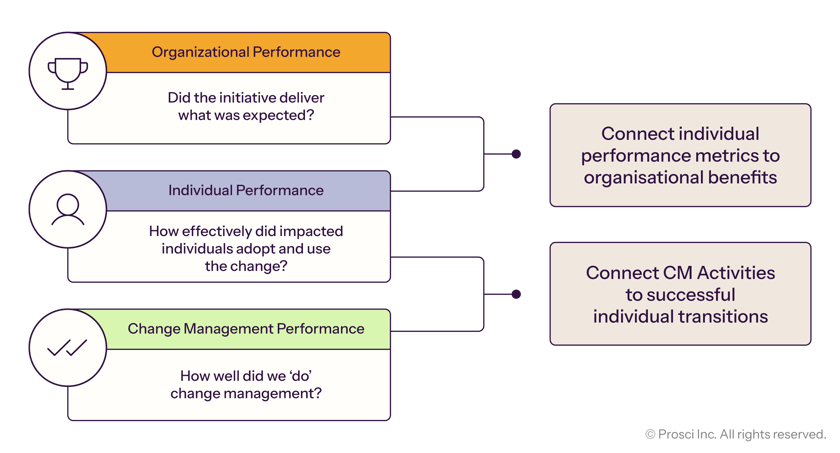
Prosci helps organizations define clear digital transformation success metrics from the start, ones that go beyond immediate revenue and cost savings. Our change experts also account for adoption metrics to help leaders monitor how well employees embrace the digital transformation.
Structured outcome tracking enables organizations to measure the actual impact of change by linking digital transformation adoption and usage to business outcomes.
Prosci Performance Levels
Future-Proofing Through Digital Transformation Trend Awareness
To future-proof their organizations, companies must continuously monitor emerging digital transformation trends and adapt strategies accordingly. Digital change success depends not just on the implementation of technology but on leadership that actively enables adoption through a clear vision, support, and cultural alignment, prioritizing the people side of change.
By staying agile and embracing change, organizations can remain competitive, resilient, and ready for whatever the digital future holds. Change is inevitable, but with the right approach, it is always an opportunity, never a crisis.