Do you have a primary sponsor named for your project but lack the true sponsorship support you need to succeed?
When project leaders and change practitioners are asked to name the number one factor in project success, they typically know the answer: active and visible sponsorship. In all of Prosci's Best Practices in Change Management research reports, active and visible sponsorship ranks as the top contributor to project success and has been cited four times more often than any other factor. Yet, despite a large percentage of projects having a named primary sponsor, many change practitioners lack the true sponsorship they need for success.
Why You Need True Sponsorship During Change
To understand why the role of the primary sponsor is important to achieving successful change, consider what the role really entails. Change leaders need primary sponsors to fulfill all of the ABC's of Sponsorship:
Active and visible participation throughout the project
Build a coalition of sponsorship
Communicate support and promote the change to impacted groups
When this level of sponsorship is lacking, change leaders often experience:
Increased resistance from employees, including key people managers in the organization
Unavailable resources to support the project
Slow adoption of the change or complete rejection of the change by some parts of the organization
Sponsor in Name or in Practice?
Consider a project you're supporting today. If you agree with the statements above and a senior leader has agreed be your primary sponsor, you might assume you are good to go. Unfortunately, the research does not support this assumption. Over the last two decades, Prosci research participants have cited ineffective change sponsorship as a top obstacle to change for a variety of reasons, such as:
The sponsor was at the wrong level or in the wrong part of the organization to support this change (i.e., the sponsor lacked control over the people and systems impacted by the change).
The sponsor was invisible (i.e., the sponsor did not get involved with the project team or communicate to employees).
The sponsor did not build a coalition of sponsorship with other business leaders (and as a result, the change team encountered resistance from managers throughout the organization).
The sponsor wavered in their support midway through the project (or found a different project that took priority).
The sponsor did not manage the resistance that surfaced during the change.
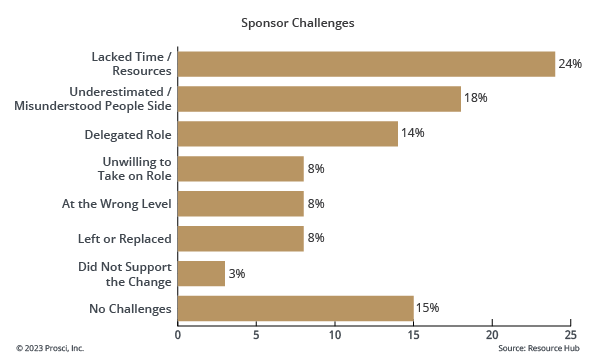
In the 12th Edition of Prosci's Best Practices in Change Management research study, participants cited the following sponsor challenges:
The upshot? Assigning a senior leader to the role of primary sponsor does not constitute effective sponsorship.
Sponsorship Checklist
The checklist below is a simple tool that can help you determine whether you are well-positioned to have the authority necessary for change success. Score each question on a scale of one to five, where one represents "no" or complete disagreement with the statement, and five represents "yes" or complete agreement with the statement.
If you score between 40 and 50 and you scored the first three questions a 4 or 5, your project likely has the elements for effective sponsorship. A score below 30 indicates that your project lacks the effective sponsorship required for successful change.
Statement
Score
My sponsor has the ability to provide the needed resources and funding for the project.
1 - 5
My sponsor has direct control over the people and processes being impacted by this change.
1 - 5
My sponsor has direct control over the systems and tools being impacted by this change.
1 - 5
My sponsor is willing and able to be active and visible throughout the entire project.
1 - 5
My sponsor will build a coalition of sponsorship with key leaders and stakeholders in the organization.
1 - 5
My sponsor will manage resistance from other managers and remove barriers to the success of the project.
1 - 5
My sponsor will communicate directly to employees about why this change is being made and the risk of not changing.
1 - 5
My sponsor will implement the necessary reinforcements to sustain the change, including modifications to performance objectives and performance evaluations, and rewards and recognition for employees who adopt the change.
1 - 5
My sponsor is credible and respected by employees and managers within the organization (i.e., employees embrace the leadership of this individual).
1 - 5
My sponsor will remain in the organization throughout the implementation of this change.
1 - 5
Total score:
How to Remedy Ineffective Sponsorship
If you scored low on the sponsorship checklist, take action to address the root cause:
A low score on any of the first three questions means your sponsor is probably not at the right level, given the scope of your project. In this case, a careful assessment of the sponsor coalition would determine if this project is in jeopardy. If you determine that your sponsorship coalition is also weak, you have two options:
Identify the right person to sponsor this initiative and begin to build the necessary sponsor coalition.
Redefine the scope of your project to fit or align with the sponsorship you do have.
Simply continuing with the project is not typically a viable option because the consequences will negatively affect the organization and your people, and your risk of project failure is high.
A low score on questions 4 through 8 means your sponsor needs coaching on the role of the primary sponsors during change. You may have a sponsor who is willing but does not know what effective sponsorship means, or you could have a sponsor who prefers not to be directly involved. The latter issue is harder to overcome, but with the right information and approach, most sponsors quickly see the importance of their role and get on board. Other the other hand, if your sponsor is willing but uneducated about the role of effective sponsorship, the change leader should directly coach and assist the sponsor to execute the role.
A low score on questions 9 or 10 likely means you need special tactics for approaching the project, including careful use of a strong sponsor coalition to carry a strong message to employees and be there throughout the entire project. If your sponsor is on a fixed term, such as with military organizations or government agencies, you may want to consider breaking the project into phases and focus on the phase that falls within the term limit of that sponsor.
Your Role in Effective Sponsorship
Having a primary sponsor named for your change and having the required sponsorship for successful change are not the same thing. Most executives and senior leaders lack understanding about how to be an effective primary sponsor of change—and that's to be expected because change management is not their primary role in the organization. Fortunately, that's where you come in. As a change practitioner, it's your job to enable your sponsor, so they are prepared and equipped to execute the critical actions needed for change success.
Tim Creasey
Tim Creasey is Prosci’s Chief Innovation Officer and a globally recognized leader in Change Management. Their work forms the basis of the world's largest body of knowledge on managing the people side of change to deliver organizational results.
M&A (merger and acquisition) cultural integration is one of the key pillars of success when combining organizations. But M&A practitioners often say cultural fit is the primary reason their deals fail. So, how do you ensure a smooth cultural integration? Companies that manage culture effectively are more likely to meet or exceed their synergy targets. Effective M&A culture integration also ensures people from each company are aligned with their vision, values, and the logistics of uprooting their entire professional set-up. Read on for the best practices to align organizational culture throughout the merger and acquisition process. What Is M&A Cultural Integration? M&A cultural integration involves aligning the organizational cultures of companies undergoing mergers or acquisitions. The aim is to align and integrate companies so the cultures work together, ultimately creating a new merged environment that represents the best of both cultures. Organizational culture is the shared values, beliefs and behaviors that shape how employees behave, interact and work together. Ian Croft, Prosci Director and Engagement Lead in Advisory Services, describes it best in his article about winning trust during cultural change: “It is often said that culture is what happens when leaders leave the room. Culture is what you see in the behavior and attitudes of your organization’s people. A culture change first happens in people’s heads, and then it is represented in behaviors that demonstrate the culture.” Why is culture important in M&A? There will inevitably be cultural differences when two organizations come together through an M&A. Regional disparities, work flexibility, professional values, and relationship dynamics are some cultural challenges that appear during a merger. These differences can cause friction within the organization, impacting the merger’s success—but M&A integration management minimizes these challenges. It considers each company's culture, preventing them from running parallel and creating inefficiencies. Not to mention, it considers how people respond to change. The process encourages change leaders to support different cultures as they merge into one, which is crucial for success. How To Align Company Cultures and Improve M&A Integration Management The best way to align corporate cultures varies depending on your stage within the merger. Here, we outline the best practices before, during and after an M&A to increase the success of cultural alignment. Key takeaways Before the M&A: Perform a culture assessment – Address cultural challenges head-on by performing a cultural diagnostic in the early planning stages of the M&A. During the M&A: Monitor progress continually – Keep track of your cultural integration efforts to ensure people are adapting and feel comfortable doing so. After the M&A: Review and reflect on integration – Review the successes and failures to identify what went well and what needs to be improved going forward. Before: Perform a cultural assessment Before starting cultural integration, it’s important to eliminate preconceived notions about each company's culture. This ensures you approach the M&A cultural integration without bias, which helps you create an inclusive environment for both parties. To do this, you can perform a cultural diagnostic, which assesses the cultural environment of the organizations to understand them better. There are a couple of ways to perform this evaluation: Run employee surveys – Generate a fact base about the existing cultures to build a single source of truth. What are their core values? Are there differences that could cause friction? What are their professional relationships like? Understand how work gets done – Get a clear picture of how each company works. What are their management practices and working norms? How do they make decisions? How do they motivate their people? How do they define success? This information also helps you identify how to bridge the gap between the two cultures, pinpointing what people need to do to fit in. The Prosci Methodology can help with this part of the process. Using the Prosci Methodology, particularly the 10 Aspects of Change Impact, improves assessing cultural differences. This approach looks at how changes influence individuals in various aspects of their work, including their roles, tools, mindset and work setting. Understanding these areas is essential for fully grasping the impact of the change and managing it successfully. The Prosci Methodology The Prosci Methodology helps you create clear success criteria for how soon people feel they work for the new entity, not their old employer. For example, how soon they feel at home with the new organization or when they accept the legitimacy of new leadership. These are some indicators of the speed of adoption, utilization of the new ways of working, and proficiency in operating in the new environment. During: Monitor cultural integration progress M&A cultural integration is an evolving process. When the merger is underway, keep tabs on progress and ensure things are running smoothly: Use the change plan as a guide to monitor progress and adjust the integration strategy as needed. Establish a cross-functional integration team from both cultures to closely monitor cultural integration. Address resistance or concerns to support people through the change and ensure they see the value of it. If you face resistance to change, focus on answering the question: What’s in it for me? (WIIFM). Making a change is a personal choice, and communications only resonate with the impacted individuals if you address what they care about. To influence their desire to participate and support the change, you must provide a compelling case for why they should support it. Answering this question early and often in your communications is a great way to combat reservations or concerns. After: Review and reflect on M&A cultural integration At the end of the M&A integration management process, review the successes and failures of the cultural integration. Reflect on the outcomes of the merger to determine whether it was a successful integration and what to improve going forward. The third phase of the Prosci 3-Phase Process is a useful framework when reflecting on outcomes. It guides you through reviewing the current state with the ideal state, the sustainability of your efforts, and how to assign accountability. Phase 3 – Sustain Outcomes Throughout this process, transparency is vital to maintain trust within the new culture. If things don’t go to plan, be honest about it to ensure the credibility of leadership. Work With Prosci To Manage Cultural Change M&A cultural integration plays a vital role in combining two companies. It ensures everyone feels comfortable with the new culture, preserving the key elements of their old culture while learning how to navigate an entirely new one. Managing cultural change is an ever-evolving process. The Prosci Methodology and tools make it easier for you to handle—and grow stronger from change.
Do you take a top-down or a bottom-up approach when driving organizational change? While the Kotter 8-Step Process focuses on a leader’s perspective, the research-based Prosci ADKAR® Model enables you to drive change more effectively by supporting leaders at the top as well as people on the front lines of your organization—and everyone in between. In this way, the Prosci ADKAR Model offers something truly unique: an insider’s perspective that makes change stick by shepherding individuals through the process. While Kotter enables organizations to “do change to people,” the ADKAR Model works with people in the trenches, supporting them through their change journeys. When considering ADKAR vs. Kotter, which change management model is best for your organization? Let's decode these change management models. Understanding the Prosci ADKAR Model The Prosci ADKAR Model is a framework for sustainable transformation that supports change at individual and organizational levels. It includes five sequential elements or building blocks: Awareness – Of the need for change Desire – To participate and support the change Knowledge – On how to change Ability – To implement the required skills and behaviors Reinforcement – To sustain the change Jeff Hiatt, the founder of Prosci, developed this model in 1994 after researching 700 organizations. He wanted to understand why some changes succeed and others don't. He learned that human beings experience and react to change in predictable ways, and that supporting employees and leaders during transitions leads to far better outcomes. The ADKAR Model is grounded in a simple truth: Organizations don’t change, people do. ADKAR is popular around the world because it’s easy to understand and intuitive. In some ways, it’s like a roadmap, guiding you and your people through the terrain of change, from the first realization that a new direction is needed (Awareness) to the final step of making that change stick (Reinforcement). Imagine you're leading a project team to implement a new technology with significant changes in workflow. If people don’t adopt and use the technology, the change will fail and your organization will lose its investment—not to mention the desired strategic outcomes from installing the technology, like efficiencies, cost savings, and better employee satisfaction. The Prosci ADKAR Model also prompts a shift from passive observation to active participation in change. Each element of the model requires people to make a conscious choice to move forward or not. A change manager can help people through transitions, but change can’t be “done to them” when organizations use ADKAR. Even better, when you scale ADKAR with an organizational approach like the full Prosci Methodology, you gain the ability to align and drive complex changes while incorporating both the employee-centric and leadership perspectives. Want to take a deeper dive? Explore the building blocks of the Prosci ADKAR Model in our Prosci ADKAR Model eBook bundle. Overview of the Kotter 8-Step Change Model The Kotter 8-step Process originated in John Kotter's 1996 book, “Leading Change” and outlines eight sequential steps for change as follows: Instill urgency by highlighting the need for change and presenting the process’ benefits to spark initial motivation. Assemble a diverse team (guiding coalition) from various levels, departments, locations and genders to drive change for organization-wide support. Set clear goals and milestones for the change initiative and demonstrate how change will shift the organization’s future. Build a volunteer army willing to contribute to driving the change at an individual level while focusing on their transformation efforts at the collective level. Identify and address cultural, structural or resource-related obstacles, such as change complacency and legacy rules, to pave the way for change. Celebrate early and meaningful wins to maintain momentum and encourage the broader adoption of change. View change as a continuous process, highlighting the need for ongoing improvement until you fully realize your vision. Embed new practices into the organization's culture to make them standard operations for lasting change. Using the Kotter 8-Step change model addresses changes through a leader's lens. These steps serve as high-level directives for the change management work to be done by change management teams. ADKAR vs. Kotter: Similarities and Differences The Prosci ADKAR Model is a key part of a comprehensive change management approach called the Prosci Methodology. Both put people at the center of successful change through a strategic, bottom-up approach. Kotter's 8-Step Change Model is broad and less detailed, emphasizing organizational change driven by top-down directives. Understanding both change management models will help you choose the approach that aligns with your unique organization. A flawed comparison: ADKAR is not the Prosci Methodology Before we dig into the models, it’s important to note that people who are new to change management often confuse the ADKAR Model with the complete Prosci Methodology. It’s true that ADKAR is an individual change model that can be used for personal, professional, individual and organizational changes. But the comprehensive Prosci Methodology is what enables you to scale the ADKAR Model for organizational changes efficiently. Although organizations change one person at a time, it would be impractical to implement large-scale change management that way. The point is that comparing ADKAR vs. Kotter can be an inaccurate comparison. Although the ADKAR Model can be used without a comprehensive methodology, when implementing organizational changes, you should compare the full Prosci Methodology, including our ADKAR Model, to the Kotter 8-Step Process, as in the table below. ADKAR vs. Kotter Aspect Prosci ADKAR Model Prosci Methodology Kotter 8-Step Process Focus Individual transitions as the foundation for driving organizational change Structured approach to managing change at both individual and organizational levels Organizational change with a top-down approach Elements/Steps Awareness Desire Knowledge Ability Reinforcement Prosci ADKAR Model Prosci 3-Phase Process: Phase 1 – Prepare Approach Phase 2 - Manage Change Phase 3 – Sustain Outcomes Prosci Change Triangle (PCT) Model Establishing a sense of urgency Creating the guiding coalition Developing a vision and strategy Building a volunteer army Identifying and tackling change-related obstacles Generating short-term wins Consolidating gains and producing more change Anchoring new approaches in the culture Key advantages Focus on individual change Practical, actionable steps Employee-centric Comprehensive and strategic Structured approach Research-based Includes additional models, frameworks, tools and assessments Comprehensive and strategic Structured approach Emphasizes vision and coalition Complexity Widely considered easy to apply to changes, from simple to complex Moderate to high Requires training and resources Requires significant buy-in from top management Can be more complex to implement Adaptability Adaptable to different types and scales of change High Best suited for large-scale changes Resistance handling Proactively and directly removes difficult obstacles to change at multiple stages Scalable to any project size Focuses on managing resistance through strategy and vision communication Now that you know the key differences between ADKAR and Kotter, let’s take a closer look. Limitations of the Kotter Change Model The Kotter 8-step change model has disadvantages that ignore the barriers to change that cause employee resistance: Emphasizes the need to create a sense of urgency without providing detailed guidance on managing the complexities of change. Lacks clarity on vision and a strategy, despite providing a high-level roadmap Follows a step-by-step process where missing detailed steps can lead to confusion or misdirection Limits employee participation with its top-down approach, leading to potential frustration and feelings of disempowerment Positions change as a one-off event and fails to consider the continuous nature of change common in today's business environment Doesn’t address change readiness and lacks an analysis of the key organizational maturity models Doesn't consider the effects of previous changes and the cultural impacts of the proposed change Focuses only on organizational change, overlooking employees' personal transitions and emotional reactions during change Advantages of ADKAR Over Kotter When comparing ADKAR vs. Kotter, the Prosci ADKAR Model stands out by combining adaptability with a focus on individual transformation. This model for individual change sets itself apart with research-backed approaches and applications for effective change across various organizational settings. Let's explore some of the advantages that ADKAR has over Kotter. Adaptability – The Prosci ADKAR Model is adaptable to various project management methodologies, including Waterfall, Agile and hybrid approaches. Its flexibility aligns it with project milestones, ensuring individual change processes synchronize with organizational goals. This makes the Prosci ADKAR Model a versatile tool across diverse change initiatives. Practical implementation – The ADKAR Model works with organizational change processes, especially the Prosci 3-Phase Process, to scale even the most complex changes with actionable insights, tactics and tools. Focus on individual change – The Prosci ADKAR Model recognizes that organizational change is the cumulative result of individual transitions. It addresses the people and groups impacted by a change and creates an inclusive and supportive environment. Real-world effectiveness – By mapping project milestones to the Prosci ADKAR Model milestones, organizations can ensure that individuals are adequately prepared and supported throughout the change process. This alignment increases the likelihood of achieving desired strategic outcomes and sustaining long-term change. Enhanced sponsorship – The Prosci ADKAR Model strengthens sponsorships roles, guiding leaders to become more effective sponsors through their change journeys. Research validation – The foundational principles of the Prosci ADKAR Model come from 25 years of extensive research and real-world applications, offering a robust framework proven to drive successful change. Aligning ADKAR Elements in Sequential Change (e.g., Waterfall) Success Story: Prospera embraces ADKAR for seamless merger and cultural integration Following the merger of two sizable credit unions, Prospera faced the challenge of uniting cultures and systems without disrupting the member-focused services that define their organizational success. Prosci solutions: Initiated the Prosci Change Management Certification Program for key team members Implemented project acceleration workshops to integrate the Prosci ADKAR Model into ongoing projects Conducted the Change Management Sponsor Briefing meetings to enhance executive leadership’s role in change initiatives Secured an Enterprise Change Management (ECM) License for comprehensive access to the Prosci Methodology, models and tools Results: Cultivated a culture of change readiness and continuous learning Established an organizational change management team and committee, enhancing internal collaboration and support Achieved over 200 successful integration projects, significantly improving service delivery and member experience Increased employee engagement by 8%, and improved the change management maturity score by 6% on a five-point scale, demonstrating a substantial uplift in internal change capabilities By strategically applying the Prosci ADKAR Model, Prospera navigated the complexities of a merger and laid the foundation for a resilient, change-ready culture. Read the detailed case study here. Implementing ADKAR: Tips and Strategies To successfully apply the Prosci ADKAR Model, focus on clear and effective communication plans, setting clear goals, and providing support. Here's a high-level look at applying the ADKAR Model when driving a change at work: Start by communicating why the change is needed and why it needs to happen now. For example, digital transformation will improve efficiency now that employees work from home offices. Highlight the specific outcomes of mastering a new tool, such as saving an hour daily or developing skills that will offer career opportunities. Build desire by connecting the change to individual or organizational goals. For instance, illustrate personal transformation by highlighting someone who achieved something great recently. Provide the necessary training and resources. For a software upgrade, offer hands-on workshops. Create opportunities for practicing new skills. Set up a pilot project for the team where they can apply the skills learned in training. Reinforce the change by celebrating milestones through the new system and offering additional support as needed. Understanding and working to support people through resistance is crucial. Directly address barriers, such as lack of awareness, fears, or lack of confidence. Offer reassurance and support, and engage in two-way communications with your team about the change and processes to come. Here's a free quick-start guide showing how to apply the Prosci ADKAR Model to today's business challenges. ADKAR vs Kotter: Which Change Model Should You Choose? In the ADKAR vs. Kotter debate, the Prosci ADKAR Model prevails with its human-centric approach. Putting people first and addressing the human aspects of change will empower your teams to achieve your desired results and outcomes—and a truly successful organizational transformation.







 The upshot? Assigning a senior leader to the role of primary sponsor does not constitute effective sponsorship.