
8 Mins
Updated: April 22, 2026
Published: August 29, 2025



Higher education providers are under increasing pressure. Student expectations are shifting, budgets are tightening, and regulatory requirements are growing. On the other hand, technology is opening new possibilities for how institutions teach and operate.
Digital transformation holds real promise for higher education. It can empower faculty, enhance the student experience, and help institutions adapt faster in a rapidly shifting environment However, successful transformation demands more than just new tools. To drive sustainable outcomes, you need a people-centric approach.
In this article, we’ll explore the drivers and benefits of digital transformation, and how to solve its human-focused challenges with a proven change management process.
We’ll also share real-world examples of digital transformation in higher education. See how leaders like CIOs, provosts and presidents can apply structured change management frameworks to achieve long-term success.
What is Digital Transformation in Higher Education?
Streamlined teaching. Automated admin. Accelerated research. The transformational impact of technology on higher education is vast. Digital transformation is about more than new tools. It’s a strategic shift in how institutions deliver learning, support their people, and operate at every level.
The digitization of higher education covers four key aspects:
- Teaching and learning – Online learning platforms and interactive content improve teaching methods and enhance the student experience.
- Administration – Robotic process automation streamlines administrative tasks like registration, financial aid and record-keeping, boosting efficiency.
- Research – Digital technologies make collaborating, analyzing and accessing information easier, speeding up processes and supporting innovation.
- Infrastructure – Robust business infrastructure, cloud computing, and secure data storage strengthen the foundation for ongoing digital transformation.
Digital transformation drivers in higher education
Higher education is at a turning point. Emerging technologies, shifting expectations, and competitive pressures are forcing institutions to rethink how they deliver education and value.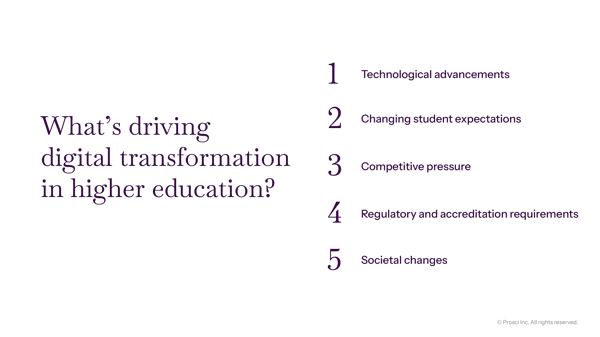
Technological advancements
Emerging technologies like AI, virtual reality, and big data are redefining the way institutions operate—and, at the ground level, benefit educational “groups,” such as students and faculty staff, in distinct ways:
- For students – Tailored learning experiences, remote access, and higher engagement with learning materials
- For faculty members – Increased connectivity and automation offer faster, more streamlined workflows
Changing student expectations
Today’s learners want digital-first educational experiences that rival those of their favorite online platforms.
A study found that 67% of students expect their university's digital experiences to be as good as those on Facebook, Amazon, or Netflix. So, whether that’s designing virtual classes or devising 24/7 support processes that align with these expectations, educational institutions must adapt—or risk falling behind.
Competitive pressure
Global online providers and alternative education platforms are raising the stakes. Universities that fail to modernize may lose both students and funding. The ones that embrace digital capabilities can differentiate with better student outcomes and operational excellence.
Regulatory and accreditation requirements
New regulations demand stronger compliance and transparent reporting. Digital tools like automated audit trails and advanced analytics help you meet evolving standards while reducing administrative pressure.
These driving forces make digital transformation essential. And unlocking its many benefits will keep you ahead in a rapidly changing industry.
Benefits of Digital Transformation in Higher Education
Digital transformation is a fundamental way for higher education providers to stay competitive and relevant.
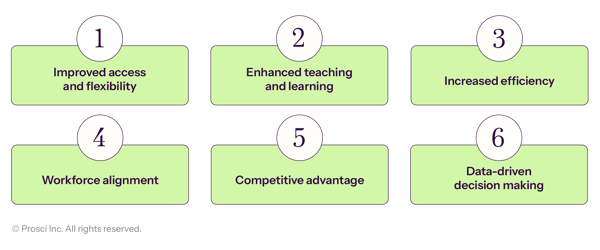
From flexible learning to data-driven decisions, digital capabilities unlock new ways to teach, operate and compete. The payoff? Stronger outcomes for students, empowered faculty and a clear edge in a crowded market.
In this Prosci webinar, change leaders from three institutions share valuable insights about their digital transformation journeys. Discover the lessons they learned and how they’re driving sustainable educational change.
Benefits of Digital Transformation in Higher Education
Improved access and flexibility
Thanks to new technologies, learning no longer needs a classroom. Online platforms allow student access at any time, from anywhere, leading to more flexible enrollment strategies and opportunities for fully remote education.
Enhanced teaching and learning quality
Digitizing education transforms the way people learn and teach. Adaptive and collaborative learning technologies allow for highly personalized learning experiences. Engagement-driving tools like forums, quizzes, and gamified learning boost interest and commitment. The potential impact is clear: 70% of leaders say digital tools will boost assignment quality.
Increased operational efficiency
Process automation turns repetitive tasks like enrollment and grading into efficient workflows. A study revealed that 68% of leaders believe technology will relieve faculty of routine work. And eight out of ten higher education institutions already rely on Software as a Service (SaaS) products to send email, manage learning programs, operate CRM systems and boost productivity.
Workforce alignment and career development
Digital transformation can allow for better career alignment and ongoing professional development in the face of evolving workforce needs. 94% of leaders believe micro-credentials strengthen students' long-term career outcomes, while flexible technology allows adult learners to upskill quickly and easily.
Competitive advantage and market positioning
77% of leaders use digital transformation to gain an advantage over competing universities. And it’s clear why: digital services help attract students and staff, and win grants and funding. With the latest technologies, higher education providers can deliver better student experiences while putting their institution out in front.
Data-driven decision making
Digital solutions like AI, machine learning and data analytics give higher education leaders the insights they need to act decisively. From predicting enrollment trends to optimizing course offerings, data drives faster, evidence-based decisions that strengthen institutional performance and student outcomes.
While the benefits are clear, what does digital transformation in higher education look like in the real world? Let’s examine the tools and technologies driving the industry's digitization.
Examples of Digital Transformation in Higher Education
From digital learning platforms to data analytics, higher education providers are tapping into various solutions to drive better outcomes and improved performance.
Examples of Digital Transformation in Higher Education
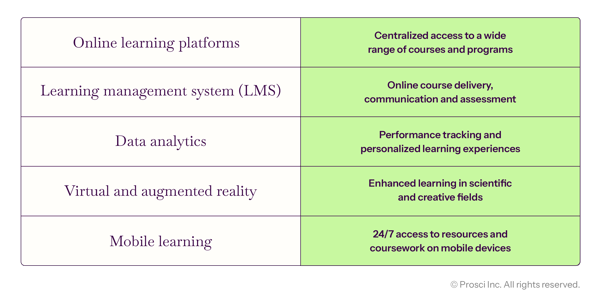
- Online learning platforms – Digital platforms like Coursera and edX provide centralized access to a wide range of online courses and degree programs.
- Learning management systems (LMS) – Tools like Moodle and Blackboard facilitate online course delivery, communication and assessment.
- Data analytics – Advanced analytics let you track student performance, identify at-risk students and personalize learning experiences.
- Virtual and augmented reality – Immersive technologies can enhance learning in medicine, engineering, and architecture.
- Mobile learning – Mobile tech empowers students to access educational resources and complete coursework from any location. 67% of students have undertaken higher education work on their mobile devices.
The question is, how are real-world institutions using these technologies effectively? Next, we’ll explore some success stories of digital transformation in higher education.
Successful digital transformation in higher education with Prosci
Technology can spark change. But people make it stick.
The following examples show how leading institutions used Prosci’s proven change management framework to achieve their digital objectives.
Texas A&M implements Workday
Faced with replacing a costly 35-year-old payroll system across 11 universities while aligning 58,000 users, Texas A&M University needed a structured approach to drive successful change.
Leveraging the Prosci ADKAR® Model and Prosci 3-Phase Process, the university built a sponsor coalition, engaged local change leaders and implemented targeted communications, training and resistance management strategies. This approach helped Texas A&M reach over 77% of users with communications, complete 70% of readiness activities months ahead of launch, and keep the Workday project on schedule and budget.
The result was a repeatable change management framework that reduced risk, boosted digital adoption and positioned the institution for future transformation success.
University of California builds change capability
The University of California, San Diego, launched a strategic plan that included major digital initiatives, new systems, and campus-wide process changes that affected 12,000 faculty and staff.
To ensure smooth adoption, UC San Diego needed to equip leaders, managers and employees to embrace new technologies. Partnering with Prosci, the university adopted the ADKAR Model, implementing tools like role-based training and sponsor engagement.
This resulted in a 90% satisfaction rate with learning programs, 500+ staff engaged in change forums and successful digital projects. UC San Diego now leads a national higher education community, driving people-centered digital transformation.
University of Virginia elevates project portfolio management
The University of Virginia faced growing change fatigue and stalled results on high-priority projects, many of which involved digital initiatives. To address this, UVA partnered with Prosci to certify 54 employees in change management and integrate the ADKAR Model into its University Project Portfolio framework.
With change management embedded in its project approach, UVA empowered project managers to engage sponsors early, navigate adoption challenges, and address resistance head-on.
The results: 24 university areas built change capability, 275 improvement initiatives launched, and major digital projects—such as Faculty Annual Reporting—delivered stronger adoption. UVA is now driving people-focused, data-backed digital transformation at scale.
These success stories make one thing clear: overcoming the challenges of digital transformation requires a human-centric approach that supports technology adoption. Without this, your digital transformation stands little chance of delivering lasting impact.

Challenges of Digital Transformation in Higher Education
Prosci’s research report, Keys to Unlocking AI Adoption, revealed that human factors are a challenge for more than 50% of organizations. Evidently, technology is only useful when people adopt it effectively.
Here’s how you can address common digital transformation challenges by supporting your people in adapting to their new digital environment.
Resistance to change
Resistance is a natural reaction to change. Faculty, staff and students may resist new technologies or ways of working, preferring familiar established processes.
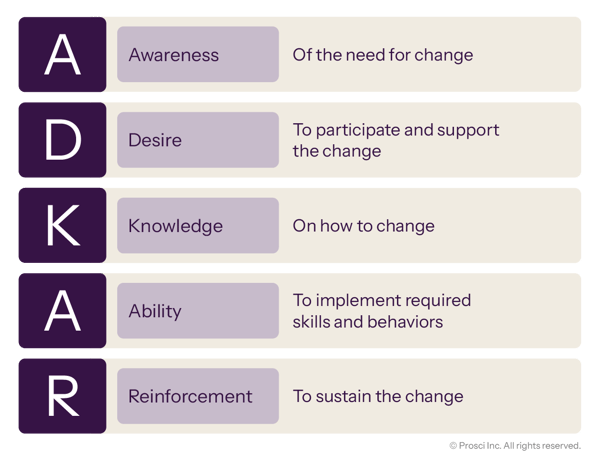
The five elements of the Prosci ADKAR® Model address this resistance in several ways:
- Awareness of the need for change builds understanding
- Desire to participate in change increases commitment
- Knowledge and Ability provide the necessary skills and the confidence to apply them
- Reinforcement drives positive behaviors to sustain the change
The Prosci ADKAR Model
Insufficient training and support
Prosci research shows that 38% of adoption challenges stem from insufficient technology training. Without adequate digital literacy, people are unlikely to integrate new tools into their workflows.
Developing a Training Plan as part of your overall Change Management Plan addresses this challenge head-on. It should include needs assessments, tailored training sessions, and ongoing support to ensure people have digital literacy and can thrive with new technology.
Integration with existing systems
Legacy systems and outdated educational tech remain sizable barriers to digital transformation. New digital tools may not easily integrate, causing operational disruption.
This is a significant problem when implementing AI solutions; Prosci research found that 16% of organizations struggle with system integration.
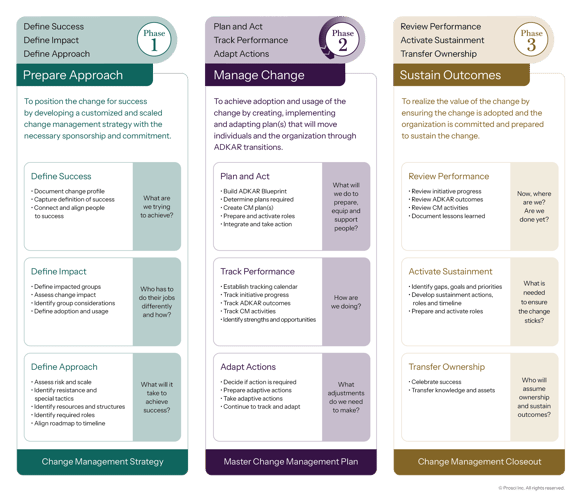
The Prosci 3-Phase Process provides a structured framework for organizational change. It lets you address both technical and process changes, and can be scaled to fit the needs of your transformation initiative.
The Prosci 3-Phase Process
Lack of leadership support
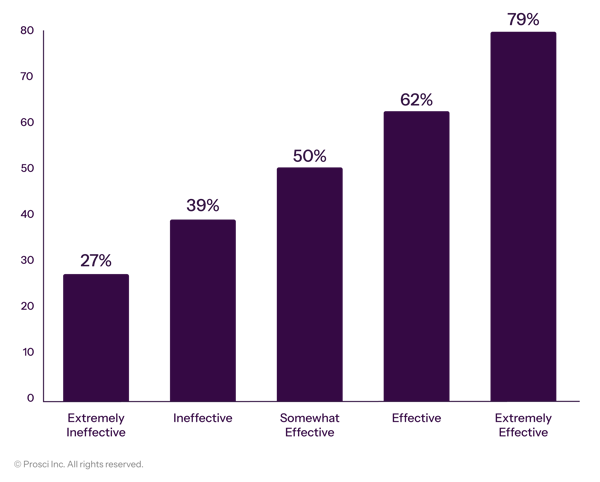
Without strong sponsorship, change initiatives may lack direction and resources. In fact, our research shows that 73% of projects with extremely effective sponsors meet their objectives, compared to just 29% of those with very ineffective sponsorship.
So, how do you ensure sponsorship effectiveness? Prosci’s structured change management approach includes developing a comprehensive Sponsor Plan. This plan outlines sponsors' roles and responsibilities, ensuring clarity and alignment.
Correlation of Sponsor Effectiveness With Meeting Objectives
Cultural resistance
Educational institutions' legacy cultures are deeply embedded, so they aren’t always able to adopt new technologies and practices as swiftly as organizations in other niches. This can make transformation efforts feel more protracted and complicated, ultimately slowing down the pace of adoption.
To address cultural resistance, you must engage faculty and staff in the change process. Using the ADKAR Blueprint, you can identify specific barriers at each stage of the transformation journey and create targeted strategies to overcome them.
Data privacy and security concerns
Even when new technologies present significant benefits, like greater cost efficiency and better student learning outcomes, integrating them into preexisting tech stacks can present some cause for concern regarding data privacy and security.
The best way to address this challenge is through education. Clearly communicate about data protection measures and involve impacted groups in discussions about security protocols. Open communication helps alleviate fear and uncertainty.
Digital Transformation in Higher Education: FAQs
What is digital transformation?
Digital transformation leverages digital tools and technologies to fundamentally change how an organization operates and provides value. The integration of advanced technologies into core operations is unlocking better student outcomes, stronger performance, and more agile institutions.
What does digital transformation mean in education?
In higher education, digital transformation involves reimagining how to create better environments for students, educators and leaders. This is achieved by bringing people, data and processes together. Through successful digital transformation, institutions can stay ahead today while preparing for future challenges.
What are the 5 main areas of digital transformation?
Digital transformation can apply to different parts of an organization. The five main types of digital transformation are:
-
Process transformation – Redesigns how tasks are executed to improve speed, efficiency and consistency.
-
Business model transformation – Changes how an organization delivers value, ensures customer engagement and generates revenue, often disrupting legacy approaches.
-
Domain transformation – Expands the business into new markets or technologies that require new skills, tools or capabilities.
-
Cultural/organizational transformation – Shifts the mindsets, behaviors, and structures that shape how people collaborate and adapt to change.
-
Operational transformation – Transforms how work gets done across teams, systems and infrastructure to boost performance and adaptability.
Embrace Change: Paving the Path to a Digital Future in Higher Education
Digital transformation should be a key focus for any institution wanting to stay competitive and relevant in a changing digital landscape.
The key to its success? Realizing that people, not technology, come first. Because digital tools can only put you ahead if they’re adopted effectively.
A people-centric change management approach like the Prosci Methodology helps you drive successful and sustainable transformation. Institutions that lead digital transformation efforts understand this truth: technology changes nothing unless people embrace it.